
Search All Items
- Filters:
- Language
- English 6457
- Spanish 23
- ENGLISH 2
- English 2
- census_013 1
- contra_costa_schedule_1_volume_1 1
- Type
- Image 3882
- Still Image 2094
- Text 445
- Text 54
- Textual 2
- Image of the California Census from the records of the office of the California Secretary of State 1
Search Results 5061 to 5070 of 6559
-
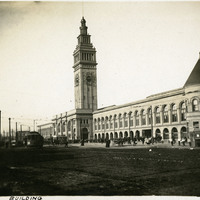
Caption: "Ferry Building," c. 1906. A view of the San Francisco Ferry Building (A. Page Brown, architect) during repairs from the 1906 earthquake. The Beaux Arts structure is located on San Francisco's Embarcadero and features a 245 foot tall clock tower, with four clock dials, each 22 feet in diameter.
Date: 1906
-
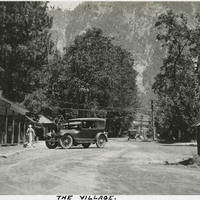
Caption: "The Village," c. 1917. Street scene in the Yosemite Village, the most developed part of the Yosemite Valley. The Village is home to such amenities as a Post Office, store, medical clinic, fire station, and restaurants. Development began at the site in 1865, but most of the buildings were constructed after 1918.
Date: 1917
-
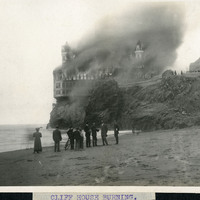
Caption: "Cliff House Burning," 1907. People standing on Ocean Beach watching the third Cliff House burning in San Francisco, in 1907. The original Cliff House was built in 1858. The second was built in 1863 and was destroyed by fire on Christmas day in 1894. The third Victorian- style Cliff House was completed in 1896, and although it survived the 1906 earthquake and fires, it burned to the ground in 1907, as seen in this image. A fourth Cliff House was then built with steel-reinforced concrete and opened in 1909.
Date: 1907
-
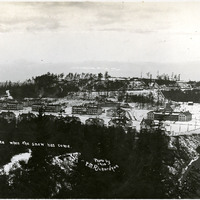
Caption: "Fort Worden when the snow has come. Greetings from Port Townsend - Wash." and "Photo by P.M. Richardson, 1910." This postcard shows an overview of Fort Worden in Port Townsend, Washington, on Admiralty Inlet of Puget Sound. Construction began on the fort in 1898, and by 1902 it was serving as an active U.S. Army base. Fort Worden was part of the "triangle of fire," three coastal defense fortifications (Fort Casey, Fort Worden, and Fort Flagler) guarding the entrance to Puget Sound. The U.S. sold the property to the state of Washington in 1957. In 1973, the fort and surrounding area opened as Fort Worden State Park.
Date: 1910
-
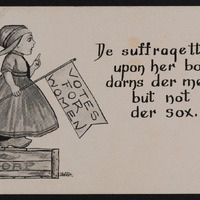
Those opposing women's suffrage created their own ephemera to spread their message, like this postcard from 1913 depicting a woman standing on a soap box declaring, “De suffragette upon her box darns der men, but not der sox.” This postcard evidenced that although women may have won the vote in California, there were still strong anti-suffragette sentiments circulating in the United States in the years following 1911.
Date: 1913
-
No Caption: See also 96-07-08-alb08-024 with caption: Ordnance Avenue, Fort Casey," Washington, c. 1908. Fort Casey was part of the "triangle of fire," three coastal defense fortifications (Fort Casey, Fort Worden, and Fort Flagler) guarding the entrance to Puget Sound. Construction began on the fort in 1897, and the U.S. Army used the facility until the 1950s, when the fort was decommissioned. The area is now a state park.
Date: 1908
-
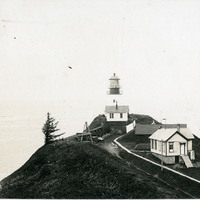
No Caption: See also 96-07-08-alb08-153 with caption: "Fort Canby Light House, Wash." c. 1910. View of the Cape Disappointment Lighthouse on a rocky point overlooking the mouth of the Columbia River. Cannons and cannon balls are stored on the lighthouse property. Built in the 1850s, the lighthouse was electrified in 1934 and automated in 1973. The lighthouse is now part of the Cape Disappointment State Park (formerly Fort Canby State Park).
Date: 1910
-
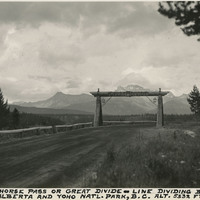
Caption: "Kicking Horse Pass or Great Divide - Line dividing Banff Natl. Park, Alberta and Yoho Natl. Park, B.C.. Alt. 5332 FT. July," c. 1935.
Date: 1935