
Search All Items
- Filters:
- Language
- English 5312
- Spanish 43
- ENGLISH 2
- English 1
- census_013 1
- Type
- Image 3851
- Still Image 1035
- Text 445
- Text 22
- Textual 2
Search Results 5101 to 5110 of 5424
-
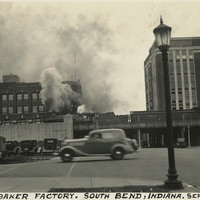
Caption: "Studebaker Factory. South Bend, Indiana. Sept. 13, 1934." Two buildings of the Studebaker Factory in South Bend are visible in this photograph. The Studebaker brothers started operations in South Bend in 1852, when they established a blacksmith shop and foundry. They soon began building wagons and carriages, demand for which soared with the advent of the Civil War and an increase in migration toward and into the American West. The company gradually phased out wagon production in favor of automobile manufacture in the early twentieth century. Sales declined after World War II, leading to the eventual closure of the factory in 1963.
Date: 9/13/1934
-
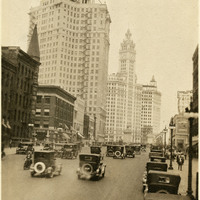
Caption: "London Guarantee & Wrigley Bldg. Chicago," c. 1923. This photograph, taken at street level, features the London Guarantee Building (with the small cupola still under construction at its top) and the Wrigley Building (just to the right of the London Guarantee Building). The London Guarantee Building (also called the London Guaranty and Accident Building), designed by Alfred S. Alschuler, was completed in 1923. The Wrigley Building, constructed by the famous chewing gum magnate William Wrigley, Jr., consists of two towers. The south tower was completed in 1921, while the north tower was finished in 1924 (you can make out construction scaffolding on the top of the tower in this photograph).
Date: 1923
-
Jackson's Eucalyptus or Australian Gum Tree and Seal Oil Liniment
Date: 1875
-
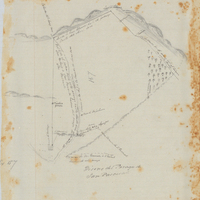
Hand-drawn sketch map of Rincon de San Pascual boundaries. Volume 1, page 386.
Date: 1843
-
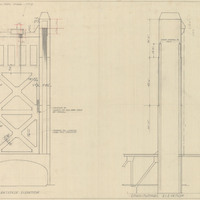
Final design drawing of transverse and longitudinal elevations for tower, M Street Bridge, by Alfred Eichler. The Tower Bridge replaced the M Street Bridge, which was removed in 1935. Project for Department of Public Works - Highways - Bridge Department.
Date: 1934
-
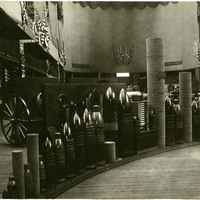
No Caption: See also 96-07-08-alb08-159 with caption: "Government exhibits of shot etc., Government Buidling." Portland Fair, Oregon, 1905. Exhibit of various types of heavy ordnance shells, including armor piercing shells as well as torpedoes. The exhibit was located in the Government Building of the Lewis and Clark Centennial Exposition, held in Portland, Oregon from June 1st to October 15th, 1905. It celebrated the one-hundred year anniversary of the exploratory expedition of the Louisiana Purchase and what became the northwestern part of the United States, led by Meriwether Lewis and William Clark. Some 1.6 million people visited the fair, viewing exhibits from twenty-one countries.
Date: 1905
-
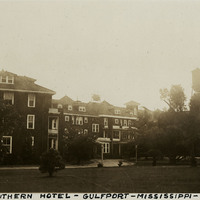
Caption: "Great Southern Hotel -- Gulfport -- Mississippi -- June 19, 34." The Great Southern Hotel, built in 1902-1903 by entrepreneur Joseph T. Jones (also the founder of Gulfport), offered luxurious amenities such as telephones in each room, baths, hot and cold running water, billiards, gardens, and a tennis court. The hotel was hit hard by the Great Depression in the 1930s, even closing briefly. After a short-lived revival in the 1940s, the hotel was demolished in 1951 to make way for U.S. Highway 90.
Date: 6/19/1934
-
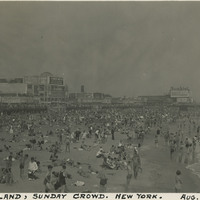
Caption: "Coney Island, Sunday Crowd. New York. Aug. 19, 1934." Very crowded beach scene on New York's Coney Island. The construction of several resort hotels on the island in the 1870s and 1880s encouraged construction of amusement parks to provide tourist destinations. Coney Island has hosted several large amusement parks over the years, including one of the world's first roller coasters (built in 1884). Numerous smaller attractions were available as well. The island's popularity peaked in the World War II era, but despite some decline is still a world-renowned recreation area.
Date: 8/19/1934
-
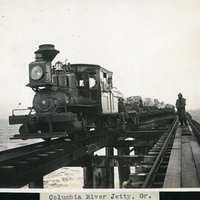
Caption: "Columbia River Jetty, Or.," c. 1910. View of a jetty built at the mouth of the Columbia River, carrying a railroad trestle. A train and its operators, hauling cars loaded with large rocks, dominates the photograph. This is likely the so-called South Jetty, extending more than six miles into the ocean from Point Adams on the Oregon side of the river mouth. The jetty system at the mouth of the Columbia River was constructed between 1885 and 1917. Designed to funnel water from the Columbia River in a more concentrated fashion into the Pacific Ocean, the jetty system helped create a deeper, more stable shipping channel.
Date: 1910
-
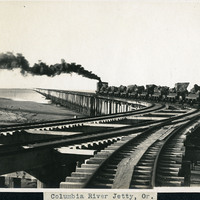
Caption: "Columbia River Jetty, Or.," c. 1910. View of a jetty built at the mouth of the Columbia River, carrying a railroad trestle. A train hauling cars loaded with large rocks is steaming away from the photographer. This is likely the so-called South Jetty, extending more than six miles into the ocean from Point Adams on the Oregon side of the river mouth. The jetty system at the mouth of the Columbia River was constructed between 1885 and 1917. Designed to funnel water from the Columbia River in a more concentrated fashion into the Pacific Ocean, the jetty system helped create a deeper, more stable shipping channel.
Date: 1910