
Search All Items
- Filters:
- Type
- Image 3871
- Still Image 1541
- Text 433
- Text 19
- Image of the California Census from the records of the office of the California Secretary of State 1
- Language
- English 5808
- Spanish 62
- ENGLISH 2
- English 1
- census_013 1
- contra_costa_schedule_1_volume_1 1
Search Results 5161 to 5170 of 5932
-
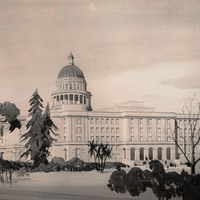
Photograph of rendering of East Wing, State Capitol, Sacramento. The rendering, in transparent watercolor by Alfred Eichler, is of a perspective drawing by Les Lam made under Eichler's direction, c. 1949. Design by R. D. Murray. Original color rendering displayed with State Office of Architecture and Construction. Trees in picture were sketched from nature by Eichler. Project for Department of General Services.
Date: 1949
-
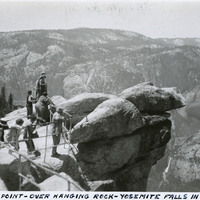
Caption: "Glacier Point - Over Hanging Rock - Yosemite Falls In The Distance," c. 1935. A group of unidentified people looking out from Glacier Point. Both Upper and Lower Yosemite Fall are visible across the valley at the right side of the photograph. Glacier Point, on the south wall of the valley 3,200 feet above what is now known as Half Dome Village, provides panoramic views of the valley and many of its features. By the time this photograph was taken, safety railings had been installed at the Point to prevent visitors from tumbling over the cliff while trying to get the best views.
Date: 1935
-
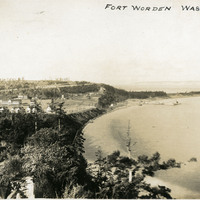
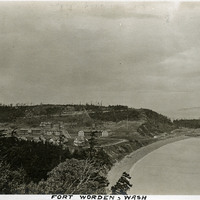
Caption: "Fort Worden, Wash." Washington, c. 1908.Construction of Fort Worden in Port Townsend, Washington, on Admiralty Inlet of Puget Sound began in 1898, and by 1902 it was serving as an active U.S. Army base. Fort Worden was part of the "triangle of fire", three coastal defense fortifications (Fort Casey, Fort Worden, and Fort Flagler) guarding the entrance to Puget Sound. The U.S. sold the property to the state of Washington in 1957. In 1973, the fort and surrounding area opened as Fort Worden State Park.
Date: 1908
-
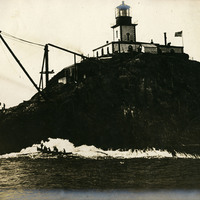
No Caption: c. 1898. View of Tillamook Rock Lighthouse and the small basalt rock upon which it sits, over one mile into the ocean from Tillamook Head. Built between 1880-1881, the treacherous ocean currents and often inclement weather associated with the area earned the lighthouse its nickname "Terrible Tillie" or "Tillie." This photograph was taken before the roof of the lighthouse was raised by five feet in 1898, to help prevent damage to the roof and the interior by crashing waves. The lighthouse was decommissioned in 1957.
Date: 1898
-
Caption: "Fort Worden, Wash.," c. 1909. Panoramic view of Fort Worden in Port Townsend, Washington, on Admiralty Inlet of Puget Sound. Construction began on the fort in 1898. By 1902 it was serving as an active U.S. Army base. Fort Worden was part of the "triangle of fire," three coastal defense fortifications (Fort Casey, Fort Worden, and Fort Flagler) guarding the entrance to Puget Sound. The U.S. sold the property to the state of Washington in 1957. In 1973, the fort and surrounding area opened as Fort Worden State Park.
Date: 1909
-
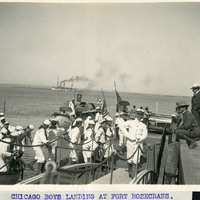
Caption: "CHICAGO BOYS LANDING AT FORT ROSECRANS." View of US Navy sailors coming ashore at Fort Rosecrans. The flagship of the US fleet in the Pacific at the time, the USS Chicago was called to the fort after a boiler explosion on the USS Bennington killed sixty-six and wounded dozens more. A board of inquiry into the cause of the explosion was convened on board the Chicago. The board found that no error on the part of the Bennington's crew contributed to the explosion.
Date: 1905
-
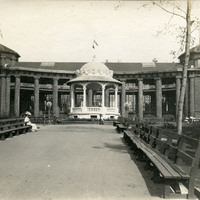
No Caption: View of the Forestry Building at the Alaska-Yukon-Pacific Exposition. Grace McCarthy is seated on a bench in front of the building, in a light-colored dress and hat. Made out of unpeeled logs, the Forestry Building was demolished in the 1930s. Held in Seattle to celebrate the development of the Pacific Northwest, the fair attracted 3.7 million visitors over the course of its run from June to October 1909. Although most of the fair's buildings have since been destroyed, several of them now serve as part of the University of Washington campus.
Date: 1909
-
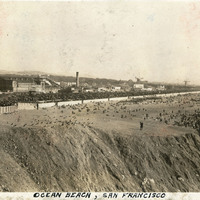
Caption: "Ocean Beach, San Francisco," c. 1925. Panorama of Ocean Beach, showing crowds not only at the beach but also at San Francisco's Playland, a series of seaside attractions and rides including a carousel, Fun House, and the Big Dipper rollercoaster. Entrepreneurs began erecting concessions and "thrill" rides at the location in the late nineteenth century. By 1913 the area was known as Chutes at the Beach. In 1923, brothers George and Leo Whitney began to purchase the attractions, eventually coming to own the entirety of what became known as Playland. The amusement park was torn down in 1972.
Date: 1925
-
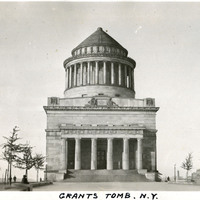
Caption: "Grants Tomb. N.Y." The remains of Ulysses S. Grant, 18th President of the U.S. and Commanding General of the Union Army during the last year of the Civil War, were laid to rest in this elaborate tomb, designed by architect John Duncan. Grant died in 1885, but construction on the granite and marble structure did not begin until 1891. Grant's remains were transferred to the tomb on April 27, 1897. The tomb is the largest mausoleum in North America. See also 96-07-08-alb11-209.
Date: 8/10/1934
-
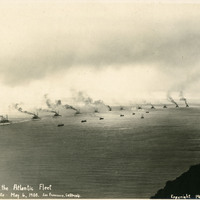
Caption: "The Arrival of the Atlantic Fleet at the Golden Gate -- May 6, 1908. San Francisco, California." and "Copyright 1908, Chas. Weidner, S.F." This photograph, by Charles Weidner, shows the U.S. Navy's Atlantic Fleet, consisting of sixteen battle cruisers and various support vessels, steaming toward the Golden Gate and San Francisco Bay. President Theodore Roosevelt ordered the Atlantic Fleet (later called the "Great White Fleet" because the ships were painted white with gold trim) on a tour around the world, beginning in December 1907, to show American goodwill and also demonstrate the power of the U.S. Navy. The Fleet reached the Golden Gate, entrance to San Francisco Bay, on May 6, 1908.
Date: 5/6/1908