
Search All Items
- Filters:
- Type
- Image 3882
- Still Image 2127
- Text 433
- Text 50
- Image of the California Census from the records of the office of the California Secretary of State 1
- Language
- English 6465
- Spanish 33
- ENGLISH 2
- English 2
- census_013 1
- contra_costa_schedule_1_volume_1 1
Search Results 5201 to 5210 of 6569
-
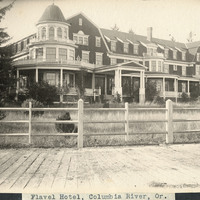
Caption: "Flavel Hotel, Columbia River, Or.," c. 1909. Built at the turn of the century, the Flavel Hotel housed passengers waiting to board steamships of the Great Northern Pacific Steamship Company bound for San Francisco and other ports. The Flavel family constructed the hotel as part of an effort to establish the town of Flavel on Tansy Point along the Columbia River. The town failed to attract sufficient residents, however, and was annexed into Warrenton by 1918. By the time this photograph was taken, the hotel appears to have been abandoned.
Date: 1909
-
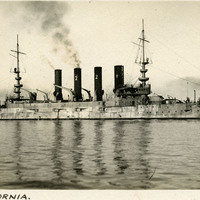
Caption: "U.S.S. California," c. 1906. This photograph shows the second U.S. Navy ship to bear the Golden State's name. Launched in 1904 and commissioned in 1907, this Pennsylvania-class armored cruiser served in the Pacific fleet. Her name was changed in 1914 to the USS San Diego, in order to free up the name for a new, Tennessee-class battleship. The USS San Diego went on to serve in both the Pacific and Atlantic fleets during World War I, until being sunk off the coast of New York by a German mine in 1918, with a loss of six lives.
Date: 1906
-
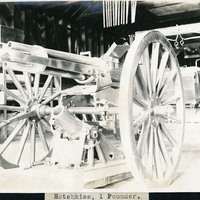
Caption: "Hotshkiss [sic], 1 pounder." The United States purchased artillery from the French arms firm, Hotchkiss, in the late 19th and early 20th centuries. The arms firm was created by American gunsmith, Benjamin B. Hotchkiss, who moved to France in 1867 to set up the factory. The heavy artillery was first used by the United States against the Nez Perce in 1877. In 1890, they were used at the Wounded Knee Massacre, and also for the attack on San Juan Hill during the Spanish-American War.
Date: Undated
-
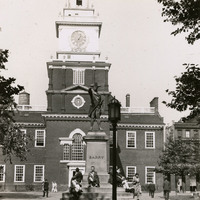
Caption: "Independence Hall -- Phila. July 31, 1934." A view of the steeple and bell tower of Independence Hall in Philadelphia, site of the debate over and signing of both the Declaration of Independence and the U.S. Constitution. Completed in 1753 for the use of the Pennsylvania Province's colonial legislature, it was also the site of a 1915 convention marking the formation of the League to Enforce Peace, predecessor entity to the United Nations. The Georgian-style building, designed by Edmund Woolley and Andrew Hamilton, has undergone several renovations. Only the central portion of the building is original -- all other portions of the building have been rebuilt at some point in its past. This building also housed the Liberty Bell until 1976, when the bell was moved to the Liberty Bell Center across the street.
Date: 7/31/1934
-
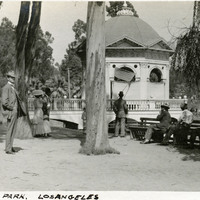
Caption: "East Lake [sic] Park. Losangeles [sic]," c. 1906. Eastlake Park in Los Angeles was originally created by the city in 1881 under the name "East Los Angeles Park." Renamed Eastlake Park in 1901, it gained its current name, Lincoln Park, in 1917. This photograph shows several people seated on benches and strolling pathways. In the background, the lake for which the park was named can be seen, as well as an elaborate bandstand situated on the lake.
Date: 1906
-
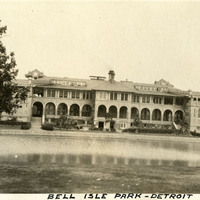
Caption: "Bell [sic] Isle Park - Detroit," c.1925. This photograph features the Belle Isle Casino, on the edge of Lake Tacoma on Belle Isle, in the Detroit River. The building is the second structure at the site, built in 1908 to replace a dilapidated wooden structure. The building is not a gambling facility, but is instead called a "casino" in the older sense of the word: a public building for meetings, dancing, reunions, and other recreation.
Date: 1925
-
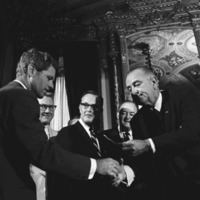
This item has no description.
Date: 1965
-
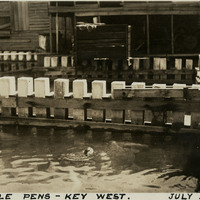
Caption: "Turtle Pens -- Key West. July 2, 1934." View of turtle kraals, or turtle corrals, used in the turtle fishing industry in Key West. Green turtles were kept in these pens prior to slaughter or transport. Turtle meat and eggs were popular food items in the early-to-mid twentieth century; turtle fat was especially prized for making turtle soup. However, the turtle population plummeted in the Florida Keys and surrounding areas as the twentieth century progressed and demand increased. The turtle kraals and nearby canneries closed when the Endangered Species Act was passed in 1971. Populations have since started to recover. The cannery near the kraals shown in this photograph now serves as the Key West Turtle Museum.
Date: 7/2/1934