
Search All Items
- Filters:
- Type
- Image 3670
- Still Image 1106
- Text 405
- Text 19
- Image of the California Census from the records of the office of the California Secretary of State 1
- Language
- English 5178
- Spanish 28
- ENGLISH 2
- English 1
- census_013 1
- contra_costa_schedule_1_volume_1 1
Search Results 5211 to 5220 of 5257
-
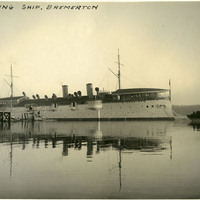
Caption: "Training Ship. Bremerton," Washington, c. 1908 - 1912. See also 96-07-08-alb08-086. View of the USS Philadelphia (C-4). The fourth ship to bear the name, the Philadelphia first launched in September 1889. She sailed as part of the U.S. Navy's Atlantic Squadron until 1893. She then sailed into the Pacific Ocean, where she served until being decommissioned and docked in Puget Sound in 1902. In 1904, the Navy "housed over" the ship (adding the roofed quarters visible on the upper deck in the photograph) and designated her a receiving ship for new sailors not yet assigned to a crew. The Philadelphia served in this capacity until 1912. After a brief stint as a prison ship, the Philadelphia again became a receiving ship in 1916. The Navy sold her in 1927.
Date: 1908
-
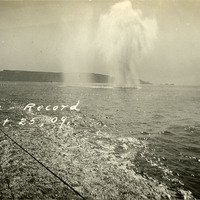
Caption: "#4 -- Record Oct 25, 09." This postcard shows plume of seawater thrown up by a mortar shell during target practice at Fort Point. The facilities at Fort Point were part of an effort by the U.S. government to protect the Golden Gate, entrance to the San Francisco Bay. Built between 1853-1861, the fort included emplacements for 141 guns but never fired a weapon in defense of the Bay. Its name was officially changed in 1882 to Fort Winfield Scott, but in 1886 the fort was officially downgraded to a sub-post of the San Francisco Presidio and the name discontinued. It was resurrected in 1912, with the establishment of a coastal artillery fortification at the Presidio, called, once again, Fort Winfield Scott.
Date: 10/25/1909
-
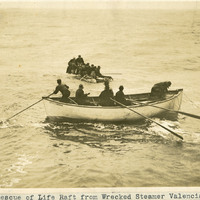
Caption: "Rescue of Life Raft from Wrecked Steamer Valencia." Photograph showing a boat crew about to rescue 18 people on a life raft. On Monday, January 22, 1906, the passenger liner Valencia ran aground on a reef during a storm off the southwestern coast of Vancouver Island (an area notorious for ship wrecks). Although the shore was only about fifty yards away, heavy seas and rock cliffs prevented the passengers and crew from making their way safely to land. Circumstances prevented rescue vessels from coming to the stricken ship's aid until Wednesday January 24th. The steamship City of Topeka rescued 18 men on a life raft, shown in this photograph. The official death toll was 136: seven officers, 33 crewmen, and 96 passengers (including seventeen women and eleven children -- all of the women and children on board perished). Only 37 people survived the wreck.
Date: 1/24/1906
-
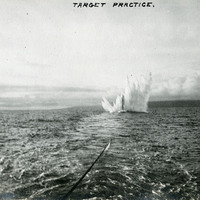
Caption: "Target Practice," c. 1908. This postcard shows a plume of seawater thrown up by a mortar shell during target practice at Fort Point. The facilities at Fort Point were part of an effort by the U.S. government to protect the Golden Gate, entrance to the San Francisco Bay. Built between 1853-1861, the fort included emplacements for 141 guns but never fired a weapon in defense of the Bay. Its name was officially changed in 1882 to Fort Winfield Scott, but in 1886 the fort was officially downgraded to a sub-post of the San Francisco Presidio and the name discontinued. It was resurrected in 1912, with the establishment of a coastal artillery fortification at the Presidio, called, once again, Fort Winfield Scott. See also 96-07-08-alb05-322.
Date: 1908
-
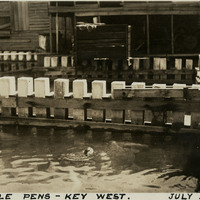
Caption: "Turtle Pens -- Key West. July 2, 1934." View of turtle kraals, or turtle corrals, used in the turtle fishing industry in Key West. Green turtles were kept in these pens prior to slaughter or transport. Turtle meat and eggs were popular food items in the early-to-mid twentieth century; turtle fat was especially prized for making turtle soup. However, the turtle population plummeted in the Florida Keys and surrounding areas as the twentieth century progressed and demand increased. The turtle kraals and nearby canneries closed when the Endangered Species Act was passed in 1971. Populations have since started to recover. The cannery near the kraals shown in this photograph now serves as the Key West Turtle Museum.
Date: 7/2/1934
-
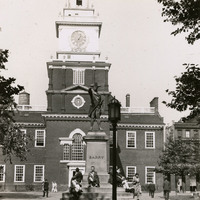
Caption: "Independence Hall -- Phila. July 31, 1934." A view of the steeple and bell tower of Independence Hall in Philadelphia, site of the debate over and signing of both the Declaration of Independence and the U.S. Constitution. Completed in 1753 for the use of the Pennsylvania Province's colonial legislature, it was also the site of a 1915 convention marking the formation of the League to Enforce Peace, predecessor entity to the United Nations. The Georgian-style building, designed by Edmund Woolley and Andrew Hamilton, has undergone several renovations. Only the central portion of the building is original -- all other portions of the building have been rebuilt at some point in its past. This building also housed the Liberty Bell until 1976, when the bell was moved to the Liberty Bell Center across the street.
Date: 7/31/1934
-
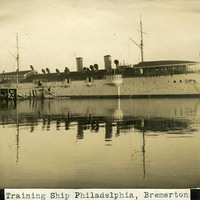
Caption: "Training Ship Philadelphia, Bremerton," c. 1908-1912. View of the USS Philadelphia (C-4). The fourth ship to bear the name, the Philadelphia first launched in September 1889. She sailed as part of the U.S. Navy's Atlantic Squadron until 1893. She then sailed into the Pacific Ocean, where she served until being decommissioned and docked in Puget Sound in 1902. In 1904, the Navy "housed over" the ship (adding the roofed quarters visible on the upper deck in the photograph) and designated her a receiving ship for new sailors not yet assigned to a crew. The Philadelphia served in this capacity until 1912. After a brief stint as a prison ship, the Philadelphia again became a receiving ship in 1916. The Navy sold her in 1927.
Date: 1908
-
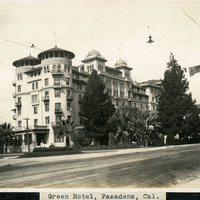
Caption: "Green Hotel, Pasadena, Cal.," c. 1905. View of Castle Green, built as an annex to the Hotel Green in 1899. The original Hotel Green opened for business as a lavish resort in 1894. Its success prompted owner George Gill Green to expand the hotel and build the additional facility shown here, connected to the original hotel by an elaborate enclosed pedestrian bridge (seen at the far right of this photograph). This second building, designed by architect Frederick I. Roehrig with Spanish, Moorish, and Victorian elements, became known as "Castle Green." Business declined in the 1910s, and the complex was sold to a series of investors. In the mid-1920s, Castle Green was subdivided into fifty residential apartments. It remains a residential complex today.
Date: 1905