
Search All Items
- Filters:
- Language
- English 5827
- Spanish 62
- ENGLISH 2
- English 1
- census_013 1
- contra_costa_schedule_1_volume_1 1
- Type
- Image 3871
- Still Image 1544
- Text 447
- Text 22
- Textual 2
- Image of the California Census from the records of the office of the California Secretary of State 1
Search Results 5221 to 5230 of 5968
-
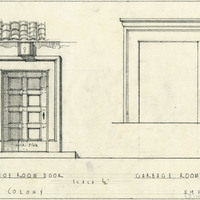
Caption: "Shoe Room Door - Garbage Room." Pacific State Hospital. Design and drawing by Alfred Eichler. Built. Project for Department of Mental Hygiene - Hospitals. The hospital was initially named Pacific Colony (1927-1953), followed by Pacific State Hospital (1953-1979); Frank D. Lanterman State Hospital and Developmental Center; and finally Lanterman Developmental Center, which closed in 2015.
Date: 1934
-
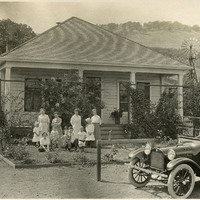
No caption: Grace McCarthy (standing, second from right), with several unidentified adults and children posing for photograph in front of a small house with a hillside of crops in the distance, and an automobile in the foreground, in Solano County, c. 1910 - 1915.
Date: 1915
-
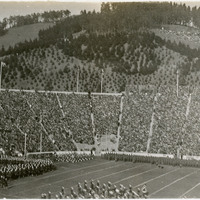
No caption, c. 1930. Football stadium filled with fans for a game, with a marching band on the field at the lower center of the photograph. The stadium is unidentified, but may be University of California, Berkeley's California Memorial Stadium, built in 1923.
Date: 1930
-
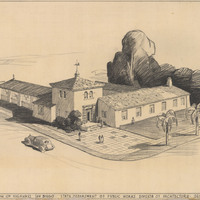
Caption: "District XI Office Bldg. Division of Highways San Diego, State Department of Public Works Division of Architecture - Geo. B. McDougall State Architect." Design by H. S. Hazen; drawing by Alfred Eichler. Built. Project for Department of Public Works - Highways - District XI - San Diego.
Date: 1934
-
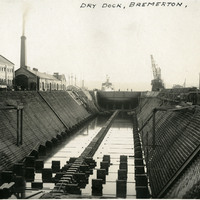
Caption: "Dry Dock, Bremerton." Bremerton, Washington, c. 1908-1912. See also 96-07-08-alb08-085. View of a dry dock at the Puget Sound Naval Shipyard in Bremerton, Washington. Established in 1891 as a naval station, it became Naval Yard Puget Sound in 1901. During World War I the shipyard constructed hundreds of ships to support the war effort, while in World War II, the shipyard was dedicated primarily to repairing damaged ships. Today, it contains a portion of the U.S. Navy's mothball fleet (ships retired but retained in case of future need), as well as building, repairing, and maintaining sea-going vessels of all kinds.
Date: 1908
-
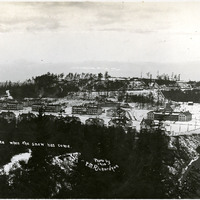
Caption: "Fort Worden when the snow has come. Greetings from Port Townsend - Wash." and "Photo by P.M. Richardson, 1910." This postcard shows an overview of Fort Worden in Port Townsend, Washington, on Admiralty Inlet of Puget Sound. Construction began on the fort in 1898, and by 1902 it was serving as an active U.S. Army base. Fort Worden was part of the "triangle of fire," three coastal defense fortifications (Fort Casey, Fort Worden, and Fort Flagler) guarding the entrance to Puget Sound. The U.S. sold the property to the state of Washington in 1957. In 1973, the fort and surrounding area opened as Fort Worden State Park.
Date: 1910
-
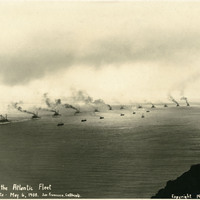
Inscribed on photograph: "The Arrival of the Atlantic Fleet at the Golden Gate - May 6, 1908. San Francisco, California. Copyright Charles Weidner, S.F." This photograph, by Charles Weidner, shows the U.S. Navy's Atlantic Fleet, consisting of sixteen battle cruisers and various support vessels, steaming toward the Golden Gate and San Francisco Bay. President Theodore Roosevelt ordered the Atlantic Fleet (later called the "Great White Fleet" because the ships were painted white with gold trim) on a tour around the world, beginning in December 1907, to show American goodwill and also demonstrate the power of the U.S. Navy. The Fleet reached the Golden Gate, entrance to San Francisco Bay, on May 6, 1908.
Date: 1908
-
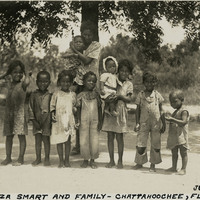
Caption: "Mrs Eliza Smart and Family -- Chattahoochee, Florida, June 22, 34." Eliza Smart (standing in the back) and nine unidentified children, posing under a tree for the photograph. This is one of the few photographs in which the McCarthys identified the people who they met along their travels.
Date: 6/22/1934
-
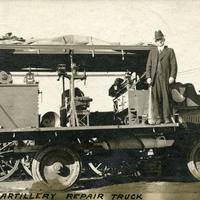
Caption: "Artillery Repair Truck," c. 1917. William McCarthy standing on a truck modified for field artillery repair, at Camp Kearney. Camp Kearney was established by the U.S. Army in 1917 just north of San Diego. The post was largely abandoned by the government in 1920, used as a military and civilian airfield. It did not see increased military service again until the 1930s.
Date: 1917