
Search All Items
- Filters:
- Type
- Image 3888
- Still Image 2857
- Text 431
- Text 50
- Image of the California Census from the records of the office of the California Secretary of State 1
- Language
- English 7190
- Spanish 43
- ENGLISH 3
- English 2
- census_013 1
- contra_costa_schedule_1_volume_1 1
Search Results 5221 to 5230 of 7317
-
This item has no description.
Date: 1964
-
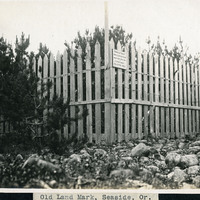
Caption: "Old Landmark, Seaside, Or.," c. 1910. Shows a picket fence erected around what a sign calls "Remains of Cairn where Lewis & Clark made salt from the ocean water Jan. & Feb. 1806." When the famous expedition led by Merriweather Lewis and William Clark reached the Pacific Ocean in late 1805, their supplies had run dangerously low, including their salt supply. Salt, used not only to flavor meat but also to preserve it, was extremely important to the health of the expedition. Three of Lewis and Clark's men traveled to a site on the coast near present-day Seaside, Oregon to set up a small salt-works, boiling ocean water in a series of large kettles and then scraping the resulting salt crust off of the sides. In this manner, the men eventually collected about twenty gallons of salt before Lewis and Clark decided the supply was sufficient for the return journey. In 1910, the property containing the remains of the cairns was deeded to the Oregon Historical Society. In 1955, replica salt cairns were built at the site by the Lions Club to commemorate the expedition's activities.
Date: 1910
-
Caption: "Embassy Club Royal Palm Garden -- Palm Beach, Fla. Designed by Adison [sic] Mizner of Benicia Calif. July 8, 1934." Grace McCarthy sitting on an ornamental fence in a garden, surrounded by palm trees. The Embassy Club was a popular Palm Beach club in the mid-twentieth century.
Date: 7/8/1934
-
Caption: "Embassy Club Royal Palm Garden -- Palm Beach, Fla. Designed by Adison [sic] Mizner of Benicia Calif. July 8, 1934." William McCarthy leaning on an ornamental fence in a garden, surrounded by palm trees and manicured hedges. The Embassy Club was a popular Palm Beach club in the mid-twentieth century.
Date: 7/8/1934
-
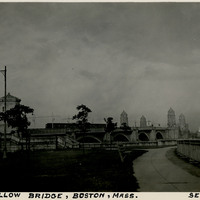
Caption: "Longfellow Bridge, Boston, Mass. Sept. 5, 1934." The Longfellow Bridge spans the Charles River between Boston and Cambridge. Originally called the Cambridge Bridge, it replaced a wood structure called the West Boston Bridge that had been constructed in 1793. This wood bridge was unable to handle large volumes of traffic or the introduction of street cars, so a new bridge was built in the early twentieth century. Opened in 1906 as the Cambridge Bridge, the name was changed in 1927 to the Longfellow Bridge in honor of poet Henry Wadsworth Longfellow. It is colloquially known as the Salt and Pepper Bridge, as its central towers are reminiscent in shape of salt and pepper shakers.
Date: 9/5/1934
-
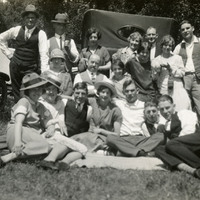
No caption, c. 1920. Group of unidentified people posing for photograph in park setting. Grace McCarthy appears seated in the middle row, at far left.
Date: 1920
-
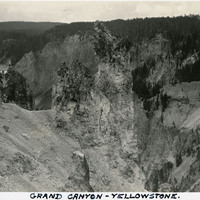
Caption: "Grand Canyon -- Yellowstone," c. 1920. Rock formations in the first large canyon along Yellowstone River below Yellowstone Falls, in Yellowstone National Park.
Date: 1920
-
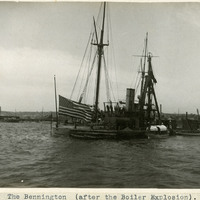
Caption: "The Bennington (after the Boiler Explosion)." View of the USS Bennington, a U.S. Navy gunboat, Yorktown class, launched in 1890. She had tours of duty in South America, the Mediterranean, North and Central America, Hawaii, and the Philippines. On July 21, 1905, while in San Diego Harbor, the Bennington's boiler exploded, killing sixty-six men and injuring many more. Taken after the explosion, in this photograph the Bennington sits low in the water.
Date: 1905