
Search All Items
- Filters:
- Type
- Image 3877
- Still Image 1470
- Text 425
- Text 50
- Image of the California Census from the records of the office of the California Secretary of State 1
- Language
- English 5791
- Spanish 37
- ENGLISH 2
- English 2
- census_013 1
- contra_costa_schedule_1_volume_1 1
Search Results 5261 to 5270 of 5886
-
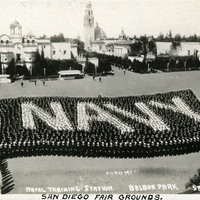
Caption: "San Diego Fair Grounds." and "39-6, 3,400 Men, Naval Training Station, Balboa Park, San Diego Cal.," c. 1917. With the advent of World War I, the U.S. Navy needed additional training grounds for sailors. In 1917, the City of San Diego offered to lease the Navy a portion of Balboa Park as a temporary training site until a new, more permanent facility could be constructed. This postcard shows 3,400 sailors lined up to form a Navy flag while at the temporary training ground.
Date: 1917
-
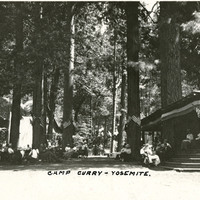
Caption: "Camp Curry- Yosemite," c. 1917. Yosemite's Half Dome Village, established by David and Jennie Curry in 1899, was originally called Camp Curry, and later Curry Village. It was designed to provide cheaper accommodations for Yosemite tourists than the resort hotels. The couple rented out furnished tents and provided amenities such as a dining tent. As time progressed, the amenities increased, and some hard-sided cabins created. This photograph shows a bustling scene around a large wood cabin with a wide covered porch. As a result of a legal dispute over trademarked names in the park, Curry Village changed its name to Half Dome Village in 2016.
Date: 1917
-
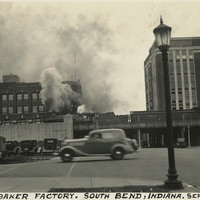
Caption: "Studebaker Factory. South Bend, Indiana. Sept. 13, 1934." Two buildings of the Studebaker Factory in South Bend are visible in this photograph. The Studebaker brothers started operations in South Bend in 1852, when they established a blacksmith shop and foundry. They soon began building wagons and carriages, demand for which soared with the advent of the Civil War and an increase in migration toward and into the American West. The company gradually phased out wagon production in favor of automobile manufacture in the early twentieth century. Sales declined after World War II, leading to the eventual closure of the factory in 1963.
Date: 9/13/1934
-
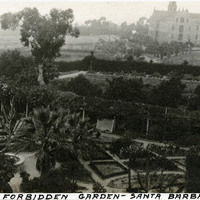
Caption: "Forbidden Garden -- Santa Barbara Mission," c. 1910. View of the gardens associated with Santa Barbara Mission. The gardens initially served as the location for instructing neophytes (Native American converts living at the mission) in trades and skills deemed necessary to life in European civilization. Later, the garden was used for meditation. The garden was often dubbed "forbidden" because it was closed to female visitors, as were many enclosures in active missions.
Date: 1910
-
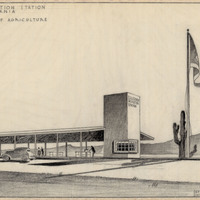
Caption: "Quarantine Inspection Station, Blythe, California, State Department of Agriculture. Department of Public Works, Division of Architecture-Sacramento." Design and drawing by Alfred Eichler. Built in 1939. Situated in desert country. Project for Department of Agriculture.
Date: 1939
-
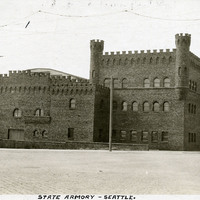
Caption: "State Armory -- Seattle.," c. 1910. View of castle-like armory building for the Washington National Guard, built in 1909 near Seattle's Pike Place Market. It was demolished in 1968.
Date: 1910