
Search All Items
- Filters:
- Language
- English 6457
- Spanish 23
- ENGLISH 2
- English 2
- census_013 1
- contra_costa_schedule_1_volume_1 1
- Type
- Image 3882
- Still Image 2094
- Text 445
- Text 54
- Textual 2
- Image of the California Census from the records of the office of the California Secretary of State 1
Search Results 5321 to 5330 of 6559
-
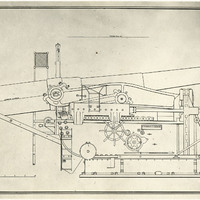
Caption: "U.S. 10" Disappearing Gun & Carriage, Model 1896, Wm McCarthy, July 20, 1905."
Date: 1905
-
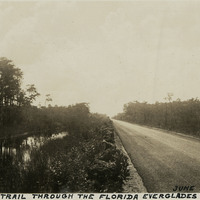
Caption: "Tamiami Trail Through the Florida Everglades, June 27, 1934." Asphalt-paved road stretching into the distance, flanked on one side by a canal. The Tamiami Trail constitutes a scenic portion of what is now U.S. Highway 41. Work on a road connecting Tampa with Miami began in 1915, but the Trail was not officially opened until 1928. Work on the route required building across a portion of the massive swamp system of the Everglades. Workers dredged and blasted a canal along the route, and used the fill dirt thus removed to construct the roadway proper.
Date: 6/27/1934
-
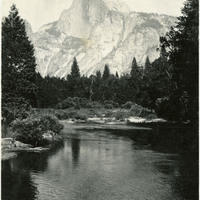
Caption: "Half Dome," c. 1917. The Merced River flows through the photograph in the foreground, while the iconic Half Dome looms in the background.
Date: 1917
-
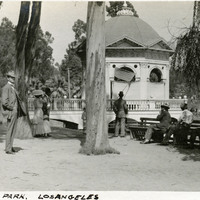
Caption: "East Lake [sic] Park. Losangeles [sic]," c. 1906. Eastlake Park in Los Angeles was originally created by the city in 1881 under the name "East Los Angeles Park." Renamed Eastlake Park in 1901, it gained its current name, Lincoln Park, in 1917. This photograph shows several people seated on benches and strolling pathways. In the background, the lake for which the park was named can be seen, as well as an elaborate bandstand situated on the lake.
Date: 1906
-
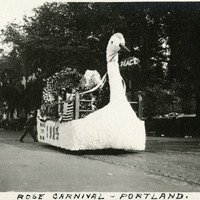
Caption: "Rose Carnival -- Portland." Features a parade float shaped as a swan, with roses, an American flag, and a sign reading "peace." The Portland Rose Festival began in 1907 as the Rose Carnival. It is now an annual festival featuring three parades, including the Grand Floral Parade, the second-largest all-floral parade in the nation (the largest being the Tournament of Roses held each New Year in Pasadena, California).
Date: 1925
-
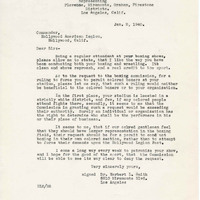
This item has no description.
Date: undated
-
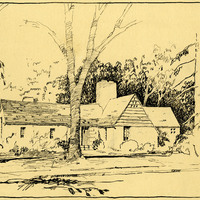
Drawing of physicians' residence, Stockton State Hospital. Design and pen and ink drawing by Alfred Eichler. Built. Project for Department of Mental Hygiene - Hospitals.
Date: 1928
-
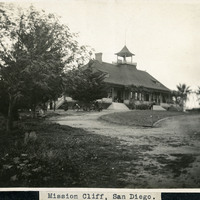
Caption: "Mission Cliff, San Diego.," c. 1905. View of the pavilion in San Diego's Mission Cliff Gardens. Originally opened in the 1880s as the "Bluffs" by the San Diego Cable Railway Company, the owners hoped to entice people to ride the cable cars by providing a recreational destination. The pavilion seen in the photograph was constructed in 1890. A few years later, the Citizens' Traction Company purchased the park and changed its name to Mission Cliff Park. In 1898, the property was sold yet again, this time to J.D. Spreckels and the San Diego Electric Railway Company. Spreckels hoped to transform the property into a quiet, restful, public botanical garden. The name changed again, to Mission Cliff Gardens, to reflect this change in direction for the park. The botanical gardens developed at the park became world-renowned before closing to the public in 1929. The property was subdivided in 1942, into residential lots.
Date: 1905