
Search All Items
- Filters:
- Language
- English 7210
- Spanish 43
- ENGLISH 3
- English 2
- census_013 1
- contra_costa_schedule_1_volume_1 1
- Type
- Image 3888
- Still Image 2860
- Text 445
- Text 54
- Textual 2
- Image of the California Census from the records of the office of the California Secretary of State 1
Search Results 5331 to 5340 of 7358
-
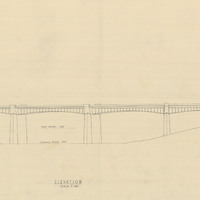
Design and drawing of elevation for bridge in Twin Trees, Humboldt County, by Alfred Eichler. Project for Department of Public Works - Highways - Bridge Department.
Date: 1933
-
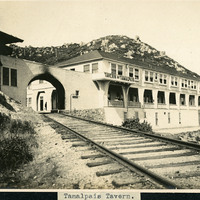
Caption: "Tamalpais Tavern," c. 1907. The Tamalpais Tavern opened in 1896 on top of Mount Tamalpais and quickly became a popular destination for Bay Area residents who rode the Muir Woods Railway up and down the mountain. A fire destroyed the tavern in 1923 and a smaller, more modest building was erected in 1924 but closed at the start of World War II.
Date: 1907
-
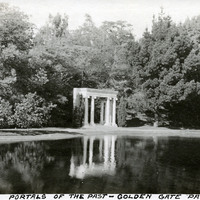
Caption: "Portals of the Past," c. 1915. A monument in Golden Gate Park in San Francisco, on the shores of Lloyd Lake, consisting of a white marble archway and columns. The archway was originally part of the Nob Hill mansion belonging to railroad tycoon Alban Towne. The mansion was destroyed in the 1906 San Francisco earthquake and fire, but the entryway still stood. It was moved to the shore of Lloyd Lake in 1909, as a memorial to the pre-1906 city.
Date: 1915
-
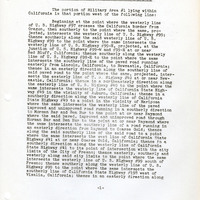
Narrative of boundaries of Military Areas #1 and #2
Date: Undated
-
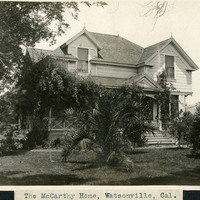
Caption: "The McCarthy Home, Watsonville, Cal," c. 1906. A view of the façade of the crossed-gabled McCarthy home, with large front porch and lush vegetation.
Date: 1906
-
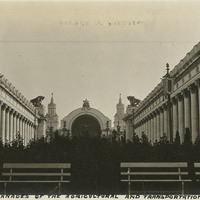
Caption: "Colonnades of the Agriculture and Transportation Building," at the Panama-Pacific International Exposition.
Date: 1915
-
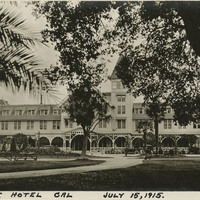
Caption: "Del Monte Hotel Cal July 15, 1915," shows the entrance to the Hotel Del Monte (Lewis P. Hobart and Clarence A. Tan Tau, architects), in Monterey, California. Originally opened in 1880, it was the world's largest luxury resort in that time. During World War II, the hotel and grounds was leased to the U.S. Navy. It later became the Naval Postgraduate School of the U.S. Navy and today functions as administrative offices and residences for the school.
Date: 1915
-
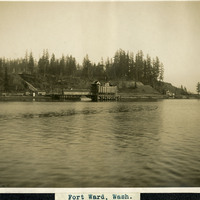
Caption: "Fort Ward, Wash.," c. 1908-1912. View from Puget Sound of a wharf and other buildings of Fort Ward. Originally known as Bean Point, Fort Ward was established by the U.S. Army Coastal Artillery Corps in 1890. Re-named Fort Ward in 1903, the facility included four coastal batteries designed to assist in protecting Puget Sound and the nearby Naval Shipyard from enemy attack. Fort Ward was placed on inactive status in the 1920s, but was revived by the U.S. Navy during World War II. The Navy discovered the fort's location was ideal for listening to radio communications from Japan, and it subsequently became a top secret listening post with a link directly to Washington, D.C. The Navy continued the fort's use as a listening post until 1956, when it was again taken over by the U.S. Army. The Army subsequently stopped all activity in 1958, ultimately selling portions of the fort to the Washington State Park System in 1960. It is now a state park.
Date: 1908
-
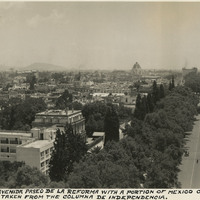
Caption: "View of the Avenida Paseo de la Reforma with a portion of Mexico City on the left. Photo taken from the Columna de Independencia."
Date: 1938