
Search All Items
- Filters:
- Type
- Image 3871
- Still Image 1541
- Text 433
- Text 19
- Image of the California Census from the records of the office of the California Secretary of State 1
- Language
- English 5808
- Spanish 62
- ENGLISH 2
- English 1
- census_013 1
- contra_costa_schedule_1_volume_1 1
Search Results 5331 to 5340 of 5932
-
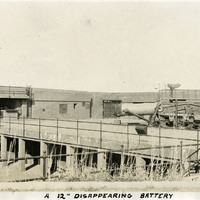
Caption: "A 12" Disappearing Battery," c. 1915. View of a barbette equipped with a 12" disappearing gun. Retracting or disappearing guns were a form of artillery developed in the nineteenth century in which heavy artillery guns were placed on rotating carriages that allowed retraction of the weapon after firing, to enable reloading while under enemy fire.
Date: 1915
-
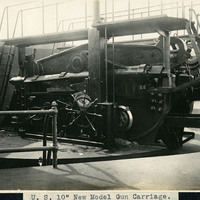
Caption: "U. S. 10" New Model Gun Carriage.," c. 1908-1912. Side view of a coastal defense disappearing gun carriage, without the gun barrel installed. Retracting or disappearing guns were a form of artillery developed in the nineteenth century in which heavy artillery guns were placed on rotating carriages that allowed retraction of the weapon after firing, to enable reloading while under enemy fire.
Date: 1908
-
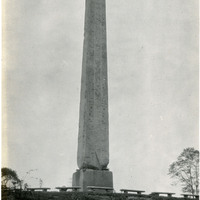
Caption: "Obelisk - Central Park," c. 1925. The obelisk in this photograph was erected in Central Park on February 22nd, 1881. It is an authentic Ancient Egyptian artifact, having been created during the rule of Thusmose III in the 18th Dynasty (despite the nickname, the obelisk has no known connection to Cleopatra). It was acquired in 1877 as a gift from the Egyptian Khedive.
Date: 1925
-
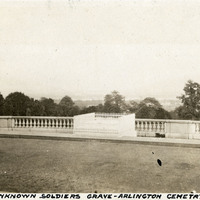
Caption: "Unknown Soldiers Grave - Arlington Cemetry[sic]," c. 1925. The Tomb of the Unknown Soldier, also called the Tomb of the Unknowns, memorializes those U.S. military service members who died without their remains being later identified. The remains of the first Unknown Soldier, stemming from World War I and disinterred from a cemetery in France, were laid to rest in the tomb in 1921.
Date: 1925
-
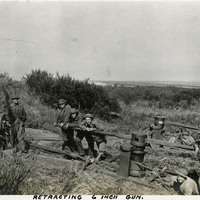
Caption: "Retracting 6 inch Gun.," c. 1909. View of crew installing coastal defense weaponry. Retracting or disappearing guns were a form of artillery developed in the nineteenth century in which heavy artillery guns were placed on rotating carriages that allowed retraction of the weapon after firing, to enable reloading while under enemy fire.
Date: 1909
-
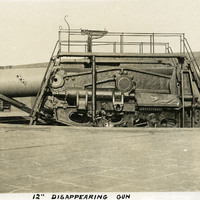
Caption: "12" Disappearing Gun," c. 1915. Side view of a coastal defense gun. Retracting or disappearing guns were a form of artillery developed in the nineteenth century in which heavy artillery guns were placed on rotating carriages that allowed retraction of the weapon after firing, to enable reloading while under enemy fire.
Date: 1915
-
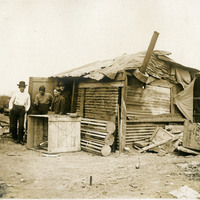
No Caption: See also 96-07-08-alb05-018 with caption: "Italian Refugee Hut S.F. 1906." Makeshift hut with four unidentified men standing in doorway. After the earthquake and fire that destroyed much of San Francisco in April 1906, hundreds of thousands of people were left homeless. Many of these people established temporary refugee camps, using debris from the destruction to cobble together shelters.
Date: 1906
-
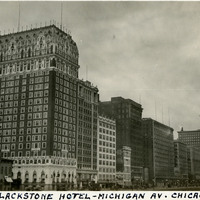
Caption: "Blackstone Hotel -- Michigan Av. Chicago," c. 1923. Built in 1909 and designed by Benjamin Marshall, the twenty-one story Blackstone Hotel sits on the corner of Michigan Avenue and Balbo Drive in Chicago Illinois. It is the building closest to the left side of the photograph in this row of high-rises. See also 96-07-08-alb09-092.
Date: 1923
-
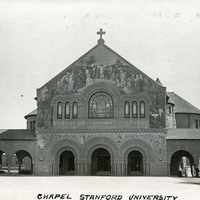
Caption: "Stanford Chapel," c. 1912-1915. Façade of Stanford Memorial Chapel, designed by Charles A. Coolidge and dedicated in 1903. The church was commissioned by Jane Stanford as a memorial to her husband, Leland Stanford. See also 96-07-08-alb04-202 and 215.
Date: 1915