
Search All Items
- Filters:
- Language
- English 6457
- Spanish 23
- ENGLISH 2
- English 2
- census_013 1
- contra_costa_schedule_1_volume_1 1
- Type
- Image 3882
- Still Image 2094
- Text 445
- Text 54
- Textual 2
- Image of the California Census from the records of the office of the California Secretary of State 1
Search Results 5341 to 5350 of 6559
-
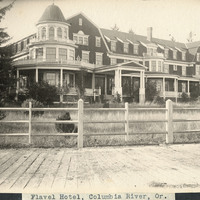
Caption: "Flavel Hotel, Columbia River, Or.," c. 1909. Built at the turn of the century, the Flavel Hotel housed passengers waiting to board steamships of the Great Northern Pacific Steamship Company bound for San Francisco and other ports. The Flavel family constructed the hotel as part of an effort to establish the town of Flavel on Tansy Point along the Columbia River. The town failed to attract sufficient residents, however, and was annexed into Warrenton by 1918. By the time this photograph was taken, the hotel appears to have been abandoned.
Date: 1909
-
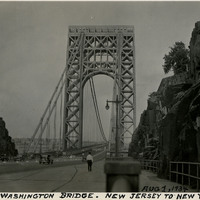
Caption: "George Washington Bridge. New Jersey to New York. Aug 1, 1934." This suspension bridge, designed by Othmar Ammann, spans the Hudson River between Manhattan in New York City, and Fort Lee, New Jersey. Constructed between 1927 and 1931, the bridge included the longest main span in the world at the time, a record it held until construction of the Golden Gate Bridge was completed in 1937. It was originally built with only one deck, but a second deck opened in 1962. Still in active use today, it carried over 51 million vehicles in 2016.
Date: 8/1/1934
-
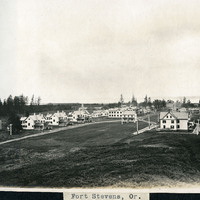
Caption: "Fort Stevens, Or.," c. 1910. View of buildings at Fort Stevens, part of the Three Fort Harbor Defense System protecting the mouth of the Columbia River from enemy incursion or attack (the other forts being Fort Columbia and Fort Canby, both in Washington). Built during the Civil War, the fort remained active until after World War II. In June 1942, Fort Stevens gained the dubious distinction of being the only military installation in the continental United States to come under enemy fire when a Japanese submarine surfaced off the coast and fired seventeen missiles at the fort. The missiles destroyed the backstop to the fort's baseball field, but otherwise did little harm. Fort Stevens was decommissioned in 1947. It was later turned over to the Oregon Parks and Recreation Department, and currently is the site of an Oregon State Park.
Date: 1910
-
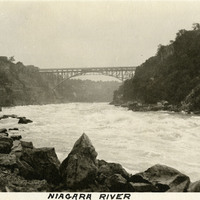
Caption: "Niagara River," c. 1920. View of river and bridge.
Date: 1920
-
Correspondence from Margaret S. Watkins to Gladys C. Johns regarding Tulare County's participation in the WCCA program
Date: May 7, 1942
-
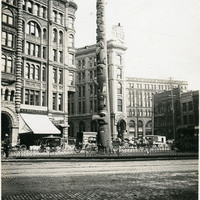
Caption: "Totem Pole, Seattle." Seattle, Washington, c. 1905. View of the Tlingit totem pole in Seattle's Pioneer Square. The totem pole was stolen in 1899 by a group of businessmen, and erected in the square, then known as Pioneer Place. An arsonist destroyed this pole in 1938, but it was later replaced by another carved by the Tlingit tribe (who were also finally paid for the original pole).
Date: 1905
-
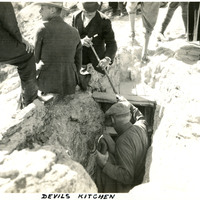
Caption: "Devil's Kitchen," c. 1923. This photograph shows several people descending into and standing around the entry to Devil's Kitchen, an extinct hot spring that left behind a cavern. Once a popular tourist attraction for its small opening that made visitors feel as if they were descending into the underworld, the site was closed in 1939 because the cavern periodically fills with dangerous levels of carbon dioxide.
Date: 1923
-
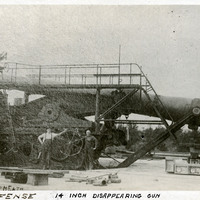
Caption: "Coast Defense: 14 Inch Disappearing Gun." Another copy of a C.D. Heath photograph, this image shows a heavy artillery gun, with two unidentified men standing next to it, at the Sandy Hook Proving Ground. Located at Sandy Hook, New Jersey, the Sandy Hook Proving Ground was used by the U.S. Army to test ordinance and materiel from 1874-1919. See also 96-07-08-alb05-101.
Date: 1910
-
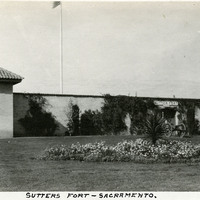
Caption: "Sutters [sic] Fort - Sacramento," c. 1920, shows a gun tower at Sutter's Fort, and a gate bracketed by two cannons. John Sutter established the fort in 1839, calling it New Helvetia. After the discovery of gold at one of Sutter's mills (at Coloma, on the American River), almost all of the fort's inhabitants left for the gold fields in the foothills. The fort deteriorated until being restored from 1891-1893. The Native Sons of the Golden West were influential in the restoration. The fort is now the site of a State Historic Park. See also 96-07-08-alb05-117 and 118.
Date: 1920
-
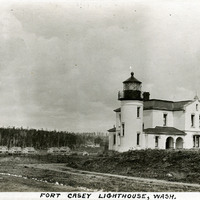
Caption: "Fort Casey Lighthouse, Wash.," c. 1909. View of the lighthouse with fort buildings in the background. Located on Whidbey Island in Puget Sound, the Admiralty Head Lighthouse was built overlooking Admiralty Inlet in 1903. It replaced an earlier structure that had to be moved in 1890 to accommodate the construction of Fort Casey. The second lighthouse, shown here, was built with thick walls in order to withstand earthquakes and the concussion of guns at Fort Casey. Deactivated in 1922, the lighthouse has since been restored by Washington State Parks, and is part of the Fort Casey State Park.
Date: 1909