
Search All Items
- Filters:
- Language
- English 6457
- Spanish 23
- ENGLISH 2
- English 2
- census_013 1
- contra_costa_schedule_1_volume_1 1
- Type
- Image 3882
- Still Image 2094
- Text 445
- Text 54
- Textual 2
- Image of the California Census from the records of the office of the California Secretary of State 1
Search Results 5391 to 5400 of 6559
-
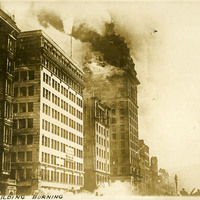
Caption: "Call Building Burning," shows the Call Building on Market and 3rd Streets on fire after the earthquake, with people and horses in the foreground. Considered one of the worst natural disasters in the country's history, the 1906 San Francisco earthquake and resulting fires killed an estimated 3,000 people and destroyed over 500 city blocks, leaving approximately 200,000 residents homeless.
Date: 1906
-
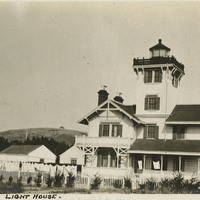
Caption: "Point Firmin [sic] Lighthouse," c. 1915, shows the Point Fermin lighthouse, built in 1874 in San Pedro Bay, which was the first navigational light into the bay. It served as a federally-operated lighthouse until 1927, when its operations were turned over to the City of Los Angeles. After the bombing of Pearl Harbor in 1941, the west coast was blacked out for fear of being an easy target to enemy forces. It was never lit again, but during WWII it served the U.S. Navy as a lookout tower and signaling station for ships coming into the San Pedro Bay. In 2003, the lighthouse was opened after being restored, retrofitted, and rehabilitated for public use. It is listed on the National Register of Historic Places and managed by the Department of Recreation and Parks of the City of Los Angeles.
Date: 1915
-
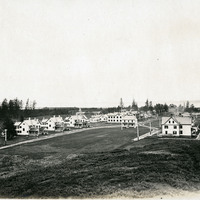
No Caption: See also 96-07-08-alb08-139 with caption: "Fort Stevens, Or," c. 1910. A view of buildings at Fort Stevens, part of the Three Fort Harbor Defense System protecting the mouth of the Columbia River from enemy incursion or attack (the other forts being Fort Columbia and Fort Canby, both in Washington). Built during the Civil War, the fort remained active until after World War II. In June 1942, Fort Stevens gained the dubious distinction of being the only military installation in the continental United States to come under enemy fire when a Japanese submarine surfaced off the coast and fired seventeen missiles at the fort. The missiles destroyed the backstop to the fort's baseball field, but otherwise did little harm. Fort Stevens was decommissioned in 1947. It was later turned over to the Oregon Parks and Recreation Department, and currently is the site of an Oregon State Park.
Date: 1910
-
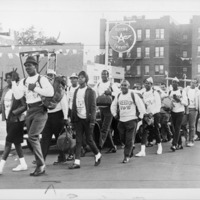
This item has no description.
Date: 1963
-
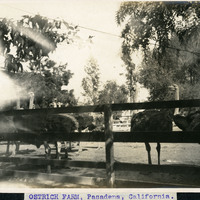
Caption: "OSTRICH FARM, Pasadena, California.," c. 1905. View of several ostriches in a corral at the Caswston Ostrich Farm in Pasadena. Opened by Edward Cawston in 1886, this was the first ostrich farm in the U.S. It became a popular tourist stop along the Pasadena and Los Angeles Electric Railway in the early twentieth century, where visitors could ride an ostrich, or be pulled by one in a light card. They could also buy merchandise made out of ostrich feathers, such as hats and boas. The farm closed in the mid-1930s.
Date: 1905
-
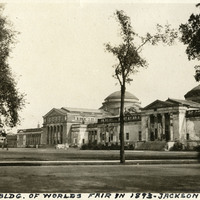
Caption: "Fine Arts Bldg. of Worlds Fair in 1893 - Jackson Park - Chicago," c. 1923. The Palace of Fine Arts building shown in this photograph was originally constructed for the World's Columbian Exposition held in Chicago in 1893. After the fair's completion, the building housed the Columbian Museum, which eventually became the Field Museum of Natural History. In 1920, that museum moved to a new building, and the Palace of Fine Arts building was left vacant. After renovations in the late 1920s, the Museum of Science and Industry opened at the site.
Date: 1923
-
Early design of California National Guard Armory, Long Beach; later modified. Design and pen and ink drawing by Alfred Eichler. Project for California Military Department.
Date: 1929
-
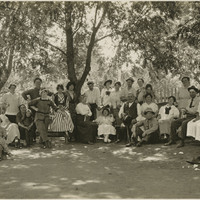
No Caption: A group photograph of William and Grace McCarthy with friends and family at the Riverside Villa resort in Healdsburg, c. 1915.
Date: 1915
-
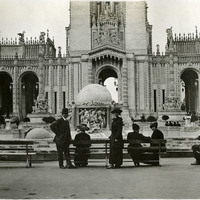
No Caption: William and Grace McCarthy (standing and looking at the camera) at the Panama-Pacific International Exposition, 1915. The Panama Pacific International Exposition was held to celebrate the completion of the Panama Canal, as well as inventive technologies and new industries from around the world. It was also a chance for San Francisco to show the world how the great city had rebuilt and thrived after the devastation of the 1906 earthquake and fire.
Date: 1915
-
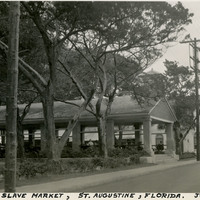
Caption: "Spanish Slave Market, St. Augustine, Florida. July 10, 1934." An open-air pavilion with a gabled roof and six bays appears in the center of this photograph, somewhat obscured by surrounding trees and vegetation. The waterfront site on which the pavilion sits has served St. Augustine as a marketplace since the city's founding in the sixteenth century, for food, commercial goods, and for slaves. The pavilion in the photograph was constructed in 1888, after a fire burned down the previous structure. In the twentieth century, entrepreneurs used the slave market aspect of the site's history as a hook to entice northern tourists into St. Augustine's historic quarter. The market has often served as a rallying site for protestors, from suffragettes to protestors of the war in Iraq. Various civil rights marches held around the market in the 1960s attracted such luminaries as Dr. Martin Luther King, Jr. and Andrew Young.
Date: 7/10/1934