
Search All Items
- Filters:
- Type
- Image 3888
- Still Image 2857
- Text 431
- Text 50
- Image of the California Census from the records of the office of the California Secretary of State 1
- Language
- English 7190
- Spanish 43
- ENGLISH 3
- English 2
- census_013 1
- contra_costa_schedule_1_volume_1 1
Search Results 5401 to 5410 of 7317
-
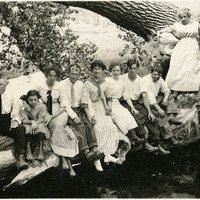
No caption, c. 1914. William and Grace McCarthy (fourth and fifth from the left) seated on a log with a group of unidentified friends and family in the Skaggs Springs area of Sonoma County. Skaggs Springs was a resort area along the Russian River, known for its hot springs. The area now lies beneath the waters of Lake Sonoma, flooded after construction of the Warm Springs Dam, completed in 1982.
Date: 1914
-
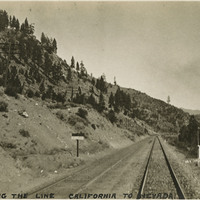
Caption: "Crossing the Line California to Nevada," c. 1915, shows railroad tracks intersecting the border between California and Nevada in the Sierra Nevada.
Date: 1915
-
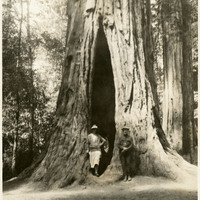
Caption: "The Mother Tree, Big Basin," c. 1935. William and Grace McCarthy posing with the Mother of the Forest, the tallest redwood tree in Big Basin Redwoods State Park at 329 feet high and 70 feet in circumference near the ground.
Date: 1935
-
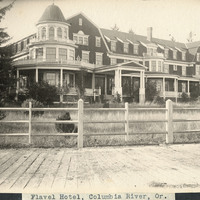
Caption: "Flavel Hotel, Columbia River, Or.," c. 1909. Built at the turn of the century, the Flavel Hotel housed passengers waiting to board steamships of the Great Northern Pacific Steamship Company bound for San Francisco and other ports. The Flavel family constructed the hotel as part of an effort to establish the town of Flavel on Tansy Point along the Columbia River. The town failed to attract sufficient residents, however, and was annexed into Warrenton by 1918. By the time this photograph was taken, the hotel appears to have been abandoned.
Date: 1909
-
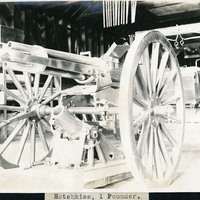
Caption: "Hotshkiss [sic], 1 pounder." The United States purchased artillery from the French arms firm, Hotchkiss, in the late 19th and early 20th centuries. The arms firm was created by American gunsmith, Benjamin B. Hotchkiss, who moved to France in 1867 to set up the factory. The heavy artillery was first used by the United States against the Nez Perce in 1877. In 1890, they were used at the Wounded Knee Massacre, and also for the attack on San Juan Hill during the Spanish-American War.
Date: Undated
-
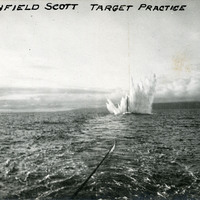
Caption: "Fort Winfield Scott Target Practice." This postcard shows a plume of seawater thrown up by a mortar shell during target practice at Fort Point. Fort Point was part of an effort by the U.S. government to protect the Golden Gate, entrance to the San Francisco Bay. Built between 1853-1861, the fort included emplacements for 141 guns but never fired a weapon in defense of the Bay. Its name was officially changed in 1882 to Fort Winfield Scott. This only lasted four years, however, for in 1886 the fort was officially downgraded to a sub-post of the San Francisco Presidio and the name discontinued. It was resurrected in 1912, with the establishment of a coastal artillery fortification at the Presidio, called, once again, Fort Winfield Scott. See also 96-07-08-alb08-029.
Date: 1909-10-25
-
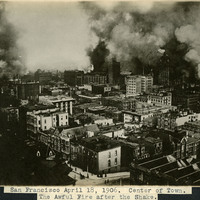
Caption: "San Francisco April 18, 1906. Center of Town. The Awful Fire after the Shake." Shows much smoke with buildings on fire in the center of the city, after the earthquake. Considered one of the worst natural disasters in the country's history, the 1906 San Francisco earthquake and resulting fires killed an estimated 3,000 people and destroyed over 500 city blocks, leaving approximately 200,000 residents homeless.
Date: 1906
-
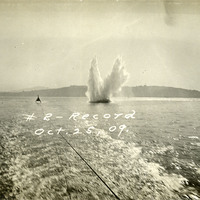
Caption: "#2 -- Record Oct 25, 09." This postcard shows plume of seawater thrown up by a mortar shell during target practice at Fort Point. The facilities at Fort Point were part of an effort by the U.S. government to protect the Golden Gate, entrance to the San Francisco Bay. Built between 1853-1861, the fort included emplacements for 141 guns but never fired a weapon in defense of the Bay. Its name was officially changed in 1882 to Fort Winfield Scott. This only lasted four years, however, for in 1886 the fort was officially downgraded to a sub-post of the San Francisco Presidio and the name discontinued. It was resurrected in 1912, however, with the establishment of a coastal artillery fortification at the Presidio, called, once again, Fort Winfield Scott.
Date: 1909-10-25
-
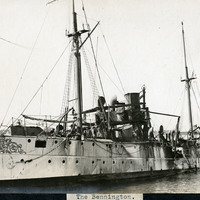
Caption: "The Bennington." View of the USS Bennington, a U.S. Navy gunboat, Yorktown class, launched in 1890. She had tours of duty in South America, the Mediterranean, North and Central America, Hawaii, and the Philippines. On July 21, 1905, while in San Diego Harbor, the Bennington's boiler exploded, killing sixty-six men and injuring many more. This photograph appears to have been taken after the explosion.
Date: 1905
-
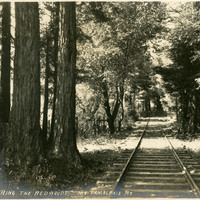
Caption: "Entering The Redwoods, Mt Tamalpais RR," c. 1907. A view of the Muir Woods Railway tracks, established in 1896 as a scenic tourist railway between Mill Valley and the east peak of Mount Tamalpais in Marin County.
Date: 1907