
Search All Items
- Filters:
- Language
- English 6457
- Spanish 23
- ENGLISH 2
- English 2
- census_013 1
- contra_costa_schedule_1_volume_1 1
- Type
- Image 3882
- Still Image 2094
- Text 445
- Text 54
- Textual 2
- Image of the California Census from the records of the office of the California Secretary of State 1
Search Results 5401 to 5410 of 6559
-
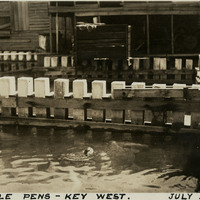
Caption: "Turtle Pens -- Key West. July 2, 1934." View of turtle kraals, or turtle corrals, used in the turtle fishing industry in Key West. Green turtles were kept in these pens prior to slaughter or transport. Turtle meat and eggs were popular food items in the early-to-mid twentieth century; turtle fat was especially prized for making turtle soup. However, the turtle population plummeted in the Florida Keys and surrounding areas as the twentieth century progressed and demand increased. The turtle kraals and nearby canneries closed when the Endangered Species Act was passed in 1971. Populations have since started to recover. The cannery near the kraals shown in this photograph now serves as the Key West Turtle Museum.
Date: 7/2/1934
-
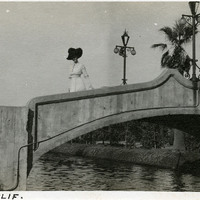
Caption: "Venice, Calif," c. 1911. Unidentified woman standing on a bridge over Lion Canal in Venice, California. In 1905, Abbot Kinney built a series of canals as part of a development project along Santa Monica Beach, hoping to recreate the look and feel of Italy's iconic "Floating City" in southern California. Called Ocean Park at first, gondoliers sailed boats under elegant bridges such as the one shown in this photograph, in an effort to attract businesses, residents, and investors. In 1911, the name officially changed to Venice. By 1929, however, many of the canals had been filled in to create roadways, and those canals that remained fell into disrepair. A revitalization movement in the early 1990s has restored some of the canals, and made the area a desirable residential neighborhood.
Date: 1911
-
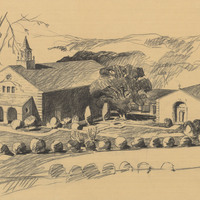
Design and drawing of Assembly Hall and Chapel, Preston School of Industry, by Alfred Eichler. Built. Project for California Youth Authority - Institutions.
Date: 1940
-
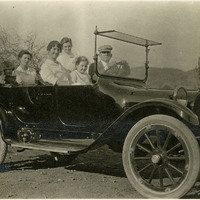
No caption, c. 1915. William (driver's seat) and Grace (front passenger seat) McCarthy posing in an automobile with a group of unidentified friends and/or family members.
Date: 1915
-
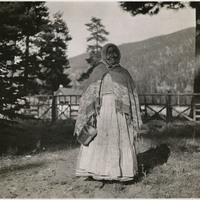
No Caption: An unidentified California Indian woman wearing a long skirt and shawl, and carrying a small pail at Yosemite National Park, c. 1935.
Date: 1935
-
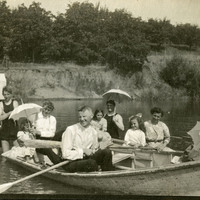
No caption, c. 1909. William McCarthy (second from the left) and a group of unidentified family and friends boating on a river or lake.
Date: 1909
-
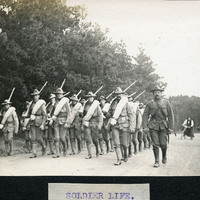
Caption: "Solider Life," c. 1910. A view of a group of soldiers, carrying long guns and supplies, and marching in formation at an unidentified location.
Date: 1910
-
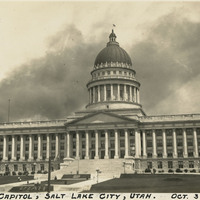
Caption: "State Capitol, Salt Lake City, Utah. Oct. 3, 1934." View of Utah's State Capitol Building, designed by Richard K.A. Kletting and built between 1912 and 1916.
Date: 10/3/1934
-
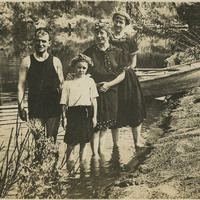
No Caption: William McCarthy (left) and Grace (far right), enjoying summertime at the Russian River with unidentified woman and child, c. 1915.
Date: 1915
-
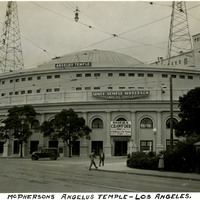
Caption: "Aimee McPherson's Angeles Temple- Los Angeles," c. 1935. Aimee Semple McPherson, also known as Sister Aimee was a Canadian-American Pentecostal evangelist and media celebrity in the 1920s and 1930s, famous for her theatrical sermons and claims of healing the sick, and for founding the Foursquare Church.
Date: 1935