
Search All Items
- Filters:
- Type
- Image 3871
- Still Image 1541
- Text 433
- Text 19
- Image of the California Census from the records of the office of the California Secretary of State 1
- Language
- English 5808
- Spanish 62
- ENGLISH 2
- English 1
- census_013 1
- contra_costa_schedule_1_volume_1 1
Search Results 5451 to 5460 of 5932
-
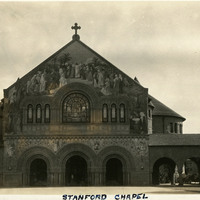
*Caption: "Stanford Chapel," c. 1920. Façade of Stanford Memorial Chapel, designed by Charles A. Coolidge and dedicated in 1903. The church was commissioned by Jane Stanford as a memorial to her husband and the University's founder, Leland Stanford. See also 96-07-08-alb04-215.
Date: 1920
-
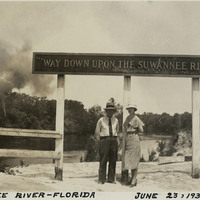
Caption: "Suwannee River -- Florida, June 23, 1934." William and Grace McCarthy posing beneath a sign reading "'Way Down Upon The Suwannee River', Stephen Foster," referring to the minstrel song written by Foster in 1851. The Suwannee River flows by in the background.
Date: 6/23/1934
-
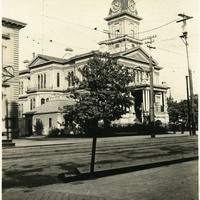
Caption: "Oakland City Hall," Oakland, California, c. 1910. Completed in 1879, the building was Oakland's second city hall and served until it was demolished in 1914 to create City Hall Plaza in front of the new City Hall that had been completed that year.
Date: 1910
-
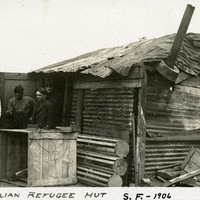
Caption: "Italian Refugee Hut S.F. -- 1906." Makeshift hut with four unidentified men standing in doorway. After the earthquake and fire that destroyed much of San Francisco in April 1906, hundreds of thousands of people were left homeless. Many of these people established temporary refugee camps, using debris from the destruction to cobble together shelters.
Date: 1906
-
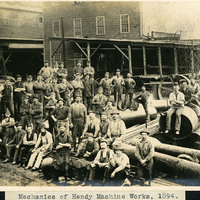
Caption: "Mechanics of Hendy Machine Works, 1894." The Joshua Hendy Machine Works operated in San Francisco until the facilities were destroyed by the 1906 earthquake. The company relocated to Sunnyvale, California, after the local government there enticed them with free land. William McCarthy can be seen standing (sixth from left) in the second from back row.
Date: 1894
-
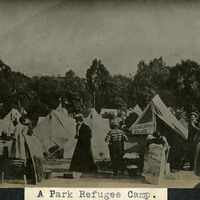
Caption: "A Park Refugee Camp," c. 1906. After the earthquake and fire that destroyed much of San Francisco in April 1906, hundreds of thousands of people were left homeless. Many of these people established temporary refugee camps, using tents or debris from the destruction to cobble together shelters.
Date: 1906
-
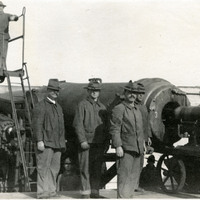
No Caption: c. 1908-1912. Group of men posing around a 12-inch disappearing gun. Retracting or disappearing guns were a form of artillery developed in the nineteenth century in which heavy artillery guns were placed on rotating carriages that allowed retraction of the weapon after firing, to enable reloading while under enemy fire. Such guns were often used in coastal fortifications.
Date: 1908
-
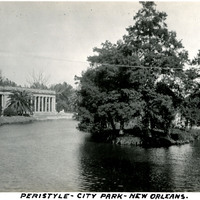
Caption: "Peristyle - City Park- New Orleans," c. 1925. The Neoclassical open air pavilion seen at the left side of this photograph was built in New Orleans' City Park in 1907 to host parties, dances and weddings. It was designed by architect Paul Andry.
Date: 1925
-
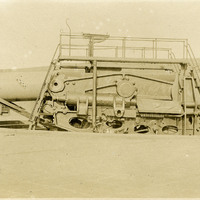
No Caption: c. 1908-1912. Side view of a disappearing coastal artillery gun. Retracting or disappearing guns were a form of artillery developed in the nineteenth century in which heavy artillery guns were placed on rotating carriages that allowed retraction of the weapon after firing, to enable reloading while under enemy fire.
Date: 1908
-
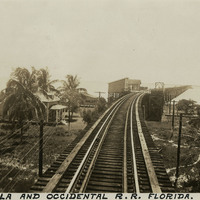
Caption: "Peninsula and Occidental R.R. Florida. July 2, 34." View of railroad tracks carried over water into the distance on a wood trestle. This is likely part of the Overseas Railroad, an extension of the Florida East Coast Railway, built to connect Key West with the Florida mainland.
Date: 7/2/1934