
Search All Items
Search Results 531 to 540 of 5365
-
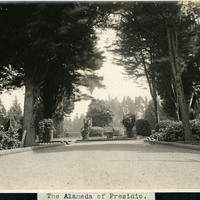
Caption: "The Alameda of Presidio," c. 1906. View of a dirt or graveled drive, lined by cannonballs, leading to a small roundabout. The Alameda served as the principle gateway into the Presidio of San Francisco from the 1860s to 1895.
Date: 1906
-
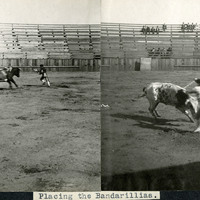
Caption: "Placing the Bandarillias [sic]." Two images pasted into the photograph album next to each other, both showing bulls in a bullring. In both photographs, banderilleros are attempting to place banderillas (short barbed sticks) in each bull's shoulders.
Date: 1905
-
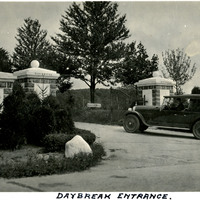
Caption: "Daybreak Entrance." A man pauses for a quick photo sitting in his car at the entrance to a private road leading to the Daybreak Estate area of Long Island.
Date: 1934
-
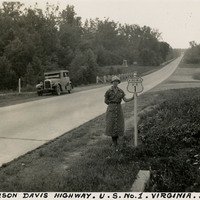
Caption: "Jefferson Davis Highway. U.S. No. 1. Virginia. July 20, 34." Grace McCarthy is standing next to a U.S. Route 1 sign along a highway in Virginia. The Jefferson Davis Highway project was begun by the United Daughters of the Confederacy (UDC). As auto tourism increased across the U.S., so to did the need for roads on which to drive. Private interests such as the UDC began to develop routes across the country, but with no central administrating organization the routes were haphazard and confusing. The UDC planned a route that was to stretch from Virginia across the southern U.S. to San Diego, but the entire route never materialized. The federal government stepped in to impose a numbering system on various routes across the nation. That portion of the planned Jefferson Davis Highway through Virginia was numbered as U.S. Route 1.
Date: 7/20/1934
-
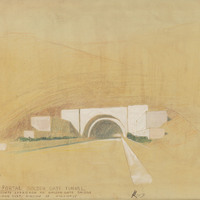
Caption: "South Portal Golden Gate Tunnel. Marin County approach to Golden Gate Bridge." Design and drawing by Alfred Eichler. Built. Project for Department of Public Works - Highways - Bridge Department.
Date: 1938
-
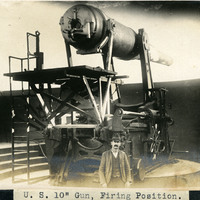
Caption: "U. S. 10" Gun, Firing Position.," c. 1905. William McCarthy standing next to a 10" disappearing gun, raised to its firing position. Retracting or disappearing guns were a form of artillery developed in the nineteenth century in which heavy artillery guns were placed on rotating carriages that allowed retraction of the weapon after firing, to enable reloading while under enemy fire.
Date: 1905
-
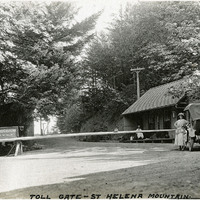
Caption: "Toll Gate -- St Helena Mountain.," c. 1920. Toll gate consists of a long wooden spar across the road, with a small building to the right. Grace McCarthy is standing next to an automobile at the gate. The St. Helena Toll Road, now part of California State Route 29, connected the Napa Valley with Lake County. It was built in 1868, and purchased by the State of California in 1925.
Date: 1920
-
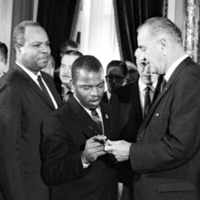
This item has no description.
Date: 1965
-
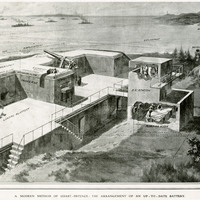
No Caption: Photograph of part of a print from the Illustrated London News, titled "A Modern Method of Coast Defense: The Arrangement of an Up-To-Date Battery." See also 96-07-08-alb05-094.
Date: 1910-09-03
-
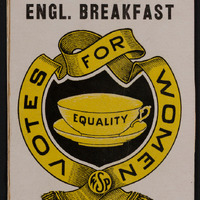
The trademark is one of many from the Trademark Series within the Secretary of State’s Records at the California State Archives. California created the nation’s first trademark law in 1861. According to the law, companies had to apply to trademark their brands through the California Secretary of State’s Office. This trademark for “Equality Brand Tea” depicts a drawing of a ribbon with “Votes for Women” emblazoned on it, surrounding a teacup labeled “Equality.” Packed for the Woman’s Suffrage Party of California, the trademark was a marketing tactic used by the organization to promote and raise money for their cause. George W. Caswell, the tea’s distributor and a well-known coffee and tea merchant in San Francisco, officially filed the trademark on June 22, 1911. However, in keeping with the practice of actively using trademarks in commerce prior to filing, Caswell began distributing the tea in support of the Women’s Suffrage Party beginning in 1910. The proceeds from the sale of Caswell’s tea provided crucial funding during the 1911 campaign for women’s suffrage in California.
Date: June 22, 1911