
Search All Items
- Filters:
- Language
- English 6457
- Spanish 23
- ENGLISH 2
- English 2
- census_013 1
- contra_costa_schedule_1_volume_1 1
- Type
- Image 3882
- Still Image 2094
- Text 445
- Text 54
- Textual 2
- Image of the California Census from the records of the office of the California Secretary of State 1
Search Results 5501 to 5510 of 6559
-
No caption, c. 1920. Shows large unidentified building with terraced gardens and a flag pole.
Date: 1920
-
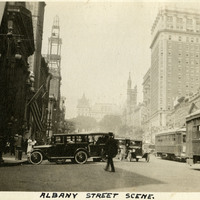
Caption: "Albany Street Scene," c. 1925. A street in Albany, lined with cars and trollies.
Date: 1925
-
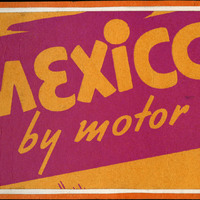
No Caption: A "Mexico by Motor" decal, c. 1938, rectangular, in yellow and purple.
Date: 1938
-
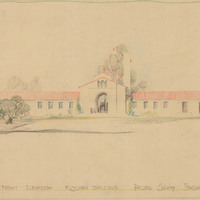
Caption: "Front Elevation - Kitchen Building - Pacific Colony, Pomona." Design and drawing of kitchen building, Pacific State Hospital, by Alfred Eichler. Built. Project for Department of Mental Hygiene - Hospitals. The hospital was initially named Pacific Colony (1927-1953), followed by Pacific State Hospital (1953-1979); Frank D. Lanterman State Hospital and Developmental Center; and finally Lanterman Developmental Center, which closed in 2015.
Date: 1925
-
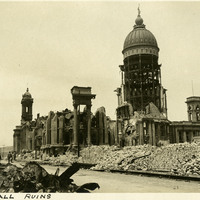
Caption: "City Hall Ruins," shows the gutted San Francisco City Hall after the 1906 earthquake and fires. Considered one of the worst natural disasters in the country's history, the 1906 San Francisco earthquake and resulting fires killed an estimated 3,000 people and destroyed over 500 city blocks, leaving approximately 200,000 residents homeless.
Date: 1906
-
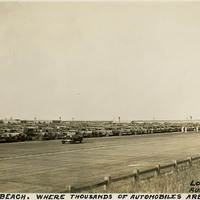
Caption: "Jones's [sic] Beach. Where Thousands of Automobiles are Parked. Long Island, N.Y. Aug. 17, 1934." Photograph of a large parking area full of automobiles on Jones Beach Island. The Long Island State Park Commission began to develop the area for a park in the 1920s, dredging enough sand to connect several of the barrier islands south of Long Island and raising the elevation of the islands by fourteen feet to create one large park. It opened to the public in 1929. It is now a state park, with an estimated six million visitors each year.
Date: 8/17/1934
-
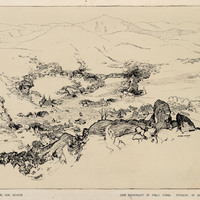
Caption: "California Institution for Women. State Department of Public Works, Division of Architecture, Sacramento." Preliminary drawing of new women's prison in Tehachapi. Design and drawing in pen and ink by Alfred Eichler. Project for Department of Corrections.
Date: 1930
-
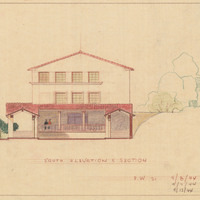
Caption: "South Elevation and Section." Color drawing of postwar building, California School for the Deaf at Berkeley. Design and drawing by Alfred Eichler, 1944; built in 1946. Project for Department of Education.
Date: 1944
-
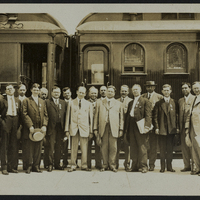
The Progressive Movement transformed California politics in the early twentieth century by promoting government reform, greater public participation, and limits on the influence of powerful corporations and political machines. Women’s suffrage became part of this broader reform agenda. Governor Hiram Johnson (1866–1945) served as California’s 23rd governor from 1911 to 1917 and was a leading figure in the Progressive Movement. Johnson became tied to the suffrage cause through the 1910 California Republican platform, which endorsed women’s right to vote as part of a larger slate of progressive reforms. Motivated by Johnson’s promise to support their political rights, women in California quickly mobilized for him in his bid for governor, organizing grassroots efforts in support of his campaign in multiple counties. As the new governor, he insisted that the Legislature honor his pledge by submitting a women’s suffrage amendment before the Senate on January 6, 1911, only 3 days after he took office.
Date: 1912
-
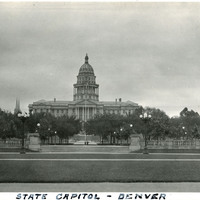
Caption: "State Capitol - Denver," c. 1923. The Colorado State Capitol in Denver is a Neoclassical building built from Colorado rose onyx, a stone so rare that all known reserves were used in the capitol's construction. Designed by Elijah E. Myers, it was first occupied in 1894.
Date: 1923