
Search All Items
- Filters:
- Language
- English 5811
- Spanish 37
- ENGLISH 2
- English 2
- census_013 1
- contra_costa_schedule_1_volume_1 1
- Type
- Image 3877
- Still Image 1473
- Text 439
- Text 54
- Textual 2
- Image of the California Census from the records of the office of the California Secretary of State 1
Search Results 5531 to 5540 of 5921
-
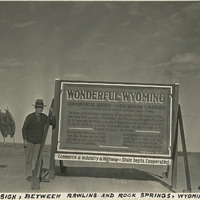
Caption: "State Sign, Between Rawlins and Rock Springs, Wyoming. Oct. 1, 1934." William McCarthy standing next to an informational road sign in Wyoming, noting the location as being along the U.S.'s primary Continental Divide.
Date: 10/1/1934
-
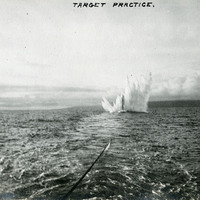
Caption: "Target Practice," c. 1908. This postcard shows a plume of seawater thrown up by a mortar shell during target practice at Fort Point. The facilities at Fort Point were part of an effort by the U.S. government to protect the Golden Gate, entrance to the San Francisco Bay. Built between 1853-1861, the fort included emplacements for 141 guns but never fired a weapon in defense of the Bay. Its name was officially changed in 1882 to Fort Winfield Scott, but in 1886 the fort was officially downgraded to a sub-post of the San Francisco Presidio and the name discontinued. It was resurrected in 1912, with the establishment of a coastal artillery fortification at the Presidio, called, once again, Fort Winfield Scott. See also 96-07-08-alb05-322.
Date: 1908
-
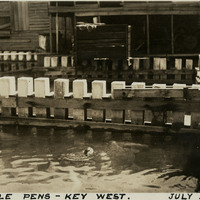
Caption: "Turtle Pens -- Key West. July 2, 1934." View of turtle kraals, or turtle corrals, used in the turtle fishing industry in Key West. Green turtles were kept in these pens prior to slaughter or transport. Turtle meat and eggs were popular food items in the early-to-mid twentieth century; turtle fat was especially prized for making turtle soup. However, the turtle population plummeted in the Florida Keys and surrounding areas as the twentieth century progressed and demand increased. The turtle kraals and nearby canneries closed when the Endangered Species Act was passed in 1971. Populations have since started to recover. The cannery near the kraals shown in this photograph now serves as the Key West Turtle Museum.
Date: 7/2/1934
-
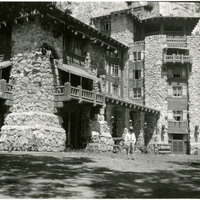
No caption. William McCarthy stands in front of the Ahwahnee Hotel in Yosemite National Park, c. 1935. Opened in 1927 and designed by architect Gilbert Stanley Underwood, the Ahwahnee Hotel is located on the floor of Yosemite Valley. It was built as a resort hotel by the Yosemite Park and Curry Company. Modernized over the years, its name was changed to the Majestic Yosemite Hotel in 2016, as a result of legal dispute over trademarked names in the park.
Date: 1935
-
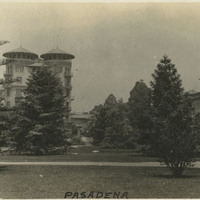
Caption: "Pasadena," c. 1915, shows the Hotel Green, built by George Gill Green in 1893, and expanded by him in 1898 and 1903 with two additional structures. The hotel complex was sold to private investors and by 1924, the 1898 Central Annex structure (Frederick L. Roehrig, architect) was turned into apartments and renamed the Castle Green. It is listed on the National Register of Historic Places, the California Register of Historic Places, and the City of Pasadena's list of historic places.
Date: 1915
-
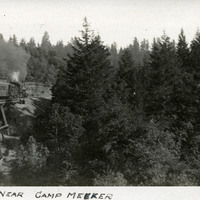
Caption: "Scenery Near Camp Meeker," c. 1906. Train crossing trestle at left side of photograph, with trees and other vegetation occupying most of the photograph's area. Camp Meeker, in Sonoma County north of San Francisco, is in the California Coast Ranges. Established by lumber baron Melvin Cyrus Meeker in 1866, by the turn of the twentieth century the area primarily served as a vacation and resort destination.
Date: 1906
-
No Caption: See also 96-07-08-alb03-065 with caption: "Fort Casey Lighthouse, Washington," c. 1910. Fort Casey was part of the "triangle of fire," three coastal defense fortifications (Fort Casey, Fort Worden, and Fort Flagler) guarding the entrance to Puget Sound. Construction began on the fort in 1897, and the U.S. Army used the facility until the 1950s, when the fort was decommissioned. The area is now a state park.
Date: 1910