
Search All Items
- Filters:
- Language
- English 6219
- Spanish 19
- ENGLISH 2
- English 1
- contra_costa_schedule_1_volume_1 1
- Type
- Image 3871
- Still Image 1869
- Text 440
- Text 54
- Textual 2
- Image of the California Census from the records of the office of the California Secretary of State 1
Search Results 5561 to 5570 of 6312
-
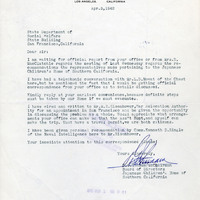
Correspondence from T. G. Ishimaru to State Department of Social Welfare in response to recommendations for children's institutions
Date: April 5, 1942
-
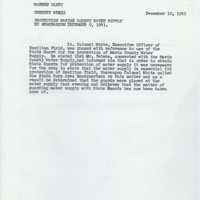
Memorandum from Herbert Wenig regarding fear of sabotage of water supply
Date: December 10, 1942
-
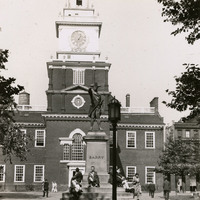
Caption: "Independence Hall -- Phila. July 31, 1934." A view of the steeple and bell tower of Independence Hall in Philadelphia, site of the debate over and signing of both the Declaration of Independence and the U.S. Constitution. Completed in 1753 for the use of the Pennsylvania Province's colonial legislature, it was also the site of a 1915 convention marking the formation of the League to Enforce Peace, predecessor entity to the United Nations. The Georgian-style building, designed by Edmund Woolley and Andrew Hamilton, has undergone several renovations. Only the central portion of the building is original -- all other portions of the building have been rebuilt at some point in its past. This building also housed the Liberty Bell until 1976, when the bell was moved to the Liberty Bell Center across the street.
Date: 7/31/1934
-
Correspondence from Donna Planz to Merle Leedy regarding statistics on applications for aid
Date: April 3, 1942