
Search All Items
- Filters:
- Type
- Image 3872
- Still Image 1847
- Text 428
- Text 50
- Image of the California Census from the records of the office of the California Secretary of State 1
- Language
- English 6191
- Spanish 11
- ENGLISH 2
- English 2
- census_013 1
- contra_costa_schedule_1_volume_1 1
Search Results 5561 to 5570 of 6265
-
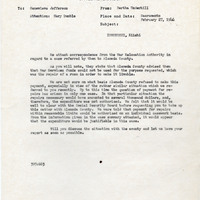
Office Memorandum from Bertha S. Underhill to Genevieve Jefferson regarding payment for repairs to home
Date: February 27, 1946
-
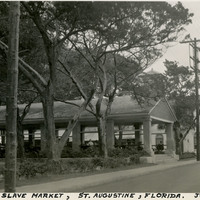
Caption: "Spanish Slave Market, St. Augustine, Florida. July 10, 1934." An open-air pavilion with a gabled roof and six bays appears in the center of this photograph, somewhat obscured by surrounding trees and vegetation. The waterfront site on which the pavilion sits has served St. Augustine as a marketplace since the city's founding in the sixteenth century, for food, commercial goods, and for slaves. The pavilion in the photograph was constructed in 1888, after a fire burned down the previous structure. In the twentieth century, entrepreneurs used the slave market aspect of the site's history as a hook to entice northern tourists into St. Augustine's historic quarter. The market has often served as a rallying site for protestors, from suffragettes to protestors of the war in Iraq. Various civil rights marches held around the market in the 1960s attracted such luminaries as Dr. Martin Luther King, Jr. and Andrew Young.
Date: 7/10/1934
-
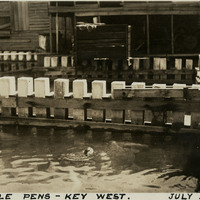
Caption: "Turtle Pens -- Key West. July 2, 1934." View of turtle kraals, or turtle corrals, used in the turtle fishing industry in Key West. Green turtles were kept in these pens prior to slaughter or transport. Turtle meat and eggs were popular food items in the early-to-mid twentieth century; turtle fat was especially prized for making turtle soup. However, the turtle population plummeted in the Florida Keys and surrounding areas as the twentieth century progressed and demand increased. The turtle kraals and nearby canneries closed when the Endangered Species Act was passed in 1971. Populations have since started to recover. The cannery near the kraals shown in this photograph now serves as the Key West Turtle Museum.
Date: 7/2/1934
-
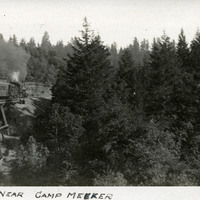
Caption: "Scenery Near Camp Meeker," c. 1906. Train crossing trestle at left side of photograph, with trees and other vegetation occupying most of the photograph's area. Camp Meeker, in Sonoma County north of San Francisco, is in the California Coast Ranges. Established by lumber baron Melvin Cyrus Meeker in 1866, by the turn of the twentieth century the area primarily served as a vacation and resort destination.
Date: 1906
-
No Caption: See also 96-07-08-alb03-065 with caption: "Fort Casey Lighthouse, Washington," c. 1910. Fort Casey was part of the "triangle of fire," three coastal defense fortifications (Fort Casey, Fort Worden, and Fort Flagler) guarding the entrance to Puget Sound. Construction began on the fort in 1897, and the U.S. Army used the facility until the 1950s, when the fort was decommissioned. The area is now a state park.
Date: 1910