Search All Items
- Filters:
- Language
- English 6853
- Spanish 18
- ENGLISH 3
- English 2
- census_013 1
- contra_costa_schedule_1_volume_1 1
- Type
- Image 3886
- Still Image 2484
- Text 441
- Text 54
- Textual 2
- Image of the California Census from the records of the office of the California Secretary of State 1
Search Results 541 to 550 of 6969
-
Correspondence from Martha A. Chickering to J. P. Hofman regarding rumors of efforts to disenfranchise Japanese-Americans; see Correspondence on Exclusionary Actions (F3729_50_001b)
Date: May 29, 1942
-
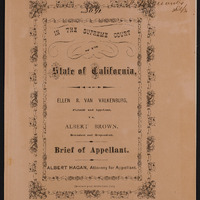
A Brief of Appellant is filed in the appellate court by the party who lost in the previous trial and argues in favor of appealing a lower court’s decision. Ellen Van Valkenburg began an important legal battle for women’s enfranchisement in California on July 21, 1871, when she requested that Santa Cruz County Clerk Albert Brown enter her name in the Great Register of voters. After Brown (a willing accomplice in helping her bring the case to court) refused to register her, Van Valkenburg and her lawyer, Santa Cruz Judge Albert Hagan, began legal proceedings by requesting a writ of mandamus, a judicial remedy used to compel agencies to perform ministerial acts, such as registering voters. Van Valkenburg and Hagan argued her case by citing the 14th Amendment of the U.S. Constitution. The new amendment, ratified 3 years earlier in 1868, defined all persons born or naturalized in the U.S. as citizens protected by civil rights. Van Valkenburg and Hagan asserted that American women were considered citizens under this amendment, and that citizenship automatically granted absolute rights, including the right to vote. The case first went to California’s Third District Court. Many of America’s most prominent suffragists, including Elizabeth Cady Stanton and Susan B. Anthony, were with Van Valkenburg in Santa Cruz when the lower court ruled against her on August 16, 1871. Van Valkenburg and Hagan swiftly appealed this decision through the Supreme Court of California. In the end, the Supreme Court of California upheld the lower court’s verdict under the reasoning that as a white American woman, Van Valkenburg already had citizenship and civil rights prior to the passage of the 14th amendment, and that the 14th amendment did not provide her with any additional political rights, such as the right to vote. While Van Valkenburg lost her case, and subsequent lawsuits failed to secure women's suffrage nationwide, the case stands as a critical early example of legal advocacy for women's political rights in California.
Date: September 29, 1871
-
Caption: "In the Siskiyou Mountains, Calif.," c. 1910. View of a train trestle, with the last car of a train passing over it.
Date: 1910
-
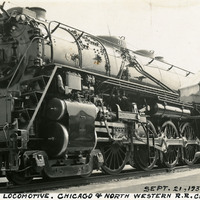
Caption: "Modern Locomotive. Chicago & North Western R.R. Chicago Fair, Sept. 21, 1934." Grace McCarthy is seated next to a large locomotive of the Chicago and North Western Railroad while visiting the Century of Progress Exposition in Chicago. The locomotive was one of the new Class H 4-8-4 engines, capable of pulling either freight or passenger trains. These locomotives were among the heaviest of their class produced in America, and were dubbed the "Zeppelins of the Rails." This photograph was loose in the box with Album 11.
Date: 9/21/1934
-
Caption: "Arch, Court of the Universe, Western," at the Panama-Pacific International Exposition. See also 96-07-08-alb01-038.
Date: 1915
-
Caption: "In the Court of Palms," at the Panama-Pacific International Exposition. See also 96-07-08-alb01-051.
Date: 1915