
Search All Items
- Filters:
- Type
- Image 3872
- Still Image 1847
- Text 428
- Text 50
- Image of the California Census from the records of the office of the California Secretary of State 1
- Language
- English 6191
- Spanish 11
- ENGLISH 2
- English 2
- census_013 1
- contra_costa_schedule_1_volume_1 1
Search Results 5621 to 5630 of 6265
-
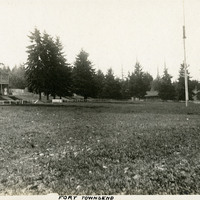
Caption: "Fort Townsend," c. 1906. Park-like scene, with buildings in the distance and a flag pole at the right. The U.S. Army established Fort Townsend in 1856. Abandoned after a fire destroyed the barracks buildings in 1895, it was reactivated during World War II to serve as a munitions defusing station. It was turned over to the State of Washington in 1953, and is now in use as Fort Townsend State Park.
Date: 1906
-
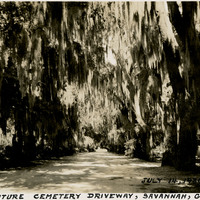
Caption: "Bonaventure Cemetery Driveway, Savannah, Georgia, July 14, 1934." Road stretching into the distance, flanked by trees dripping with Spanish moss. The Bonaventure Cemetery in Savannah originated in a private cemetery on a plantation. The plantation was sold in 1846. Major William H. Wiltberger, son of the new owner, formed the Evergreen Cemetery Company in 1868. The City of Savannah purchased the company and cemetery in 1907, and changed its name to Bonaventure Cemetery.
Date: 7/14/1934
-
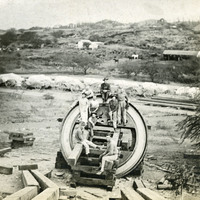
No caption, c. 1909-1915. Group of unidentified men gathered around a part of what appears to be a 12-inch mortar at Fort Ruger, Hawaii. Farm buildings and rolling hills appear in the distance. Fort Ruger was established on the Island of O'ahu by the U.S. in 1906 as the Diamond Head Reservation. Its name was changed to Fort Ruger in 1909. See also 96-07-08-alb05-098 and 099.
Date: 1915
-
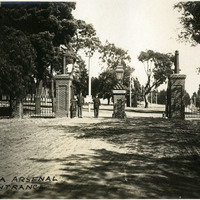
Caption: "Benicia Arsenal Entrance," c. 1905, Benicia, California. William McCarthy began his career as an inspector of armaments for the U.S. War Department at the Benicia Arsenal in 1903. The arsenal was established in 1851 as the first Ordnance Supply Depot in the West, from which it supplied and supported U.S. troops, from the Civil War through WWII and the Korean War. It was deactivated in 1963.
Date: 1905
-
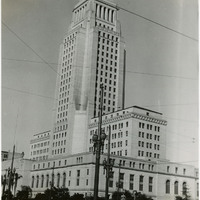
Caption: "City Hall, Los Angeles, Population of Los Angeles 1, 360,000," The iconic Los Angeles City Hall building, completed in 1928, still houses the offices of the mayor and city council. Defined as "Modern American" by one of the architects who worked on the original building, the landmark was restored to its original grandeur and seismically stabilized in 2001. See also 96-07-08-alb11-005, dated May 18, 1934.
Date: 1934
-
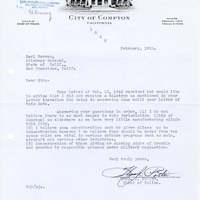
Correspondence from Thos. J. Potter to Earl Warren regarding views on law enforcement problems involving enemy aliens
Date: February 19, 1942
-
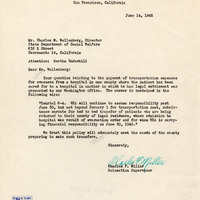
Correspondence from Charles F. Miller to Charles M. Wollenberg regarding transportation expenses for evacuees needing hospital care
Date: June 14, 1945
-
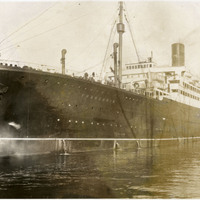
No caption, c. 1925. View of the RMS Franconia, an ocean liner operated by the Cunard Line. She launched in October 1922, operating on the route between Liverpool and New York in the summers, and as a world cruise ship in the winters. The Franconia was requisitioned as a troop ship during World War II, then returned to the Cunard Line until being retired in 1956.
Date: 1925