
Search All Items
- Filters:
- Language
- English 7210
- Spanish 43
- ENGLISH 3
- English 2
- census_013 1
- contra_costa_schedule_1_volume_1 1
- Type
- Image 3888
- Still Image 2860
- Text 445
- Text 54
- Textual 2
- Image of the California Census from the records of the office of the California Secretary of State 1
Search Results 5691 to 5700 of 7358
-
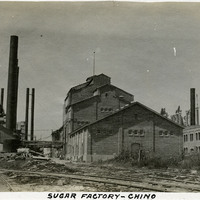
Caption: "Sugar Factory -- Chino," c. 1915. View of Chino's sugar beet factory, established in 1891 by Robert and Henry Oxnard. Henry later established a larger factory in the town that now bears his name (Oxnard, in Ventura County). The factory operated for more than twenty-five years before closing in October 1917.
Date: 1915
-
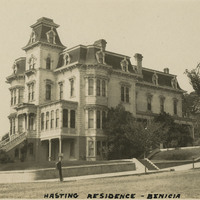
Caption: "Hasting [sic] Residence - Benicia," c. 1915, was a grand home built for Daniel N. Hastings, a prominent landowner. The home, completed in 1881 at the tremendous cost of $350,000, including furnishings, was called "Hastings' folly," because it nearly bankrupted its owner. It was dismantled in 1937.
Date: 1915
-
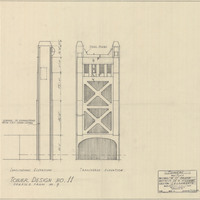
Caption: "Tower Design No. 11. Adapted from No. 9." Design drawing of M Street Bridge tower by Alfred Eichler. The Tower Bridge replaced the M Street Bridge, which was removed in 1935. Project for Department of Public Works - Highways - Bridge Department.
Date: 1934
-
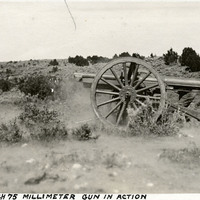
Caption: "French 75 Millimeter Gun In Action," c. 1912-1915. Commonly called the French 75, or simply the 75, this heavy, rapid-fire artillery gun was developed in 1897. During World War I it was adapted to fire shells full of toxic gas, and was also modified for mounting on an armored vehicle. See also 96-07-08-alb05-060.
Date: 1915
-
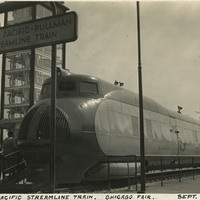
Caption: "Union Pacific Streamline Train. Chicago Fair. Sept. 22, 1934." View of the engine on the Union Pacific's new M-10000, on exhibit at Chicago's Century of Progress Exposition. The M-10000 was the first lightweight express passenger train powered by an internal combustion engine in the U.S. The train went on an exhibition tour of the US in 1934, which included a stop at the Exposition. The Exposition, a world fair attended by thirty-nine million people, celebrated Chicago's one-hundred year anniversary of incorporation. Originally planned to only run from May to November in 1933, it was such a success that its organizers decided to keep it running for a second season from May through October the following year. The central theme of the Exposition was technological innovation, with a motto of "Science Finds, Industry Applies, Man Conforms."
Date: 9/22/1934
-
Caption: "San Diego Fair Grounds." and "39-9, U.S. Naval Training Station, Balboa Park, San Diego," c. 1917. With the advent of World War I, the U.S. Navy needed additional training grounds for sailors. In 1917, the City of San Diego offered to lease the Navy a portion of Balboa Park as a temporary training site until a new, more permanent facility could be constructed. This postcard shows groups of sailors drilling in formation while a small crowd watches.
Date: 1917
-
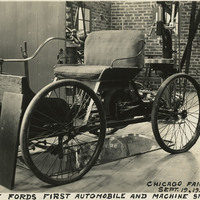
Caption: "Henry Ford's First Automobile and Machine Shop, Chicago Fair Exhibit. Sept. 19, 1934." This exhibit within the Ford Building at Chicago's Century of Progress Exposition replicated Henry Ford's original workshop, including a Quadricycle, the first automobile produced by Ford. The Exposition, a world fair attended by thirty-nine million people, celebrated Chicago's one-hundred year anniversary of incorporation. Originally planned to only run from May to November in 1933, it was such a success that its organizers decided to keep it running for a second season from May through October the following year. The central theme of the Exposition was technological innovation, with a motto of "Science Finds, Industry Applies, Man Conforms."
Date: 9/19/1934
-
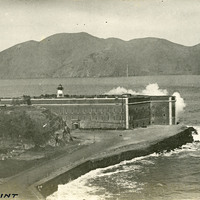
Caption: "Fort Point," c. 1910. This postcard shows a view of Fort Point, at the entrance to San Francisco Bay. The facilities at Fort Point were part of an effort by the U.S. government to protect the Golden Gate, entrance to the San Francisco Bay. Built between 1853-1861, the fort included emplacements for 141 guns but never fired a weapon in defense of the Bay. Its name was officially changed in 1882 to Fort Winfield Scott, but in 1886 the fort was officially downgraded to a sub-post of the San Francisco Presidio and the name discontinued. It was resurrected in 1912, with the establishment of a coastal artillery fortification at the Presidio, called, once again, Fort Winfield Scott.
Date: 1910