
Search All Items
- Filters:
- Language
- English 6457
- Spanish 23
- ENGLISH 2
- English 2
- census_013 1
- contra_costa_schedule_1_volume_1 1
- Type
- Image 3882
- Still Image 2094
- Text 445
- Text 54
- Textual 2
- Image of the California Census from the records of the office of the California Secretary of State 1
Search Results 5701 to 5710 of 6559
-
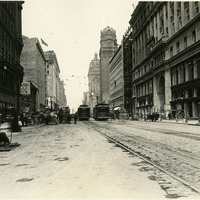
No Caption: A view of the reconstruction on Market Street after the 1906 earthquake and fires, c. 1907.
Date: 1907
-
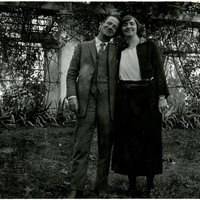
No caption. William McCarthy and an unidentified woman pose in front of a landscaped area with an arbor, c. 1925.
Date: 1925
-
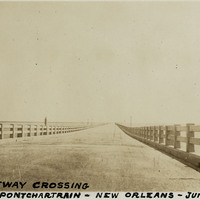
Caption: "Causeway Crossing Lake Pontchartrain -- New Orleans -- June 19, 34." The concrete deck of the Maestri Bridge (also called the Pontchartrain Bridge, the Five Mile Bridge, or the Watson-Williams Pontchartrain Bridge) stretches into the distance over Lake Pontchartrain in this photograph. Built in 1928 as the first permanent crossing of Lake Pontchartrain, it was also the longest concrete bridge in the world at the time of its construction. The bridge, almost five miles long, spans the lake between New Orleans and Slidell, Louisiana.
Date: 6/17/1934
-
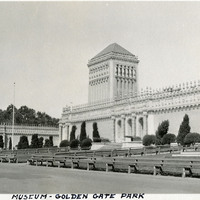
Caption: "Museum -- Golden Gate Park," c. 1922. The Memorial Museum in Golden Gate Park, designed by Louis Christian Mulgardt in the Spanish-Plateresque style, was built in 1919. Michael H. de Young, co-founder of the San Francisco Chronicle, added the central tower in 1921. The museum's name was later changed to honor de Young, becoming the M. H. de Young Memorial Museum (now commonly known as the de Young Museum). This building has since been replaced with a more modern facility.
Date: 1922
-
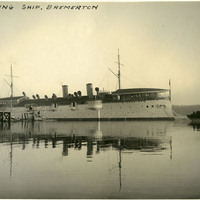
Caption: "Training Ship. Bremerton," Washington, c. 1908 - 1912. See also 96-07-08-alb08-086. View of the USS Philadelphia (C-4). The fourth ship to bear the name, the Philadelphia first launched in September 1889. She sailed as part of the U.S. Navy's Atlantic Squadron until 1893. She then sailed into the Pacific Ocean, where she served until being decommissioned and docked in Puget Sound in 1902. In 1904, the Navy "housed over" the ship (adding the roofed quarters visible on the upper deck in the photograph) and designated her a receiving ship for new sailors not yet assigned to a crew. The Philadelphia served in this capacity until 1912. After a brief stint as a prison ship, the Philadelphia again became a receiving ship in 1916. The Navy sold her in 1927.
Date: 1908
-
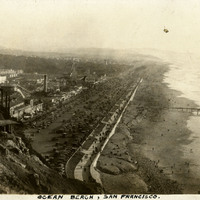
Caption: "Ocean Beach, San Francisco," c. 1925. Panorama of Ocean Beach, showing crowds not only at the beach but also at San Francisco's Playland, a series of seaside attractions and rides including a carousel, Fun House, and the Big Dipper rollercoaster. Entrepreneurs began erecting concessions and "thrill" rides at the location in the late nineteenth century. By 1913 the area was known as Chutes at the Beach. In 1923, brothers George and Leo Whitney began to purchase the attractions, eventually coming to own the entirety of what became known as Playland. The amusement park was torn down in 1972.
Date: 1925
-
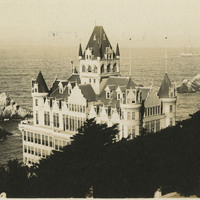
Caption: "Cliff House #2." View of the third Cliff House, of Victorian-style architecture, that was built on that site in San Francisco, c. 1906. The original Cliff House was built in 1858. The second was built in 1863 and was destroyed by fire on Christmas day in 1894. The third Victorian- style Cliff House (pictured) was completed in 1896, and although it survived the 1906 earthquake and fires, it burned to the ground in 1907. A fourth Cliff House was then built with steel-reinforced concrete and opened in 1909.
Date: 1906
-
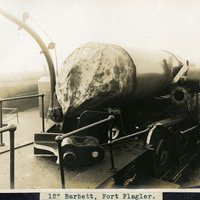
Caption: "12" Barbett [sic], Fort Flagler.," c. 1908-1912. View of a 12" disappearing gun at Fort Flagler. The coastal artillery fortification Fort Flagler was established in 1897 and activated in 1899. Most of the fort's buildings and batteries had been completed by 1907. Fort Flagler was part of the "triangle of fire," three coastal defense fortifications (Fort Casey, Fort Worden, and Fort Flagler) guarding the entrance to Puget Sound. Fort Flagler was decommissioned in 1953, and purchased by the State of Washington in 1955 for use as a state park.
Date: 1908
-
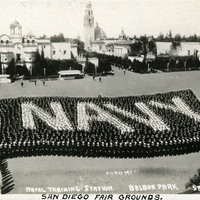
Caption: "San Diego Fair Grounds." and "39-6, 3,400 Men, Naval Training Station, Balboa Park, San Diego Cal.," c. 1917. With the advent of World War I, the U.S. Navy needed additional training grounds for sailors. In 1917, the City of San Diego offered to lease the Navy a portion of Balboa Park as a temporary training site until a new, more permanent facility could be constructed. This postcard shows 3,400 sailors lined up to form a Navy flag while at the temporary training ground.
Date: 1917
-
Aerial view of Veterans Home, Yountville; pen and ink drawing by Alfred Eichler. Project for Department of Veterans Affairs.
Date: 1930