
Search All Items
- Filters:
- Type
- Image 3877
- Still Image 1470
- Text 425
- Text 50
- Image of the California Census from the records of the office of the California Secretary of State 1
- Language
- English 5791
- Spanish 37
- ENGLISH 2
- English 2
- census_013 1
- contra_costa_schedule_1_volume_1 1
Search Results 5731 to 5740 of 5886
-
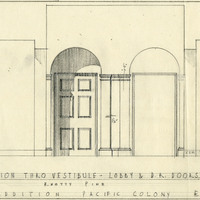
Caption: "Kitchen Addition, Pacific Colony. Section thro Vestibule - Lobby & D. R. Doors. Knotty pine." Design and drawing of kitchen addition, Pacific State Hospital, by Alfred Eichler. Built. Project for Department of Mental Hygiene - Hospitals. The hospital was initially named Pacific Colony (1927-1953), followed by Pacific State Hospital (1953-1979); Frank D. Lanterman State Hospital and Developmental Center; and finally Lanterman Developmental Center, which closed in 2015.
Date: 1936
-
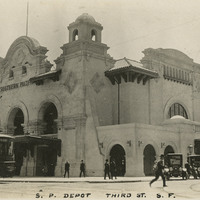
Caption: "S.P. Depot, Third St. S.F.," c. 1915, shows the Southern Pacific Railroad Depot on Third and Townsend Streets in San Francisco. The mission revival architectural - style depot was built as a temporary structure in 1914 to serve the 1915 Panama-Pacific International Exposition. It remained in service for almost sixty years before it was demolished and replaced by a new station on 4th and King Streets in 1975-1976.
Date: 1915
-
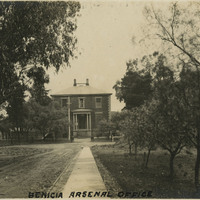
Caption: "Benicia Arsenal Office," c. 1915. William McCarthy began his career as an inspector of armaments for the U.S. War Department at the Benicia Arsenal in 1903. The arsenal was established in 1851 as the first Ordnance Supply Depot in the West, from which it supplied and supported U.S. troops from the Civil War through WWII and the Korean War. It was deactivated in 1963.
Date: 1915
-
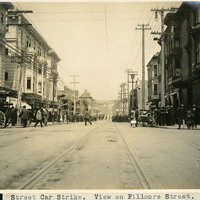
Caption: "Street Car Strike," c. 1907. San Francisco's street car union workers called for a strike after their request to be paid three dollars per eight- hour work day was declined. At the start of the strike, two strikers were shot by strike breakers and many more causalities were reported. Hundreds of passengers were injured during the strike due to inexperienced operators, and twenty-five of those passengers died as a result. In total, the upheaval resulted in thirty-one causalities.
Date: 1907
-
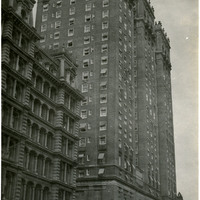
Caption: "Vanderbilt Hotel N.Y," c. 1925. Wealthy businessman Alfred Gwynne Vanderbilt, Sr. had the Vanderbilt Hotel constructed on the site of a former Vanderbilt residence in New York City, just six blocks from the new Grand Central Terminal. Designed by architects Warren & Wetmore, the hotel opened in 1912. The top two stories were constructed as a private residence for Vanderbilt's family. The hotel still stands today, although it has undergone some renovations.
Date: 1925
-
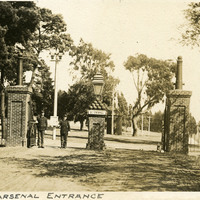
Caption: "Benicia Arsenal Entrance," c. 1915. View of the gateway to Benicia Arsenal, where William McCarthy worked (starting in 1903). Established in 1851, the Benicia Arsenal was the primary ordnance facility of the U.S. Army on the West Coast. The facility was deactivated in 1963, and closed completely the following year. The area now serves a vastly different function, providing work and retail space for artists and artisans.
Date: 1915
-
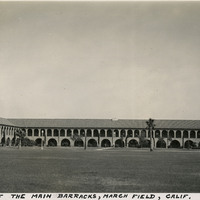
Caption: "One of the Main Barracks, March Field, Calif.," c. 1935. Today known as March Air Reserve Base, March Field was one of several airfields established in April 1917, just after the United State's entry in World War 1. The airfield was named for Peyton C. March Jr., son of then Army Chief of Staff, Peyton C. March, who had been killed in an air crash just fifteen days after being commissioned.
Date: 1935
-
No Caption: This postcard shows a view of the Government Building and the Cascades (a terraced fountain leading up to the building), part of the Alaska-Yukon-Pacific Exposition. Held in Seattle to celebrate the development of the Pacific Northwest, the fair attracted 3.7 million visitors over the course of its run from June to October 1909. Although most of the fair's buildings have since been destroyed, several of them now serve as part of the University of Washington campus. See also 96-07-08-alb05-212.
Date: 1909
-
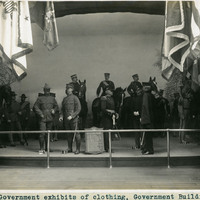
Caption: "Government exhibits of clothing, Government Building." This exhibit demonstrates a variety of military uniforms, displayed on mannequins. It was located in the Government Building of the Lewis and Clark Centennial Exposition, held in Portland, Oregon from June 1st to October 15th, 1905. It celebrated the one-hundred year anniversary of the exploratory expedition of the Louisiana Purchase and what became the northwestern part of the United States, led by Meriwether Lewis and William Clark. Some 1.6 million people visited the fair, viewing exhibits from twenty-one countries.
Date: 1905