
Search All Items
- Filters:
- Type
- Image 3888
- Still Image 2857
- Text 431
- Text 50
- Image of the California Census from the records of the office of the California Secretary of State 1
- Language
- English 7190
- Spanish 43
- ENGLISH 3
- English 2
- census_013 1
- contra_costa_schedule_1_volume_1 1
Search Results 5801 to 5810 of 7317
-
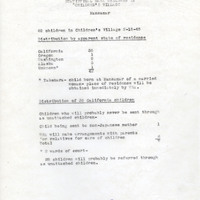
Statistics on number and ages of children in the Manzanar Children's Village
Date: February 15, 1945
-
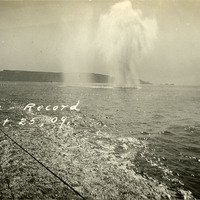
Caption: "#4 -- Record Oct 25, 09." This postcard shows plume of seawater thrown up by a mortar shell during target practice at Fort Point. The facilities at Fort Point were part of an effort by the U.S. government to protect the Golden Gate, entrance to the San Francisco Bay. Built between 1853-1861, the fort included emplacements for 141 guns but never fired a weapon in defense of the Bay. Its name was officially changed in 1882 to Fort Winfield Scott, but in 1886 the fort was officially downgraded to a sub-post of the San Francisco Presidio and the name discontinued. It was resurrected in 1912, with the establishment of a coastal artillery fortification at the Presidio, called, once again, Fort Winfield Scott.
Date: 10/25/1909
-
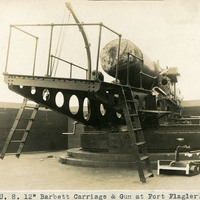
Caption: "U. S. 12" Barbett [sic] Carriage & Gun at Fort Flagler.," c. 1908-1912. View of a 12" disappearing gun installed at Fort Flagler. The coastal artillery fortification Fort Flagler was established in 1897 and activated in 1899. Most of the fort's buildings and batteries had been completed by 1907. Fort Flagler was part of the "triangle of fire," three coastal defense fortifications (Fort Casey, Fort Worden, and Fort Flagler) guarding the entrance to Puget Sound. Fort Flagler was decommissioned in 1953, and purchased by the State of Washington in 1955 for use as a state park.
Date: 1908
-
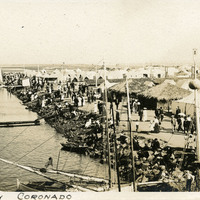
Caption: "Tent City Coronado," c. 1910-1913. View of rows of tents and sheds thatched in palm fronds along the coast near Coronado Hotel, with people strolling along the roadways. Established in 1900 for travelers who could not afford to stay in the resort hotel, the Coronado Tent City consisted of a grid of streets lined with furnished tents, near the sea shore. It also featured restaurants, a library, soda fountain, theater, bandstand, and other recreational facilities. See also 96-07-08-alb08-210, and 263.
Date: 1910
-
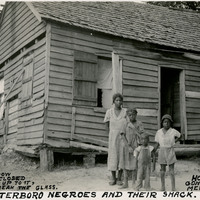
Caption: "Walterboro Negroes and Their Shack. If the Window Wont [sic] Stay Closed, Put a Stick Up to It, You Wont [sic] Break the Glass. House Foundation Gone But They Live Merrily On. July 17, 1934." Unidentified family posing in front of a dilapidated home in Walterboro.
Date: 7/17/1934
-
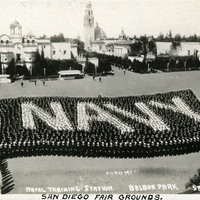
Caption: "San Diego Fair Grounds." and "39-6, 3,400 Men, Naval Training Station, Balboa Park, San Diego Cal.," c. 1917. With the advent of World War I, the U.S. Navy needed additional training grounds for sailors. In 1917, the City of San Diego offered to lease the Navy a portion of Balboa Park as a temporary training site until a new, more permanent facility could be constructed. This postcard shows 3,400 sailors lined up to form a Navy flag while at the temporary training ground.
Date: 1917
-
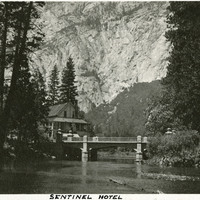
Caption: "Sentinel Hotel," c. 1917. The Sentinel Hotel at Yosemite Village, with a granite cliff in the background and the Merced River in the foreground. Construction of the hotel began in 1876, and at the turn of the century it was the only hotel operating in the valley. Increased attendance as the twentieth century progressed resulted in the construction of other tourist areas such as Curry Village, and the Sentinel gradually became obsolete. The Sentinel and the complex of buildings that had grown up around it were torn down in the late 1930s.
Date: 1917
-
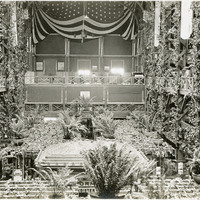
No Caption: A view of the interior of the state of Oregon building at the Panama-Pacific International Exposition.
Date: 1915