
Search All Items
- Filters:
- Language
- English 5811
- Spanish 37
- ENGLISH 2
- English 2
- census_013 1
- contra_costa_schedule_1_volume_1 1
- Type
- Image 3877
- Still Image 1473
- Text 439
- Text 54
- Textual 2
- Image of the California Census from the records of the office of the California Secretary of State 1
Search Results 5811 to 5820 of 5921
-
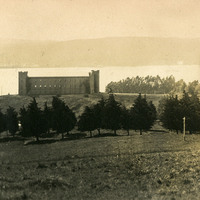
No Caption. A view of the Benicia Arsenal, with the store house in the distance. William McCarthy began his career as an inspector of armaments for the U.S. War Department at the Benicia Arsenal in 1903. The arsenal was established in 1851 as the first Ordnance Supply Depot in the West, from which it supplied and supported U.S. troops, from the Civil War through WWII and the Korean War. It was deactivated in 1963. Benicia Arsenal store house in the distance, c. 1905.
Date: 1905
-
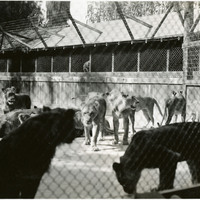
No Caption: Shows a group of adult African lions in a enclosed area of Gay's Lion Farm in El Monte, Los Angeles. Charles and Muriel Gay opened the farm in 1925 and operated it until 1942 as a popular tourist attraction where lions were selectively bred and trained for the Hollywood film industry. It was closed during WWII due to wartime meat shortages, and the lions were loaned to zoos around the country, c. 1935.
Date: 1935
-
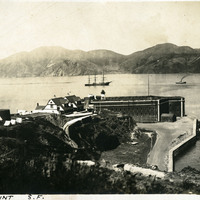
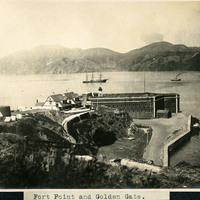
Caption: "Fort Point S.F." c. 1906. See also 96-07-08-alb06-009 with caption: "Fort Point and Golden Gate." A view of Fort Point in the foreground, with ships in the bay. Fort Point was part of an effort by the U.S. government to protect the Golden Gate, entrance to the San Francisco Bay. Built between 1853-1861 of brick and mortar, the fort included emplacements for 141 guns but never fired a weapon in defense of the Bay.
Date: 1906
-
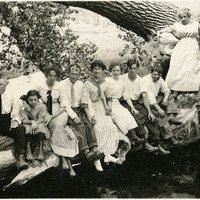
No caption, c. 1914. William and Grace McCarthy (fourth and fifth from the left) seated on a log with a group of unidentified friends and family in the Skaggs Springs area of Sonoma County. Skaggs Springs was a resort area along the Russian River, known for its hot springs. The area now lies beneath the waters of Lake Sonoma, flooded after construction of the Warm Springs Dam, completed in 1982.
Date: 1914
-
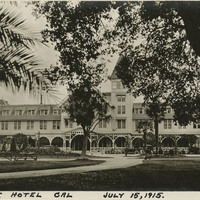
Caption: "Del Monte Hotel Cal July 15, 1915," shows the entrance to the Hotel Del Monte (Lewis P. Hobart and Clarence A. Tan Tau, architects), in Monterey, California. Originally opened in 1880, it was the world's largest luxury resort in that time. During World War II, the hotel and grounds was leased to the U.S. Navy. It later became the Naval Postgraduate School of the U.S. Navy and today functions as administrative offices and residences for the school.
Date: 1915
-
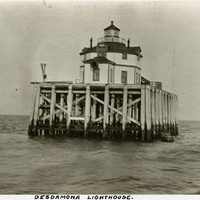
Caption: "Desdamona [sic] Lighthouse.," c. 1905-1909. View of the Desdemona Lighthouse, constructed in 1901 or 1902 on wood pilings over a group of shoals at the mouth of the Columbia River. The shoals carry the same name as the lighthouse, both of which are named for the boat Desdemona which ran aground and was destroyed by the shoals in 1857. The lighthouse was automated in 1934, and its light eventually removed in 1965.
Date: 1905
-
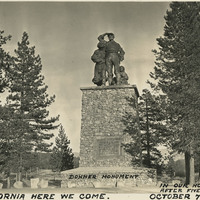
Caption: "California Here We Come. Donner Monument. In Our Home State Again After Five Months Tour. October 7, 1934." William and Grace McCarthy took this photograph of the Pioneer Monument when they arrived back in California after a five month road trip to the East Coast. The Pioneer Monument, featuring a pair of pioneers with their two children looking west, was first dedicated on June 6, 1918 to commemorate those who emigrated to California in the mid 1800s. Today, the monument and surrounding area is known as Donner Memorial State Park. The park was established in memory of the ill-fated Donner Party, a group of emigrants whose wagon train was caught in the Sierra Nevada Mountains during the winter of 1846-47. The Pioneer Monument's stone pedestal stands twenty-two feet high, the height of the snow that the party had to contend with. Of the eighty-seven people in the wagon train, only forty-eight survived to be rescued the following spring. Some of the survivors are said to have resorted to cannibalism in order to survive.
Date: 10/7/1934
-
Caption: "Fort Point and Golden Gate," c. 1906. Fort Point in the foreground, with ships in the bay. Fort Point was part of an effort by the U.S. government to protect the Golden Gate, entrance to the San Francisco Bay. Built between 1853-1861 of brick and mortar, the fort included emplacements for 141 guns but never fired a weapon in defense of the Bay.
Date: 1906
-
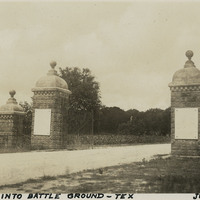
Caption: "San Jacinto Battle Ground -- Tex, June 11 34." View of the gated entry to the San Jacinto Battleground. The site was the location of the Battle of San Jacinto, in which the Texan Army (led by Sam Houston) defeated the Mexican army (led by General Antonio López de Santa Anna), paving the way for the formation of the Republic of Texas. A Texas Historic Site, the battleground was also declared a National Historic Landmark in 1960.
Date: 6/11/1934