
Search All Items
- Filters:
- Type
- Image 3877
- Still Image 1470
- Text 425
- Text 50
- Image of the California Census from the records of the office of the California Secretary of State 1
- Language
- English 5791
- Spanish 37
- ENGLISH 2
- English 2
- census_013 1
- contra_costa_schedule_1_volume_1 1
Search Results 5831 to 5840 of 5886
-
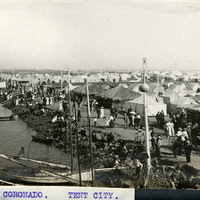
Caption: "CORONADO. TENT CITY.," c. 1910. View of rows of tents and sheds thatched in palm fronds along the coast near Coronado Hotel, with people strolling along the roadways. Established in 1900 for travelers who could not afford to stay in the resort hotel, the Coronado Tent City consisted of a grid of streets lined with furnished tents, near the sea shore. It also featured restaurants, a library, soda fountain, theater, bandstand, and other recreational facilities. See also 96-07-08-alb05-202 and 96-07-08-alb08-263.
Date: 1910
-
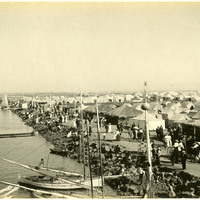
No Caption: c. 1910. View of rows of tents and sheds thatched in palm fronds along the coast near Coronado Hotel, with people strolling along the roadways. Established in 1900 for travelers who could not afford to stay in the resort hotel, the Coronado Tent City consisted of a grid of streets lined with furnished tents, near the sea shore. It also featured restaurants, a library, soda fountain, theater, bandstand, and other recreational facilities. See also 96-07-08-alb05-202 and 96-07-08-alb08-210.
Date: 1910
-
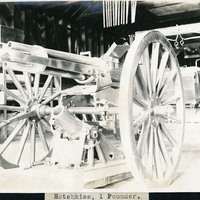
Caption: "Hotshkiss [sic], 1 pounder." The United States purchased artillery from the French arms firm, Hotchkiss, in the late 19th and early 20th centuries. The arms firm was created by American gunsmith, Benjamin B. Hotchkiss, who moved to France in 1867 to set up the factory. The heavy artillery was first used by the United States against the Nez Perce in 1877. In 1890, they were used at the Wounded Knee Massacre, and also for the attack on San Juan Hill during the Spanish-American War.
Date: Undated
-
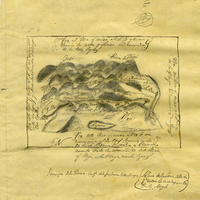
Hand-drawn sketch map of Guadalasca (Guasalagsa) boundaries. Volume 1, page 30.
Date: 1836
-
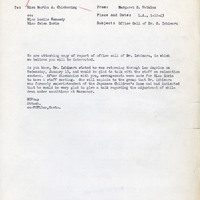
Office Memorandum from Margaret S. Watkins to Martha A. Chickering regarding children at Manzanar
Date: January 12, 1943
-
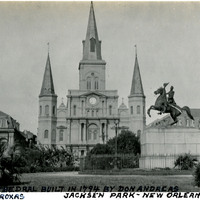
Caption: "St. Louis Cathedral Built in 1794 by Don Andreas Almonastry Roxas - Jacksen[sic] Park - New Orleans." St. Louis Cathedral anchors one end of Jackson Square in New Orleans' French Quarter. The structure of the cathedral largely dates to the 1850 restoration and expansion of an older cathedral built on the site in 1793. Very little of the older church survived, although the central bell tower (added on to the older church in 1819) was reused in the new structure and is still extant today. A statue of Andrew Jackson mounted on a rearing horse (Clark Mills, sculptor) stands in the square in front of the cathedral. The sculpture was erected in 1856. See also 96-07-08-alb11-052.
Date: 6/15/1934
-
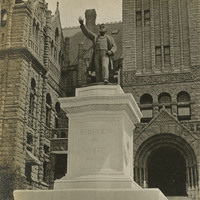
No Caption: c. 1915, shows a monument with a statue of Stephen M. White on the grounds of the Los Angeles County Courthouse. Stephen M. White, a former Los Angeles district attorney, served in the California Senate, as well as acting Lieutenant Governor from 1887-1891. He also served in the United States Senate from 1893 -1899. White was also responsible for the creation of Los Angeles Harbor in San Pedro. The monument was moved in 1989 to the entrance of Cabrillo Beach near the harbor where it resides today.
Date: 1915
-
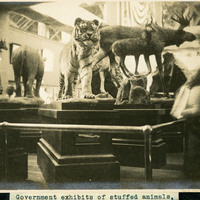
Caption: "Government exhibits of stuffed animals." Various mammals stuffed for display, including a tiger, moose, deer, and antelope, exhibited in the Government Building of the Lewis and Clark Centennial Exposition. The exposition was held in Portland, Oregon from June 1st to October 15th, 1905. It celebrated the one-hundred year anniversary of the exploratory expedition of the Louisiana Purchase and what became the northwestern part of the United States, led by Meriwether Lewis and William Clark. Some 1.6 million people visited the fair, viewing exhibits from twenty-one countries.
Date: 1905
-
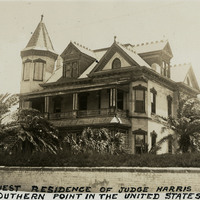
Caption: "Key West Residence of Judge Harris, Most Southern Point in the United States July 2, 1934." View of the Queen Anne-style Victorian mansion constructed in Key West by Judge Vinning Harris in 1897. The home was originally touted as occupying the southernmost point in the U.S., resulting in the colloquial name "Southernmost House." During the Prohibition years (1920-1933) the house operated as a speakeasy, with a restaurant and casino. In 1939, it was converted to use as a nightclub. Today, it has been renovated for use as a bed-and-breakfast.
Date: 7/2/1934
-
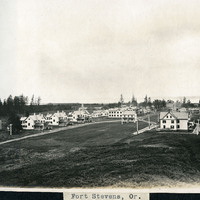
Caption: "Fort Stevens, Or.," c. 1910. View of buildings at Fort Stevens, part of the Three Fort Harbor Defense System protecting the mouth of the Columbia River from enemy incursion or attack (the other forts being Fort Columbia and Fort Canby, both in Washington). Built during the Civil War, the fort remained active until after World War II. In June 1942, Fort Stevens gained the dubious distinction of being the only military installation in the continental United States to come under enemy fire when a Japanese submarine surfaced off the coast and fired seventeen missiles at the fort. The missiles destroyed the backstop to the fort's baseball field, but otherwise did little harm. Fort Stevens was decommissioned in 1947. It was later turned over to the Oregon Parks and Recreation Department, and currently is the site of an Oregon State Park.
Date: 1910