
Search All Items
- Filters:
- Type
- Image 3877
- Still Image 1470
- Text 425
- Text 50
- Image of the California Census from the records of the office of the California Secretary of State 1
- Language
- English 5791
- Spanish 37
- ENGLISH 2
- English 2
- census_013 1
- contra_costa_schedule_1_volume_1 1
Search Results 5861 to 5870 of 5886
-
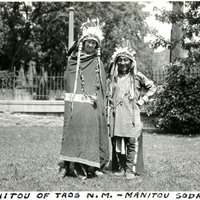
Caption: "Chief Manitou of Taos N. M. - Manitou Soda Springs," c. 1923. Grace McCarthy, wearing a Native American headdress and beaded blanket, stands next to a smiling Pedro Cajete in traditional dress. Mr. Cajete, better known to many as Chief Manitou, was a Native American of the Tewa tribe near Santa Fe, New Mexico, who was hired to promote tourism in the Manitou Springs/Colorado Springs area of Colorado. He often sold trinkets and posed for photographs with tourists near the mouth of Manitou Cave, resulting in his moniker Chief Manitou.
Date: 1923
-
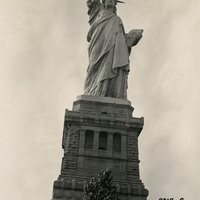
Caption: "Statue of Liberty, New York. Aug 2, 1934." View of the Statue of Liberty on Bedloe Island (now called Liberty Island). Designed by French sculptor Frédéric Auguste Bartholdi, the now-iconic statue was a gift from the people of France to the U.S. Built in segments in France by Gustave Eiffel (also famous for building the Eiffel Tower in Paris), the pieces were shipped from Paris to New York in 1885 and assembled. The Statue of Liberty was subsequently dedicated on October 28, 1886.
Date: 8/2/1934
-
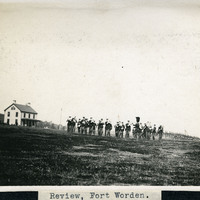
Caption: "Review, Fort Worden.," c. 1908-1912. Shows a military band playing or preparing to play, with rows of troops assembled in the background on the right side of the photograph. Fort Worden is located in Port Townsend, Washington, on Admiralty Inlet of Puget Sound. Construction began on the fort in 1898, and by 1902 it was serving as an active U.S. Army base. Fort Worden was part of the "triangle of fire," three coastal defense fortifications (Fort Casey, Fort Worden, and Fort Flagler) guarding the entrance to Puget Sound. The U.S. sold the property to the State of Washington in 1957. In 1973, the fort and surrounding area opened as Fort Worden State Park.
Date: 1908
-
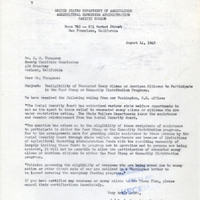
Correspondence from I. C. May to S. H. Thompson regarding food stamp policy
Date: August 14, 1942
-
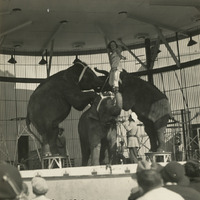
Caption: "Chicago Fair, Sept. 23, 1934." Three elephants performing in a circus ring at Chicago's Century of Progress Exposition. The Exposition, a world fair attended by thirty-nine million people, celebrated Chicago's one-hundred year anniversary of incorporation. Originally planned to only run from May to November in 1933, it was such a success that its organizers decided to keep it running for a second season from May through October the following year. The central theme of the Exposition was technological innovation, with a motto of "Science Finds, Industry Applies, Man Conforms."
Date: 9/23/1934
-
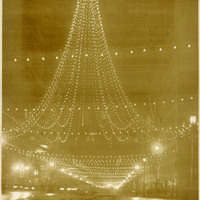
No Caption: The photograph has a hand-written inscription stating: "Portola Electric Bell Copyright 1909 Pillsbury Picture Co. No. 800." Installed on the intersection of Third and Market Streets in San Francisco, the Portola Electric Bell contained two thousand bulbs and rose 125 feet above the street. It was part of the Portola Festival of 1909, a grand celebration devised to commemorate the discovery of San Francisco Bay by Gaspar De Portola, and for the public to celebrate the future of the rebuilt city after the 1906 earthquake and fires.
Date: 1909
-
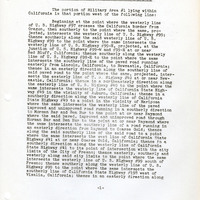
Narrative of boundaries of Military Areas #1 and #2
Date: Undated
-
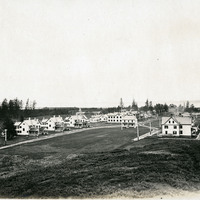
No Caption: See also 96-07-08-alb08-139 with caption: "Fort Stevens, Or," c. 1910. A view of buildings at Fort Stevens, part of the Three Fort Harbor Defense System protecting the mouth of the Columbia River from enemy incursion or attack (the other forts being Fort Columbia and Fort Canby, both in Washington). Built during the Civil War, the fort remained active until after World War II. In June 1942, Fort Stevens gained the dubious distinction of being the only military installation in the continental United States to come under enemy fire when a Japanese submarine surfaced off the coast and fired seventeen missiles at the fort. The missiles destroyed the backstop to the fort's baseball field, but otherwise did little harm. Fort Stevens was decommissioned in 1947. It was later turned over to the Oregon Parks and Recreation Department, and currently is the site of an Oregon State Park.
Date: 1910
-
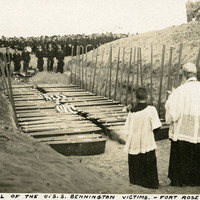
Caption: "Buriel [sic] of the U.S.S. Bennington Victims. -- Fort Rosecrans." Shows a grave site with dozens of caskets ready for burial. A priest and two altar boys stand at one side of the caskets, while a large group of U.S. Navy sailors looks on from the other side. While sailing from port in San Diego on the morning of July 21, 1905, the boiler of the USS Bennington exploded, killing sixty-six of her crew. The victims were laid to rest in the cemetery at Fort Rosecrans. See also 96-07-08-alb08-217.
Date: 1905-07-23
-
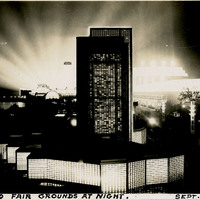
Caption: "Chicago Fair Grounds at Night. Sept. 22, 1934." View of a portion of the Century of Progress Exposition as seen at night. The Exposition, a world fair attended by thirty-nine million people, celebrated Chicago's one-hundred year anniversary of incorporation. Originally planned to only run from May to November in 1933, it was such a success that its organizers decided to keep it running for a second season from May through October the following year. The central theme of the Exposition was technological innovation, with a motto of "Science Finds, Industry Applies, Man Conforms."
Date: 9/22/1934