
Search All Items
- Filters:
- Type
- Image 3877
- Still Image 1470
- Text 425
- Text 50
- Image of the California Census from the records of the office of the California Secretary of State 1
- Language
- English 5791
- Spanish 37
- ENGLISH 2
- English 2
- census_013 1
- contra_costa_schedule_1_volume_1 1
Search Results 5881 to 5886 of 5886
-
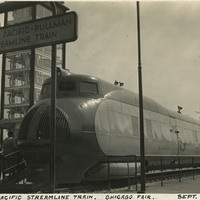
Caption: "Union Pacific Streamline Train. Chicago Fair. Sept. 22, 1934." View of the engine on the Union Pacific's new M-10000, on exhibit at Chicago's Century of Progress Exposition. The M-10000 was the first lightweight express passenger train powered by an internal combustion engine in the U.S. The train went on an exhibition tour of the US in 1934, which included a stop at the Exposition. The Exposition, a world fair attended by thirty-nine million people, celebrated Chicago's one-hundred year anniversary of incorporation. Originally planned to only run from May to November in 1933, it was such a success that its organizers decided to keep it running for a second season from May through October the following year. The central theme of the Exposition was technological innovation, with a motto of "Science Finds, Industry Applies, Man Conforms."
Date: 9/22/1934
-
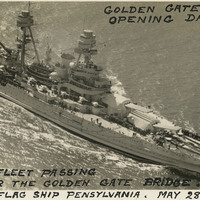
Caption: "Golden Gate Bridge Opening Day. U.S. Fleet Passing Under the Golden Gate Bridge. U.S. Flag Ship Pennsylvania [sic]. May 28, 1937." View of the super-dreadnaught battleship USS Pennsylvania as she passed under the Golden Gate Bridge as part of the celebrations surrounding the bridge's opening day. The third U.S. Navy ship named for the state of Pennsylvania, she was launched in 1915. The Pennsylvania served in both the Atlantic and Pacific Fleets, and was damaged while in dry-dock during the attack on Pearl Harbor in 1941. After being repaired, she spend the remainder of World War II in the Pacific Theater. Hit by a torpedo in August 1945, the severely damaged Pennsylvania was repaired well enough to serve as a target ship during Operation Crossroads atomic bomb tests off Bikini Atoll in July 1946. She was decommissioned that year, and after undergoing radiation testing, was scuttled by the U.S. Navy in February 1948.
Date: 5/28/1937
-
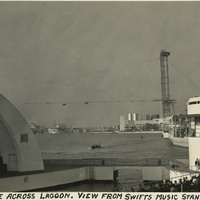
Caption: "Sky Ride Across Lagoon. View from Swifts Music Stand. Chicago Fair, Sept. 18, 1934." One of the 628-foot towers making up the Sky Ride, an aerial tramway which carried fair goers in small gondolas or trams (visible in the center of the photograph) over the harbor around which the Century of Progress Exposition was held. Over 4.5 million passengers enjoyed the views from the Sky Ride before it was demolished after the conclusion of the exposition in 1934. The Exposition, a world fair attended by thirty-nine million people, celebrated Chicago's one-hundred year anniversary of incorporation. Originally planned to only run from May to November in 1933, it was such a success that its organizers decided to keep it running for a second season from May through October the following year. The central theme of the Exposition was technological innovation, with a motto of "Science Finds, Industry Applies, Man Conforms."
Date: 9/18/1934
-
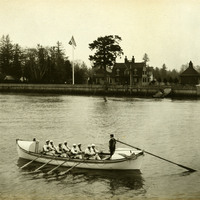
No Caption: c. 1910. View of the Point Adams Lifesaving Station near Hammond, Oregon, including a rowboat ("Point Adams") manned by eight rowers, with one man at the rudder. The Point Adams Lifesaving Station was established in 1889 by the federal government, in response to growing numbers of merchant, fishing, and other sailing vessels along the Columbia River. The stationhouse, visible in the center of the photograph, was demolished in 1939 to make way for a new building. The two-bay boathouse visible at the right had to be moved in 1913-1915 due to erosion of the bank upon which it stood. The U.S. Coastguard took over operation of the station in 1915. The station remained operational until 1967. The remaining buildings now house the Point Adams Research Facility of the Northwest Fisheries Science Center.
Date: 1910
-
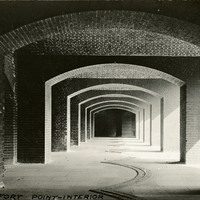
Caption: "Fort Point -- Interior," c. 1910. Postcard showing a view of an interior hall or walkway featuring several arches at Fort Point. The facilities at Fort Point were part of an effort by the U.S. government to protect the Golden Gate, entrance to the San Francisco Bay. Built between 1853-1861, the fort included emplacements for 141 guns but never fired a weapon in defense of the Bay. Its name was officially changed in 1882 to Fort Winfield Scott, but in 1886 the fort was officially downgraded to a sub-post of the San Francisco Presidio and the name discontinued. It was resurrected in 1912, with the establishment of a coastal artillery fortification at the Presidio, called, once again, Fort Winfield Scott.
Date: 1910
-
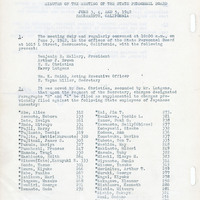
Item in meeting minutes regarding protest of charges against listed Japanese employees by James Purcell
Date: June 3, 1942