
Search All Items
- Filters:
- Language
- English 5811
- Spanish 37
- ENGLISH 2
- English 2
- census_013 1
- contra_costa_schedule_1_volume_1 1
- Type
- Image 3877
- Still Image 1473
- Text 439
- Text 54
- Textual 2
- Image of the California Census from the records of the office of the California Secretary of State 1
Search Results 5901 to 5910 of 5921
-
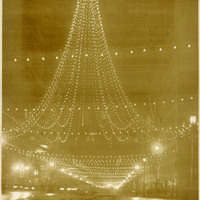
No Caption: The photograph has a hand-written inscription stating: "Portola Electric Bell Copyright 1909 Pillsbury Picture Co. No. 800." Installed on the intersection of Third and Market Streets in San Francisco, the Portola Electric Bell contained two thousand bulbs and rose 125 feet above the street. It was part of the Portola Festival of 1909, a grand celebration devised to commemorate the discovery of San Francisco Bay by Gaspar De Portola, and for the public to celebrate the future of the rebuilt city after the 1906 earthquake and fires.
Date: 1909
-
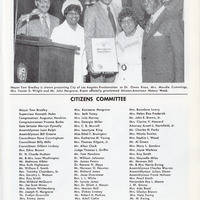
This item has no description.
Date: 1974
-
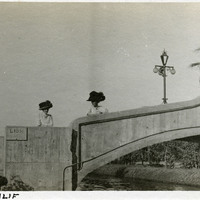
Caption: "Venice, Calif," c. 1911. Grace McCarthy and an unidentified woman standing on a bridge over Lion Canal in Venice, California. In 1905, Abbot Kinney built a series of canals as part of a development project along Santa Monica Beach, hoping to recreate the look and feel of Italy's iconic "Floating City" in southern California. Called Ocean Park at first, gondoliers sailed boats under elegant bridges such as the one shown in this photograph, in an effort to attract businesses, residents, and investors. In 1911, the name officially changed to Venice. By 1929, however, many of the canals had been filled in to create roadways, and those canals that remained fell into disrepair. A revitalization movement in the early 1990s has restored some of the canals, and made the area a desirable residential neighborhood.
Date: 1911
-
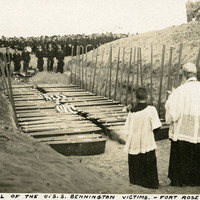
Caption: "Buriel [sic] of the U.S.S. Bennington Victims. -- Fort Rosecrans." Shows a grave site with dozens of caskets ready for burial. A priest and two altar boys stand at one side of the caskets, while a large group of U.S. Navy sailors looks on from the other side. While sailing from port in San Diego on the morning of July 21, 1905, the boiler of the USS Bennington exploded, killing sixty-six of her crew. The victims were laid to rest in the cemetery at Fort Rosecrans. See also 96-07-08-alb08-217.
Date: 1905-07-23
-
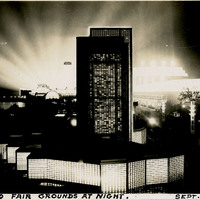
Caption: "Chicago Fair Grounds at Night. Sept. 22, 1934." View of a portion of the Century of Progress Exposition as seen at night. The Exposition, a world fair attended by thirty-nine million people, celebrated Chicago's one-hundred year anniversary of incorporation. Originally planned to only run from May to November in 1933, it was such a success that its organizers decided to keep it running for a second season from May through October the following year. The central theme of the Exposition was technological innovation, with a motto of "Science Finds, Industry Applies, Man Conforms."
Date: 9/22/1934
-
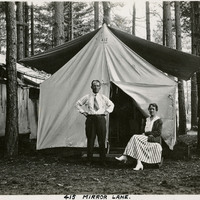
Caption: "Mirror Lane - Camp Curry," c. 1917. William and Grace McCarthy pose in front of their tent at what was then called Camp Curry. Yosemite's Half Dome Village, established by David and Jennie Curry in 1899, was originally called Camp Curry, and then later Curry Village. It was designed to provide cheaper accommodations for Yosemite tourists than the resort hotels. The couple rented out furnished tents and provided amenities such as a dining tent. As time progressed, the amenities increased, and some hard-sided cabins created.
Date: 1917
-
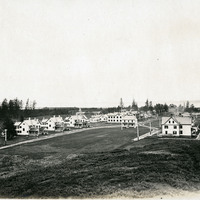
No Caption: See also 96-07-08-alb08-139 with caption: "Fort Stevens, Or," c. 1910. A view of buildings at Fort Stevens, part of the Three Fort Harbor Defense System protecting the mouth of the Columbia River from enemy incursion or attack (the other forts being Fort Columbia and Fort Canby, both in Washington). Built during the Civil War, the fort remained active until after World War II. In June 1942, Fort Stevens gained the dubious distinction of being the only military installation in the continental United States to come under enemy fire when a Japanese submarine surfaced off the coast and fired seventeen missiles at the fort. The missiles destroyed the backstop to the fort's baseball field, but otherwise did little harm. Fort Stevens was decommissioned in 1947. It was later turned over to the Oregon Parks and Recreation Department, and currently is the site of an Oregon State Park.
Date: 1910
-
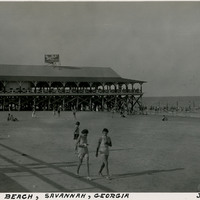
Caption: "Tybee Beach, Savannah, Georgia, July 14, 1934." Beach scene with a small crowd of unidentified people enjoying the ocean waves and strolling in the sand. The large Tybrisa Pavilion, set on a wood pier, extends into the water. Tybee Beach is one of several beaches in Tybee Island, a town on an island of the same name located across the river from Savannah. The island became a popular tourist spot between the Civil War and the mid-twentieth century, particularly after the Central of Georgia Railway constructed a line to the island. To encourage tourists, the railroad built Tybrisa Pavilion in 1891. It featured a large dance floor that became popular on the Big Band circuit, but was destroyed by fire in 1967.
Date: 7/14/1934
-
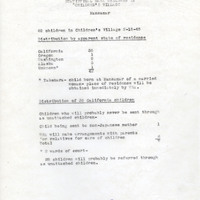
Statistics on number and ages of children in the Manzanar Children's Village
Date: February 15, 1945
-
Correspondence from K. C. May to S. H. Thompson regarding food stamp policy; Attached to Correspondence on Policy Ruling (F3729_66_005)
Date: August 14, 1942