
Search All Items
- Filters:
- Type
- Image 3872
- Still Image 1847
- Text 428
- Text 50
- Image of the California Census from the records of the office of the California Secretary of State 1
- Language
- English 6191
- Spanish 11
- ENGLISH 2
- English 2
- census_013 1
- contra_costa_schedule_1_volume_1 1
Search Results 5911 to 5920 of 6265
-
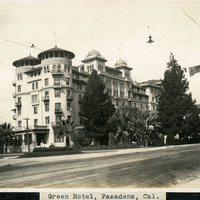
Caption: "Green Hotel, Pasadena, Cal.," c. 1905. View of Castle Green, built as an annex to the Hotel Green in 1899. The original Hotel Green opened for business as a lavish resort in 1894. Its success prompted owner George Gill Green to expand the hotel and build the additional facility shown here, connected to the original hotel by an elaborate enclosed pedestrian bridge (seen at the far right of this photograph). This second building, designed by architect Frederick I. Roehrig with Spanish, Moorish, and Victorian elements, became known as "Castle Green." Business declined in the 1910s, and the complex was sold to a series of investors. In the mid-1920s, Castle Green was subdivided into fifty residential apartments. It remains a residential complex today.
Date: 1905
-
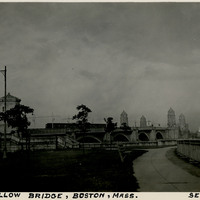
Caption: "Longfellow Bridge, Boston, Mass. Sept. 5, 1934." The Longfellow Bridge spans the Charles River between Boston and Cambridge. Originally called the Cambridge Bridge, it replaced a wood structure called the West Boston Bridge that had been constructed in 1793. This wood bridge was unable to handle large volumes of traffic or the introduction of street cars, so a new bridge was built in the early twentieth century. Opened in 1906 as the Cambridge Bridge, the name was changed in 1927 to the Longfellow Bridge in honor of poet Henry Wadsworth Longfellow. It is colloquially known as the Salt and Pepper Bridge, as its central towers are reminiscent in shape of salt and pepper shakers.
Date: 9/5/1934
-
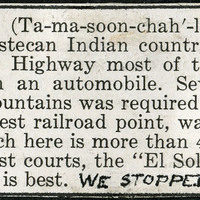
Caption: "We stopped at Gandy Courts." A section of a tourist informational brochure describing the village of Tamazunchale, in "the heart of the Huastecan Indian country."
Date: 1938
-
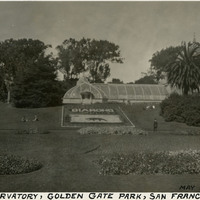
Caption: "Conservatory, Golden Gate Park, San Francisco, May 14, 1934." View of one wing of the Conservatory of Flowers in Golden Gate Park. A planting bed in front of the wing has been planted with flowers in such a way as to portray the California flag and the letters "California Diamond Jubilee, 1850-1925." The date on this photograph may not be accurate, given the dates included in the flower bed. The Conservatory of Flowers is the oldest building in Golden Gate Park, dating to 1879. The Victorian-style building has housed rare and exotic plants since its completion.
Date: 5/14/1934
-
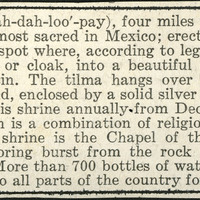
No Caption: A section from an informational tourist brochure describing the Guadalupe shrine in Mexico City.
Date: 1938
-
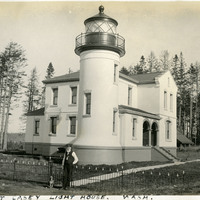
Caption: "Fort Casey Light House, Wash." c. 1905. Located on Whidbey Island in Puget Sound, the Admiralty Head Lighthouse was built overlooking Admiralty Inlet in 1903. It replaced an earlier structure that had to be moved in 1890 to accommodate the construction of Fort Casey. The second lighthouse, shown here, was built with thick walls in order to withstand earthquakes and the concussion of guns at Fort Casey. The man shown in the photograph is likely Charles H. Davis, who was appointed keeper of the lighthouse in 1900 and served until his death in 1914. The lighthouse, deactivated in 1922, has since been restored by Washington State Parks, and is part of the Fort Casey State Park.
Date: 1905
-
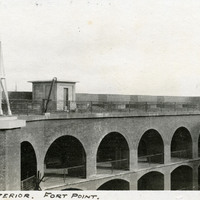
Caption: "Portion of Interior. Fort Point.," c. 1906. View of arched colonnades on ground and middle floors of Fort Point, and an upper tier with barbettes for the future installation of heavy artillery coastal defense weapons. The facilities at Fort Point were part of an effort by the U.S. government to protect the Golden Gate, entrance to the San Francisco Bay. Built between 1853-1861, the fort included emplacements for 141 guns but never fired a weapon in defense of the Bay. Its name was officially changed in 1882 to Fort Winfield Scott, but in 1886 the fort was officially downgraded to a sub-post of the San Francisco Presidio and the name discontinued. It was resurrected in 1912, with the establishment of a coastal artillery fortification at the Presidio, called, once again, Fort Winfield Scott.
Date: 1906