
Search All Items
- Filters:
- Type
- Image 3871
- Still Image 1541
- Text 433
- Text 19
- Image of the California Census from the records of the office of the California Secretary of State 1
- Language
- English 5808
- Spanish 62
- ENGLISH 2
- English 1
- census_013 1
- contra_costa_schedule_1_volume_1 1
Search Results 5921 to 5930 of 5932
-
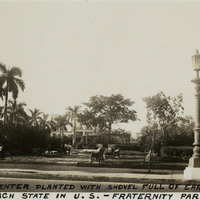
Caption: "Tree in Center Planted with Shovel Full of Earth From Each State in U.S. -- Fraternity Park -- Havana, July 4, 34." This photograph captures a view of Havana's Fraternity Park. The area originally served the city as a military parade and training ground (called Campo de Marte). In 1928, the park was renovated and a ceiba (or kapok) tree was planted in one of the central parcels. This tree, seen in the center of this photograph, was planted as the Tree of American Fraternity. When Havana hosted the sixth International American Conference later in 1928 (also known as one of the Pan-American Conferences), each of the twenty-one visiting dignitaries brought earth from their native counties in which to plant the tree (William McCarthy mistakenly identified the earth as coming from each state in the U.S.).
Date: 7/4/1934
-
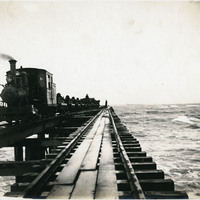
No Caption: See also 97-07-08-alb08-143 with caption: "Columbia River Jetty, Or.," c. 1910. View of a jetty built at the mouth of the Columbia River, carrying a railroad trestle. A train hauling cars loaded with large rocks is visible at the left side of the photograph. This is likely the so-called South Jetty, extending more than six miles into the ocean from Point Adams on the Oregon side of the river mouth. The jetty system at the mouth of the Columbia River was constructed between 1885 and 1917. Designed to funnel water from the Columbia River in a more concentrated fashion into the Pacific Ocean, the jetty system helped create a deeper, more stable shipping channel.
Date: 1910
-
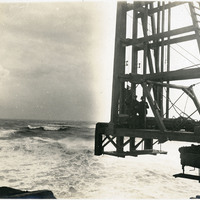
No Caption: See also 96-07-08-alb08-145 with caption: "Pile Driver in the Breakers, Columbia River Jetty," c. 1910. View of a large pile driver used in the construction of the jetty system at the mouth of the Columbia River. This is likely at the end of the so-called South Jetty, extending more than six miles into the ocean from Point Adams on the Oregon side of the river mouth. The jetty system at the mouth of the Columbia River was constructed between 1885 and 1917. Designed to funnel water from the Columbia River in a more concentrated fashion into the Pacific Ocean, the jetty system helped create a deeper, more stable shipping channel.
Date: 1910
-
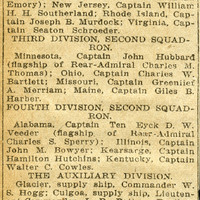
No caption. An undated and unidentified newspaper article titled, "What Ships Make Up the Armada in the Harbor." c.1908. The article describes the forty-three battleships, cruisers, torpedo boats, torpedo boat destroyers, and auxiliary ships in the San Francisco Bay under the Flag of Rear Admiral Evans.
Date: 1908
-
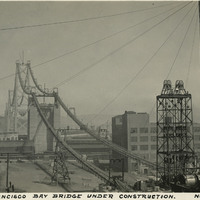
Caption: "San Francisco Bay Bridge Under Construction. Nov. 1, 1935." View of the towers and suspension cables of the western half of the San Francisco-Oakland Bay Bridge, spanning the distance between Yerba Buena Island in San Francisco Bay to the City of San Francisco. The bridge deck has not yet been completed. The Bay Bridge's design combined three different types of bridge-building technology over the five miles it covers between San Francisco and Oakland: a suspension span, a cantilevered span, and a tunnel. At the time of its completion in 1936, the bridge was the longest steel structure on the globe. It also featured the deepest bridge pier ever built, and the world's largest bore tunnel.
Date: 11/1/1935