
Search All Items
- Filters:
- Type
- Image 3872
- Still Image 1847
- Text 428
- Text 50
- Image of the California Census from the records of the office of the California Secretary of State 1
- Language
- English 6191
- Spanish 11
- ENGLISH 2
- English 2
- census_013 1
- contra_costa_schedule_1_volume_1 1
Search Results 5931 to 5940 of 6265
-
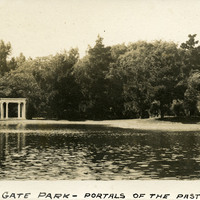
Caption: "Golden Gate Park -- Portals of the Past," c. 1910. A monument in Golden Gate Park in San Francisco, on the shores of Lloyd Lake, consisting of a white marble archway and columns. The archway was originally part of the Nob Hill mansion belonging to railroad tycoon Alban Towne. The mansion was destroyed in the 1906 San Francisco earthquake and fire, but the entryway still stood. It was moved to the shore of Lloyd Lake in 1909, as a memorial to the pre-1906 city.
Date: 1910
-
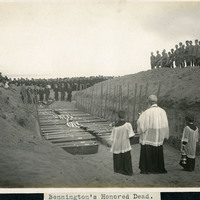
Caption: "Bennington's Honored Dead." Shows a grave site with dozens of caskets ready for burial. A priest and two altar boys stand at one side of the caskets, while a large group of U.S. Navy sailors looks on from the other side. While sailing from port in San Diego on the morning of July 21, 1905, the boiler of the USS Bennington exploded, killing sixty-six of her crew. The victims were laid to rest in the cemetery at Fort Rosecrans. See also 96-07-08-alb05-142 and 96-07-08-alb08-217.
Date: 1905-07-23
-
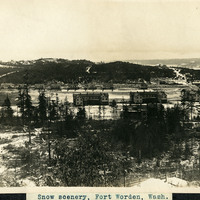
Caption: "Snow scenery, Fort Worden, Wash.," c. 1908. Overview of Fort Worden in Port Townsend, Washington, on Admiralty Inlet of Puget Sound. Construction began on the fort in 1898. By 1902 it was serving as an active U.S. Army base. Fort Worden was part of the so-called "triangle of fire," three coastal defense fortifications (Fort Casey, Fort Worden, and Fort Flagler) guarding the entrance to Puget Sound. The U.S. sold the property to the State of Washington in 1957. In 1973, the fort and surrounding area opened as Fort Worden State Park.
Date: 1908
-
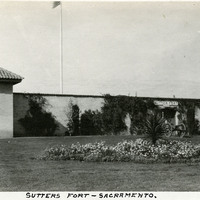
Caption: "Sutters [sic] Fort - Sacramento," c. 1920, shows a gun tower at Sutter's Fort, and a gate bracketed by two cannons. John Sutter established the fort in 1839, calling it New Helvetia. After the discovery of gold at one of Sutter's mills (at Coloma, on the American River), almost all of the fort's inhabitants left for the gold fields in the foothills. The fort deteriorated until being restored from 1891-1893. The Native Sons of the Golden West were influential in the restoration. The fort is now the site of a State Historic Park. See also 96-07-08-alb05-117 and 118.
Date: 1920
-
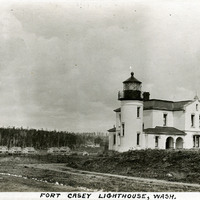
Caption: "Fort Casey Lighthouse, Wash.," c. 1909. View of the lighthouse with fort buildings in the background. Located on Whidbey Island in Puget Sound, the Admiralty Head Lighthouse was built overlooking Admiralty Inlet in 1903. It replaced an earlier structure that had to be moved in 1890 to accommodate the construction of Fort Casey. The second lighthouse, shown here, was built with thick walls in order to withstand earthquakes and the concussion of guns at Fort Casey. Deactivated in 1922, the lighthouse has since been restored by Washington State Parks, and is part of the Fort Casey State Park.
Date: 1909
-
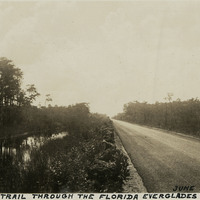
Caption: "Tamiami Trail Through the Florida Everglades, June 27, 1934." Asphalt-paved road stretching into the distance, flanked on one side by a canal. The Tamiami Trail constitutes a scenic portion of what is now U.S. Highway 41. Work on a road connecting Tampa with Miami began in 1915, but the Trail was not officially opened until 1928. Work on the route required building across a portion of the massive swamp system of the Everglades. Workers dredged and blasted a canal along the route, and used the fill dirt thus removed to construct the roadway proper.
Date: 6/27/1934
-
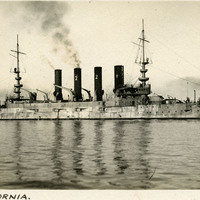
Caption: "U.S.S. California," c. 1906. This photograph shows the second U.S. Navy ship to bear the Golden State's name. Launched in 1904 and commissioned in 1907, this Pennsylvania-class armored cruiser served in the Pacific fleet. Her name was changed in 1914 to the USS San Diego, in order to free up the name for a new, Tennessee-class battleship. The USS San Diego went on to serve in both the Pacific and Atlantic fleets during World War I, until being sunk off the coast of New York by a German mine in 1918, with a loss of six lives.
Date: 1906
-
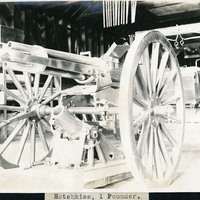
Caption: "Hotshkiss [sic], 1 pounder." The United States purchased artillery from the French arms firm, Hotchkiss, in the late 19th and early 20th centuries. The arms firm was created by American gunsmith, Benjamin B. Hotchkiss, who moved to France in 1867 to set up the factory. The heavy artillery was first used by the United States against the Nez Perce in 1877. In 1890, they were used at the Wounded Knee Massacre, and also for the attack on San Juan Hill during the Spanish-American War.
Date: Undated