
Search All Items
- Filters:
- Language
- English 6219
- Spanish 19
- ENGLISH 2
- English 1
- contra_costa_schedule_1_volume_1 1
- Type
- Image 3871
- Still Image 1869
- Text 440
- Text 54
- Textual 2
- Image of the California Census from the records of the office of the California Secretary of State 1
Search Results 5951 to 5960 of 6312
-
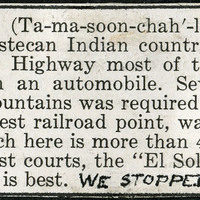
Caption: "We stopped at Gandy Courts." A section of a tourist informational brochure describing the village of Tamazunchale, in "the heart of the Huastecan Indian country."
Date: 1938
-
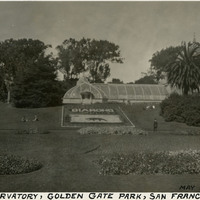
Caption: "Conservatory, Golden Gate Park, San Francisco, May 14, 1934." View of one wing of the Conservatory of Flowers in Golden Gate Park. A planting bed in front of the wing has been planted with flowers in such a way as to portray the California flag and the letters "California Diamond Jubilee, 1850-1925." The date on this photograph may not be accurate, given the dates included in the flower bed. The Conservatory of Flowers is the oldest building in Golden Gate Park, dating to 1879. The Victorian-style building has housed rare and exotic plants since its completion.
Date: 5/14/1934
-
The Progressive Movement transformed California politics in the early twentieth century by promoting government reform, greater public participation, and limits on the influence of powerful corporations and political machines. Women’s suffrage became part of this broader reform agenda. Governor Hiram Johnson (1866–1945) served as California’s 23rd governor from 1911 to 1917 and was a leading figure in the Progressive Movement. Johnson became tied to the suffrage cause through the 1910 California Republican platform, which endorsed women’s right to vote as part of a larger slate of progressive reforms. Motivated by Johnson’s promise to support their political rights, women in California quickly mobilized for him in his bid for governor, organizing grassroots efforts in support of his campaign in multiple counties. As the new governor, he insisted that the Legislature honor his pledge by submitting a women’s suffrage amendment before the Senate on January 6, 1911, only 3 days after he took office.
Date: 1912
-
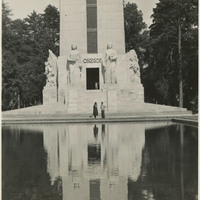
Caption: "Obregon's tomb, Mexico City." William and Grace McCarthy standing before the monument to General Alvaro Obregon (1880-1928), who was a leader of the Mexican Revolution (1920-1920). Obregon was elected President of post-Revolution Mexico, serving from 1920-1924. In 1928, he was again elected but was assassinated by Jose de Leon Toral, a Roman Catholic who opposed Obregon's policies on religious matters. The monument was completed in 1935 and stands in the San Angel region of Mexico City, in the same location where Obregon was assassinated.
Date: 1938
-
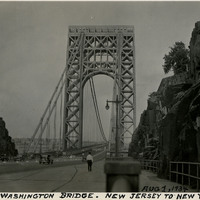
Caption: "George Washington Bridge. New Jersey to New York. Aug 1, 1934." This suspension bridge, designed by Othmar Ammann, spans the Hudson River between Manhattan in New York City, and Fort Lee, New Jersey. Constructed between 1927 and 1931, the bridge included the longest main span in the world at the time, a record it held until construction of the Golden Gate Bridge was completed in 1937. It was originally built with only one deck, but a second deck opened in 1962. Still in active use today, it carried over 51 million vehicles in 2016.
Date: 8/1/1934
-
Caption: "George Washington Bridge, Crossing the Hudson River, N.Y. Sept. 3, 1934." This suspension bridge, designed by Othmar Ammann, spans the Hudson River between Manhattan in New York City, and Fort Lee, New Jersey. Constructed between 1927 and 1931, the bridge included the longest main span in the world at the time, a record it held until construction of the Golden Gate Bridge was completed in 1937. It was originally built with only one deck (as seen in this photograph), but a second deck opened in 1962. Still in active use today, it carried over 51 million vehicles in 2016.
Date: 9/3/1934
-
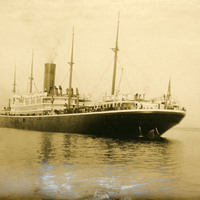
No Caption: c. 1909. View of the steamship Minnesota II, built in 1903. She was said to be the largest U.S. merchant ship afloat at the time. Operated by the Great Northern Steamship Company, she sailed between the U.S. and markets in Asia until 1915 when she was sold. In 1917 the Minnesota II began operating in the Atlantic between the U.S. and the United Kingdom. The U.S. Navy commissioned her as a troop ship in 1919, changing her name to Troy. She brought over 14,000 U.S. troops home from war-torn Europe. She never resumed active service after this, being scrapped in 1923.
Date: 1909
-
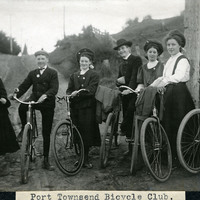
Caption: "Port Townsend Bicycle Club.," c. 1910. Seven unidentified men and women posing with bicycles. The bicycle made its first appearance in the Puget Sound area in the late 1870s. Within twenty years, thousands of enthusiasts had adapted the new mode of transportation. Such enthusiasts often formed clubs, such as the Queen City Good Roads Club, based in Seattle (south of Port Townsend). These clubs advocated, constructed, and helped to maintain pathways dedicated specifically to bicycle traffic. Ironically, the efforts made by the bicyclists to generally improve roadways contributed to the rise of another new mode of transportation -- the automobile.
Date: 1910
-
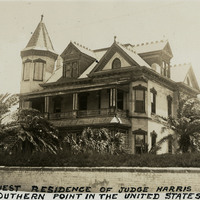
Caption: "Key West Residence of Judge Harris, Most Southern Point in the United States July 2, 1934." View of the Queen Anne-style Victorian mansion constructed in Key West by Judge Vinning Harris in 1897. The home was originally touted as occupying the southernmost point in the U.S., resulting in the colloquial name "Southernmost House." During the Prohibition years (1920-1933) the house operated as a speakeasy, with a restaurant and casino. In 1939, it was converted to use as a nightclub. Today, it has been renovated for use as a bed-and-breakfast.
Date: 7/2/1934
-
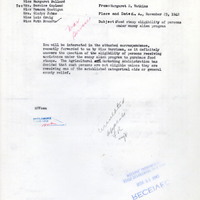
Office Memorandum from Margaret S. Watkins to Margaret Bullard, et al. regarding eligibility for food stamps
Date: November 23, 1942