
Search All Items
- Filters:
- Language
- English 6219
- Spanish 19
- ENGLISH 2
- English 1
- contra_costa_schedule_1_volume_1 1
- Type
- Image 3871
- Still Image 1869
- Text 440
- Text 54
- Textual 2
- Image of the California Census from the records of the office of the California Secretary of State 1
Search Results 5961 to 5970 of 6312
-
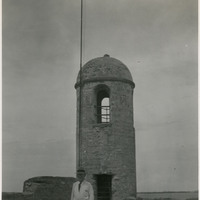
Caption: "Fort Marion, St. Augustine, Fla. July 10, 1934." William McCarthy standing in front of a corner tower on the ramparts of Castillo de San Marcos (Castle of Saint Mark). The core structures of this coastal defense fort were completed by Spanish forces in 1695. Numerous additions, renovations, and repairs have occurred since that time. When Spain ceded Florida to the U.S. in 1821, the Castillo was designated a U.S. Army base and renamed Fort Marion, in honor of Frances Marion (also known as the Swamp Fox, Marion was an American Revolutionary War hero known for his guerilla war tactics). The fort was deactivated in 1933, and turned over to the National Park Service.
Date: 7/10/1934
-
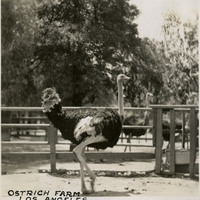
Caption: "Ostrich Farm, Los Angeles," c. 1935. View of several ostriches in a corral at the Cawston Ostrich Farm in Pasadena. Opened by Edward Cawston in 1886, this was the first ostrich farm in the U.S. It became a popular tourist stop along the Pasadena and Los Angeles Electric Railway in the early twentieth century, where visitors could ride an ostrich, or be pulled by one in a light card. They could also buy merchandise made out of ostrich feathers, such as hats and boas. The farm closed in the mid-1930s.
Date: 1935
-
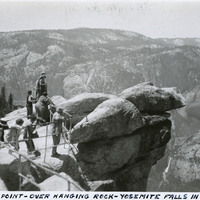
Caption: "Glacier Point - Over Hanging Rock - Yosemite Falls In The Distance," c. 1935. A group of unidentified people looking out from Glacier Point. Both Upper and Lower Yosemite Fall are visible across the valley at the right side of the photograph. Glacier Point, on the south wall of the valley 3,200 feet above what is now known as Half Dome Village, provides panoramic views of the valley and many of its features. By the time this photograph was taken, safety railings had been installed at the Point to prevent visitors from tumbling over the cliff while trying to get the best views.
Date: 1935
-
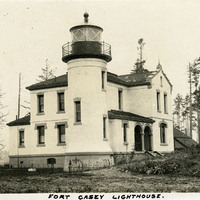
Caption: "Fort Casey Lighthouse.," c. 1909. Located on Whidbey Island in Puget Sound, the Admiralty Head Lighthouse was built overlooking Admiralty Inlet in 1903. It replaced an earlier structure that had to be moved in 1890 to accommodate the construction of Fort Casey. The second lighthouse, shown here, was built with thick walls in order to withstand earthquakes and the concussion of guns at Fort Casey. Deactivated in 1922, the lighthouse has since been restored by Washington State Parks, and is part of the Fort Casey State Park.
Date: 1909
-
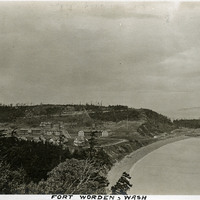
Caption: "Fort Worden, Wash.," c. 1909. Panoramic view of Fort Worden in Port Townsend, Washington, on Admiralty Inlet of Puget Sound. Construction began on the fort in 1898. By 1902 it was serving as an active U.S. Army base. Fort Worden was part of the "triangle of fire," three coastal defense fortifications (Fort Casey, Fort Worden, and Fort Flagler) guarding the entrance to Puget Sound. The U.S. sold the property to the state of Washington in 1957. In 1973, the fort and surrounding area opened as Fort Worden State Park.
Date: 1909
-
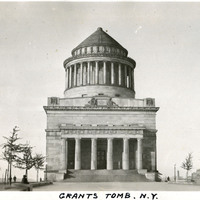
Caption: "Grants Tomb. N.Y." The remains of Ulysses S. Grant, 18th President of the U.S. and Commanding General of the Union Army during the last year of the Civil War, were laid to rest in this elaborate tomb, designed by architect John Duncan. Grant died in 1885, but construction on the granite and marble structure did not begin until 1891. Grant's remains were transferred to the tomb on April 27, 1897. The tomb is the largest mausoleum in North America. See also 96-07-08-alb11-209.
Date: 8/10/1934
-
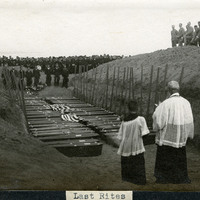
Caption: "Last Rites." Shows a grave site with dozens of caskets ready for burial. A priest and two altar boys stand at one side of the caskets, while a large group of U.S. Navy sailors looks on from the other side. While sailing from port in San Diego on the morning of July 21, 1905, the boiler of the USS Bennington exploded, killing sixty-six of her crew. The victims were laid to rest in the cemetery at Fort Rosecrans. See also 96-07-08-alb05-142 and 96-07-08-alb08-222.
Date: 1905-07-23
-
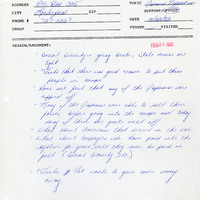
Written statement arguing in opposition of AB2710
Date: February 22, 1982