
Search All Items
- Filters:
- Type
- Image 3872
- Still Image 1847
- Text 428
- Text 50
- Image of the California Census from the records of the office of the California Secretary of State 1
- Language
- English 6191
- Spanish 11
- ENGLISH 2
- English 2
- census_013 1
- contra_costa_schedule_1_volume_1 1
Search Results 6131 to 6140 of 6265
-
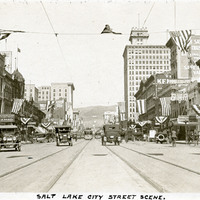
Caption: "Salt Lake City Street Scene.," c. 1916. Street scene in Salt Lake City, Utah. Flags and buntings suggest that the city was holding some kind of celebration at the time of the photograph. Several bicyclists appear at the photograph's right side.
Date: 1916
-
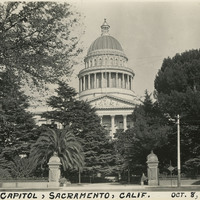
Caption: "State Capitol, Sacramento, Calif. Oct. 8, 1934." Construction began on the neoclassical California State Capitol Building, the dome of which is seen here (the rest of the building is largely obscured by trees), in 1860. Completed in 1874, the building still houses the state's legislature and the offices of the Governor.
Date: 10/8/1934
-
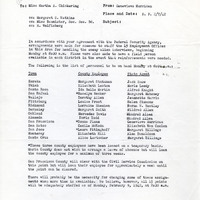
Office Memorandum from Genevieve Murrican to Martha A. Chickering regarding staff made available by the Federal Security Agency
Date: February 7, 1942
-
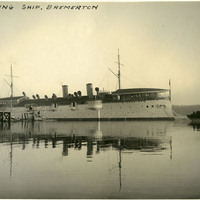
Caption: "Training Ship. Bremerton," Washington, c. 1908 - 1912. See also 96-07-08-alb08-086. View of the USS Philadelphia (C-4). The fourth ship to bear the name, the Philadelphia first launched in September 1889. She sailed as part of the U.S. Navy's Atlantic Squadron until 1893. She then sailed into the Pacific Ocean, where she served until being decommissioned and docked in Puget Sound in 1902. In 1904, the Navy "housed over" the ship (adding the roofed quarters visible on the upper deck in the photograph) and designated her a receiving ship for new sailors not yet assigned to a crew. The Philadelphia served in this capacity until 1912. After a brief stint as a prison ship, the Philadelphia again became a receiving ship in 1916. The Navy sold her in 1927.
Date: 1908
-
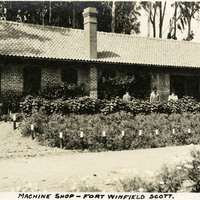
Caption: "Machine Shop -- Fort Winfield Scott," c. 1913. Low brick building with tile roof, with William McCarthy (far left) and two unidentified men standing in front. Fort Winfield Scott, formerly Fort Point, was part of an effort by the U.S. government to protect the Golden Gate, entrance to the San Francisco Bay. Built between 1853-1861, the fort included emplacements for 141 guns but never fired a weapon in defense of the Bay. Its name was officially changed in 1882 to Fort Winfield Scott. This only lasted four years, however, for in 1886 the fort was officially downgraded to a sub-post of the San Francisco Presidio and the name discontinued. It was resurrected in 1912, with the establishment of a coastal artillery fortification at the Presidio, called, once again, Fort Winfield Scott.
Date: 1913
-
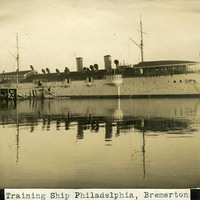
Caption: "Training Ship Philadelphia, Bremerton," c. 1908-1912. View of the USS Philadelphia (C-4). The fourth ship to bear the name, the Philadelphia first launched in September 1889. She sailed as part of the U.S. Navy's Atlantic Squadron until 1893. She then sailed into the Pacific Ocean, where she served until being decommissioned and docked in Puget Sound in 1902. In 1904, the Navy "housed over" the ship (adding the roofed quarters visible on the upper deck in the photograph) and designated her a receiving ship for new sailors not yet assigned to a crew. The Philadelphia served in this capacity until 1912. After a brief stint as a prison ship, the Philadelphia again became a receiving ship in 1916. The Navy sold her in 1927.
Date: 1908
-
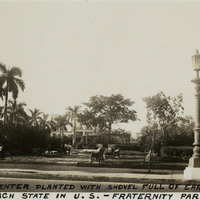
Caption: "Tree in Center Planted with Shovel Full of Earth From Each State in U.S. -- Fraternity Park -- Havana, July 4, 34." This photograph captures a view of Havana's Fraternity Park. The area originally served the city as a military parade and training ground (called Campo de Marte). In 1928, the park was renovated and a ceiba (or kapok) tree was planted in one of the central parcels. This tree, seen in the center of this photograph, was planted as the Tree of American Fraternity. When Havana hosted the sixth International American Conference later in 1928 (also known as one of the Pan-American Conferences), each of the twenty-one visiting dignitaries brought earth from their native counties in which to plant the tree (William McCarthy mistakenly identified the earth as coming from each state in the U.S.).
Date: 7/4/1934
-
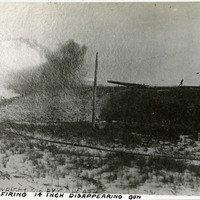
Caption: "Firing 14 Inch Disappearing Gun." This is a copy of a photograph taken by C.D. Heath at the Sandy Hook Proving Ground. It shows a heavy artillery gun firing from an embankment upon which several people stand. Located at Sandy Hook, New Jersey, the Sandy Hook Proving Ground was used by the U.S. Army to test ordinance and materiel from 1874-1919. See also 96-07-08-alb05-102.
Date: 1910
-
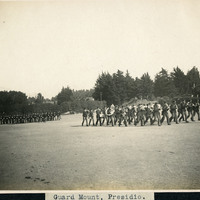
Caption: "Guard Mount. Presidio," c. 1906, shows two groups of men in formation on the Presidio grounds. One group of men is playing musical instruments, while the other group is carrying firearms. Established in 1776 by Spanish explorers, the Presidio is a fortified location overlooking the Golden Gate, the entrance into San Francisco Bay. It was closed as a military structure in 1995, and is now a park within the Golden Gate National Recreation Area.
Date: 1906
-
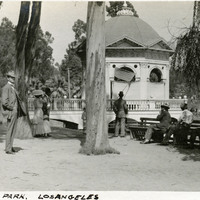
Caption: "East Lake [sic] Park. Losangeles [sic]," c. 1906. Eastlake Park in Los Angeles was originally created by the city in 1881 under the name "East Los Angeles Park." Renamed Eastlake Park in 1901, it gained its current name, Lincoln Park, in 1917. This photograph shows several people seated on benches and strolling pathways. In the background, the lake for which the park was named can be seen, as well as an elaborate bandstand situated on the lake.
Date: 1906