
Search All Items
- Filters:
- Language
- English 6457
- Spanish 23
- ENGLISH 2
- English 2
- census_013 1
- contra_costa_schedule_1_volume_1 1
- Type
- Image 3882
- Still Image 2094
- Text 445
- Text 54
- Textual 2
- Image of the California Census from the records of the office of the California Secretary of State 1
Search Results 6131 to 6140 of 6559
-
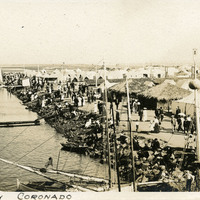
Caption: "Tent City Coronado," c. 1910-1913. View of rows of tents and sheds thatched in palm fronds along the coast near Coronado Hotel, with people strolling along the roadways. Established in 1900 for travelers who could not afford to stay in the resort hotel, the Coronado Tent City consisted of a grid of streets lined with furnished tents, near the sea shore. It also featured restaurants, a library, soda fountain, theater, bandstand, and other recreational facilities. See also 96-07-08-alb08-210, and 263.
Date: 1910
-
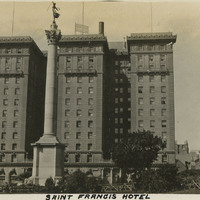
Caption: "Saint Francis Hotel." See also 96-07-08-alb01-002, with caption: "Hotel-Saint Francis," c. 1913. St. Francis Hotel at Union Square with partial north wing extension and the Dewey Monument in the foreground (Robert I. Aitken, sculptor), which commemorated U.S. Admiral George Dewey's naval victory at the battle of Manila Bay during the Spanish American War of 1898. The luxury hotel opened in 1904 and, fortunately, suffered little damage from the 1906 earthquake. It was expanded in 1913, and 1972, making it one of the largest hotels in the city.
Date: 1913
-
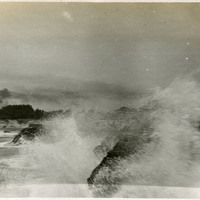
No Caption: c. 1910. Ocean shore scene with waves and high spray. The Vue de L'eau (View of the Water) was a station on the Santa Cruz, Garfield Park and Capitola Electric Railway electric streetcar line. Built in 1891, the station was located at the very end of the line, on a promontory overlooking the Pacific Ocean. It featured an observatory on the top story. The same company also built a casino, ballroom, and restaurant nearby. The station burned down in 1925. See also 96-07-08-alb05-074.
Date: 1910
-
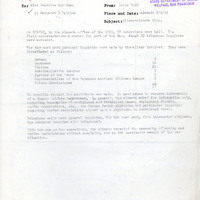
Office Memorandum from Doris Todd to Genevieve Murrican regarding the number of telephone inquiries for information
Date: February 9, 1942
-
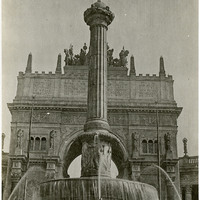
Caption: "Fountain - Rising Sun" (Adolph A. Weinman, sculptor), in the Court of the Universe, at the Panama- Pacific International Exposition.
Date: 1915
-
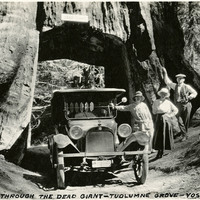
Caption: "Driveway Through the Dead Giant - Tuolumne Grove - Yosemite," c. 1917. Grace (next to automobile) and William (far right) McCarthy pose with their vehicle and an unidentified woman in the tunnel of "The Dead Giant," the remains of a giant sequoia in the Tuolumne Grove. The tunnel was cut into the trunk in 1878.
Date: 1917
-
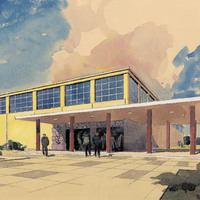
Color rendering of exhibit building, State Fair, Stockton Boulevard, Sacramento, by Alfred Eichler. One of two steel-frame tilt-up precast concrete wall buildings along main entrance from Stockton Blvd. Design by Alfred Eichler and V. I. Osborn. Built. Project for Department of Finance - Fairs and Expositions.
Date: 1952
-
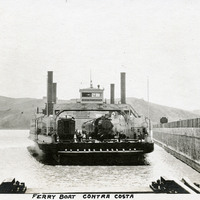
Caption: "Ferry Boat Contra Costa," c. 1920. Built in 1914, the Contra Costa ferried locomotives and train cars across the Carquinez Strait between Benicia and Port Costa. The largest rail ferry ever built, the Contra Costa operated until the Benicia-Martinez Railroad Bridge opened in 1930. She made the crossing as many as 52 times in 24 hours.
Date: 1920
-
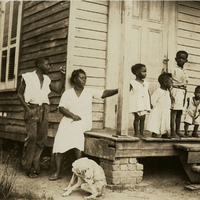
Unidentified African-American woman, several children, and a dog, posing on and around the porch of a wood-plank home. *Please note:* Original caption removed due to sensitive content. To view the original photograph with caption, please contact the California State Archives Reference Desk.
Date: 6/17/1934