
Search All Items
- Filters:
- Language
- English 6457
- Spanish 23
- ENGLISH 2
- English 2
- census_013 1
- contra_costa_schedule_1_volume_1 1
- Type
- Image 3882
- Still Image 2094
- Text 445
- Text 54
- Textual 2
- Image of the California Census from the records of the office of the California Secretary of State 1
Search Results 6141 to 6150 of 6559
-
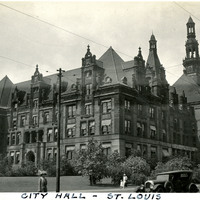
Caption: "City Hall - St. Louis," c. 1923. Grace McCarthy poses in front of the St. Louis City Hall, while a man mows the lawn and an adult and child stroll on the sidewalk. The French Renaissance Revival style building, designed by George Richard Mann, has been home to the city's governmental offices since 1898.
Date: 1923
-
Correspondence from K. C. May to S. H. Thompson regarding food stamp policy; Attached to Correspondence on Policy Ruling (F3729_66_005)
Date: August 14, 1942
-
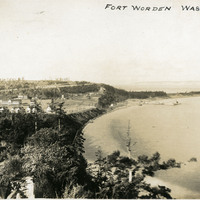
Caption: "Fort Worden, Wash." Washington, c. 1908.Construction of Fort Worden in Port Townsend, Washington, on Admiralty Inlet of Puget Sound began in 1898, and by 1902 it was serving as an active U.S. Army base. Fort Worden was part of the "triangle of fire", three coastal defense fortifications (Fort Casey, Fort Worden, and Fort Flagler) guarding the entrance to Puget Sound. The U.S. sold the property to the state of Washington in 1957. In 1973, the fort and surrounding area opened as Fort Worden State Park.
Date: 1908
-
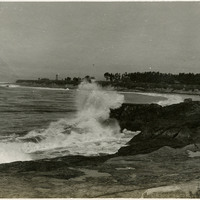
No Caption: c. 1910. Ocean shore scene with waves and high spray, with a promontory in the distance featuring several buildings. The Vue de L'eau (View of the Water) was a station on the Santa Cruz, Garfield Park and Capitola Electric Railway electric streetcar line. Built in 1891, the station was located at the very end of the line, on a promontory overlooking the Pacific Ocean. It featured an observatory on the top story. The same company also built a casino, ballroom, and restaurant nearby. The station burned down in 1925. See also 96-07-08-alb05-159.
Date: 1910
-
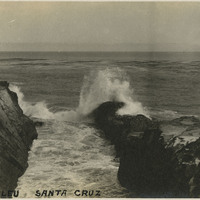
Caption: "Ver De Leu [sic], Santa Cruz", c. 1910. Ocean shore scene with rocks, waves, and high spray. The Vue de L'eau (View of the Water) was a station on the Santa Cruz, Garfield Park and Capitola Electric Railway electric streetcar line. The station, built in 1891, was located at the very end of the line, on a promontory overlooking the Pacific Ocean. It featured an observatory on the top story. The same company also built a casino, ballroom, and restaurant nearby. The station burned down in 1925. See also 96-07-08-alb05-079.
Date: 1910
-
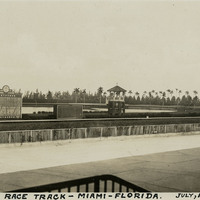
Caption: "Hialeah Race Track -- Miami -- Florida July 1, 1934." View of the infield at Hialeah Park Race Track. Constructed in 1922 as a greyhound racetrack, Hialeah began hosting horse races in 1925. Joseph E. Widener purchased the track in 1930. He embarked upon a series of improvements, adding a grandstand (seen here) and clubhouse facilities designed by Lester W. Geisler, as well as landscaped gardens and a lake in the infield that became home to a flock of flamingos. The new and improved Hialeah track, now called Hialeah Park, officially opened in 1932.
Date: 7/1/1934
-
Caption: "Hialeah Race Track -- Miami -- Florida July 1, 1934." View of the grandstand at Hialeah Park Race Track. Constructed in 1922 as a greyhound racetrack, Hialeah began hosting horse races in 1925. Joseph E. Widener purchased the track in 1930. He embarked upon a series of improvements, adding a grandstand (seen here) and clubhouse facilities designed by Lester W. Geisler, as well as landscaped gardens and a lake in the infield that became home to a flock of flamingos. The new and improved Hialeah track, now called Hialeah Park, officially opened in 1932.
Date: 7/1/1934
-
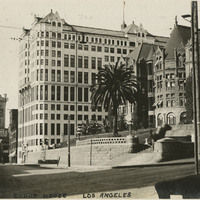
Caption: "Court House - Los Angeles." c. 1915-1920. The Los Angeles County Courthouse, also known as the Red Sandstone Courthouse, was completed in 1891. Located at the southeast corner of Temple and Broadway, the courthouse was damaged beyond repair by the 1933 Long Beach earthquake and demolished in 1936. To the left of the courthouse stands the Hall of Records, built in 1911 and used, along with other buildings, as the county courthouse from 1934 until 1959, when the current courthouse was occupied. The Hall of Records was demolished in 1973. See also 96-07-08-alb01-147.
Date: 1915
-
Caption: "Hialeah Race Track -- Miami -- Florida July 1, 1934." Grace McCarthy standing behind the grandstand at Hialeah Park Race Track, in Hialeah (near Miami). Constructed in 1922 as a greyhound racetrack, Hialeah began hosting horse races in 1925. Joseph E. Widener purchased the track in 1930. He embarked upon a series of improvements, adding a grandstand (seen here) and clubhouse facilities designed by Lester W. Geisler, as well as landscaped gardens and a lake in the infield that became home to a flock of flamingos. The new and improved Hialeah track, now called Hialeah Park, officially opened in 1932.
Date: 7/1/1934