
Search All Items
- Filters:
- Language
- English 6219
- Spanish 19
- ENGLISH 2
- English 1
- contra_costa_schedule_1_volume_1 1
- Type
- Image 3871
- Still Image 1869
- Text 440
- Text 54
- Textual 2
- Image of the California Census from the records of the office of the California Secretary of State 1
Search Results 6181 to 6190 of 6312
-
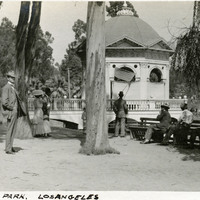
Caption: "East Lake [sic] Park. Losangeles [sic]," c. 1906. Eastlake Park in Los Angeles was originally created by the city in 1881 under the name "East Los Angeles Park." Renamed Eastlake Park in 1901, it gained its current name, Lincoln Park, in 1917. This photograph shows several people seated on benches and strolling pathways. In the background, the lake for which the park was named can be seen, as well as an elaborate bandstand situated on the lake.
Date: 1906
-
Caption: "The Breakers Hotel, Palm Beach, Florida. July 8, 1934." The imposing resort hotel shown in this photograph was originally called the Palm Beach Inn when it opened in 1896. The original hotel burned down in 1903, reopened in 1904, and burned again in 1925. After the 1925 fire, the building's owners abandoned wood frame construction in favor of concrete. The new hotel building, as shown in this photograph, was reopened in December 1926.
Date: 7/8/1934
-
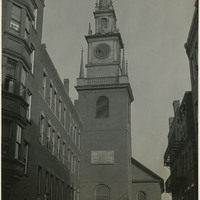
Caption: "Historic North Church, Boston. Where Signal was Hung for Paul Revere, Sept. 5, 1934." View of the clock tower and steeple of the Old North Church, built in 1723. The church is said to be the site where Paul Revere, after his famous midnight ride, caused two lanterns to be hung as the signal that British troops were advancing into the area by sea rather than by land.
Date: 9/5/1934
-
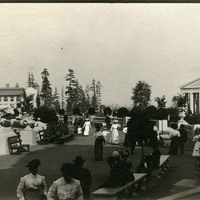
No Caption: View of a portion of the fairgrounds of the Alaska-Yukon-Pacific Exposition in Seattle, showing elegantly attired fairgoers strolling pathways and resting on benches. Held in Seattle to celebrate the development of the Pacific Northwest, the fair attracted 3.7 million visitors over the course of its run from June to October 1909. Although most of the fair's buildings have since been destroyed, several of them now serve as part of the University of Washington campus.
Date: 1909
-
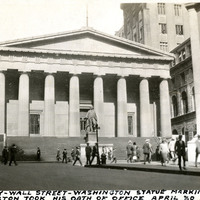
Caption: "Subtreasury - Wall Street - Washington Statue Marking Spot Where Washington Took His Oath of Office April 30 1789." The original building on this site, constructed in 1700, served as New York's city hall, then as the Capitol for the newly-created United States under the Constitution of 1789, and was the site of George Washington's inauguration as the first U.S. President. The original building was demolished in 1812, but a new building, designed to house the U.S. Custom House for the Port of New York, was opened in 1842. It is this building that is seen in the photograph. The new building subsequently housed one of six U.S. sub-treasuries between 1862 and 1920. A statue of George Washington (John Quincy Adams Ward, sculptor) was erected in front of the building in 1882, to commemorate the approximate site of Washington's inauguration. See also 96-07-08-alb11-204.
Date: 8/6/1934
-
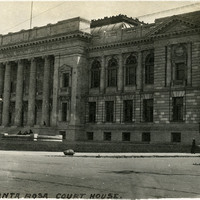
Caption: "Santa Rosa Court House.," c. 1914. Built in 1910, this building replaced the original Sonoma County courthouse that was destroyed by the great earthquake and fire that ravaged the San Francisco Bay Area in 1906. This second courthouse served the county for more than fifty years before being declared seismically unsafe in the 1960s. It was subsequently torn down, but the area still retains the name "Old Courthouse Square."
Date: 1914
-
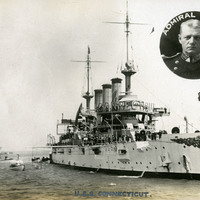
Caption: "USS Connecticut, Admiral Evans," c. 1908. View of the USS Connecticut, with an inset circular photograph of Admiral Evans. The USS Connecticut was commissioned on September 29, 1906 as the most advanced ship in the U.S. Navy. Because the provisions of the Washington Naval Treaty of 1922 stipulated that older battleships would be disposed of, the Connecticut was decommissioned and sold for scrap in 1923.
Date: 1908
-
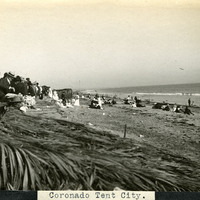
Caption: "Coronado Tent City.," c. 1910. Beach scene near the Coronado Hotel, showing groups of people enjoying a day at the sea shore. Established in 1900 for travelers who could not afford to stay in the resort hotel, the Coronado Tent City consisted of a grid of streets lined with furnished tents, near the sea shore. It also featured restaurants, a library, soda fountain, theater, bandstand, and other recreational facilities.
Date: 1910
-
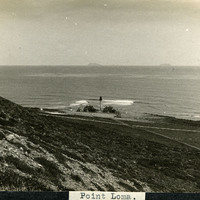
Caption: "Point Loma.," c. 1905. View of Point Loma and the so-called "New Point Loma Lighthouse" in the center. The lighthouse, first lit in 1891, replaced the "Old Point Loma Lighthouse" that had been constructed in 1855. The old lighthouse was often obscured by fog, so a new lighthouse was built at a much lower elevation much closer to sea level. The light was automated in 1973.
Date: 1905
-
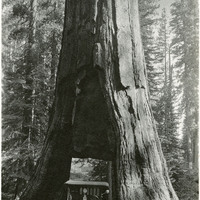
Caption: "California," c, 1917. The McCarthy's vehicle is squeezed into the tunnel carved through the California Tree, a Giant Sequoia in the Mariposa Grove of Yosemite National Park. The tunnel was cut through the tree in 1895 to facilitate travel on the road into the grove, and also as a tourist attraction. It is now the only living Giant Sequoia with a tunnel cut through it (so-called "tunnel trees"), the others having all fallen.
Date: 1917