
Search All Items
- Filters:
- Language
- English 6457
- Spanish 23
- ENGLISH 2
- English 2
- census_013 1
- contra_costa_schedule_1_volume_1 1
- Type
- Image 3882
- Still Image 2094
- Text 445
- Text 54
- Textual 2
- Image of the California Census from the records of the office of the California Secretary of State 1
Search Results 6181 to 6190 of 6559
-
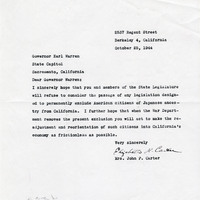
Correspondence from Mrs. Elizabeth R. Carter to Earl Warren regarding opposition to legislation that would exclude Japanese-Americans from California
Date: October 25, 1944
-
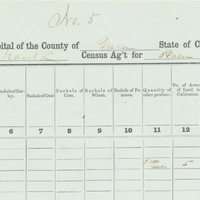
Image of Census of 1852, page 5 from Placer County Schedule II Volume I.
Date: 1852
-
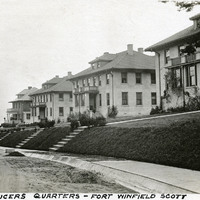
Caption: "Officers Quarters -- Fort Winfield Scott," c. 1912. Shows a row of multi-story homes along a landscaped street. Fort Winfield Scott was a coastal artillery post at the San Francisco Presidio. Originally named Fort Point, it was part of an effort by the U.S. government to protect the Golden Gate, entrance to the San Francisco Bay. Built between 1853-1861, the fort included emplacements for 141 guns but never fired a weapon in defense of the Bay. Its name was officially changed in 1882 to Fort Winfield Scott. This only lasted four years, until 1886 when the fort was officially downgraded to a sub-post of the San Francisco Presidio and the name discontinued. It was resurrected in 1912, with the establishment of a coastal artillery fortification at the Presidio, called, once again, Fort Winfield Scott.
Date: 1912
-
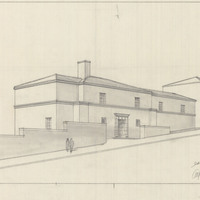
Early study of San Francisco State College by Alfred Eichler. Project for Department of Education.
Date: undated
-
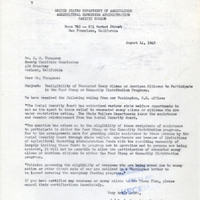
Correspondence from I. C. May to S. H. Thompson regarding food stamp policy
Date: August 14, 1942
-
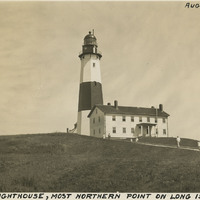
Caption: "Montauk Lighthouse, Most Northern Point on Long Island, N.Y., Aug. 18, 1934." The Montauk Lighthouse, first lit in 1797, was the first lighthouse built in New York. Ezra L'Hommedieu designed the building as well as choosing its site on the eastern edge of Long Island. A renovation in 1860 raised the lighthouse to its current height of more than 110 feet. A larger lantern was installed at that time as well. Electrified in 1940, it is now a National Historic Landmark as well as an active lighthouse.
Date: 8/18/1934
-
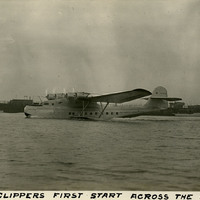
Caption: "The China Clippers [sic] First Start Across the Pacific Ocean. Nov. 22, 1935." View of the China Clipper, a Martin M-130 four-engine flying boat constructed for Pan American Airways in 1935. One of the largest planes of its time, the China Clipper flew the first transpacific commercial airmail flight between San Francisco and Manila in the Philippines. The China Clipper was destroyed in a crash ten years later, in January 1945, at the Port of Spain, Trinidad and Tobago.
Date: 11/22/1935
-
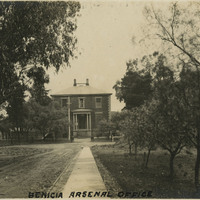
Caption: "Benicia Arsenal Office," c. 1915. William McCarthy began his career as an inspector of armaments for the U.S. War Department at the Benicia Arsenal in 1903. The arsenal was established in 1851 as the first Ordnance Supply Depot in the West, from which it supplied and supported U.S. troops from the Civil War through WWII and the Korean War. It was deactivated in 1963.
Date: 1915
-
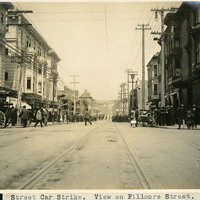
Caption: "Street Car Strike," c. 1907. San Francisco's street car union workers called for a strike after their request to be paid three dollars per eight- hour work day was declined. At the start of the strike, two strikers were shot by strike breakers and many more causalities were reported. Hundreds of passengers were injured during the strike due to inexperienced operators, and twenty-five of those passengers died as a result. In total, the upheaval resulted in thirty-one causalities.
Date: 1907
-
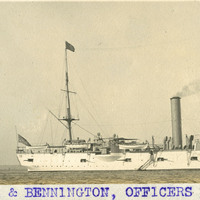
Caption: "CHICAGO AND BENNINGTON, OFFICERS & CREW." View of the USS Chicago. The flagship of the US fleet in the Pacific at the time, the USS Chicago was called to the fort after a boiler explosion on the USS Bennington killed sixty-six and wounded dozens more. A board of inquiry into the cause of the explosion was convened on board the Chicago. The board found that no error on the part of the Bennington's crew contributed to the explosion.
Date: 1905