
Search All Items
- Filters:
- Language
- English 6219
- Spanish 19
- ENGLISH 2
- English 1
- contra_costa_schedule_1_volume_1 1
- Type
- Image 3871
- Still Image 1869
- Text 440
- Text 54
- Textual 2
- Image of the California Census from the records of the office of the California Secretary of State 1
Search Results 6191 to 6200 of 6312
-
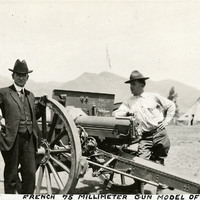
Caption: "French 75 Millimeter Gun Model of 1897." c. 1912-1915. William McCarthy posing with a French 75mm field gun, with an unidentified man. Commonly called the French 75, or simply the 75, this heavy, rapid-fire artillery gun was developed in 1897. During World War I it was adapted to fire shells full of toxic gas, and was also modified for mounting on an armored vehicle. See also 96-07-08-alb05-061.
Date: 1915
-
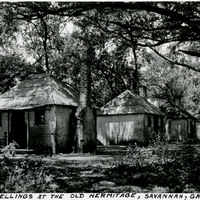
Caption: "Slave Dwellings at the Old Hermitage, Savannah, Ga. July 15, 1934." A row of small brick houses surrounded by trees. The Old Hermitage was a 400-acre plantation on the Savannah River, owned by Henry McAlpin. McAlpin not only conducted farming operations at the plantation, but also manufactured bricks, barrels, cast iron products, and lumber. For that reason, he built the slave quarters for the plantation from brick, rather than wood as was common for most other plantations in the South.
Date: 7/15/1934
-
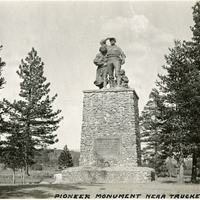
Caption: "Pioneer Monument Near Truckee." Tall monument with man, woman, and two children peering west. The Pioneer Monument was first dedicated on June 6, 1918 to commemorate those who emigrated to California in the mid 1800s. Today, the monument and surrounding area is known as Donner Memorial State Park. The park was established in memory of the ill-fated Donner Party, a group of emigrants whose wagon train was caught in the Sierra Nevada Mountains during the winter of 1846-47. The Pioneer Monument's stone pedestal stands twenty-two feet high, the height of the snow that the party had to contend with. Of the eighty-seven people in the wagon train, only forty-eight survived to be rescued the following spring. Some of the survivors are said to have resorted to cannibalism in order to survive.
Date: 1927
-
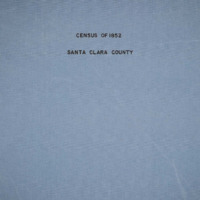
The Census of 1852 collection includes enumerations of California's 32 counties, arranged into 126 volumes. Schedule I enumerated the county's inhabitants, while schedule II enurmerated economic production. Many pages of this volume are damaged.
Date: 1852
-
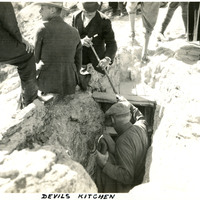
Caption: "Devil's Kitchen," c. 1923. This photograph shows several people descending into and standing around the entry to Devil's Kitchen, an extinct hot spring that left behind a cavern. Once a popular tourist attraction for its small opening that made visitors feel as if they were descending into the underworld, the site was closed in 1939 because the cavern periodically fills with dangerous levels of carbon dioxide.
Date: 1923
-
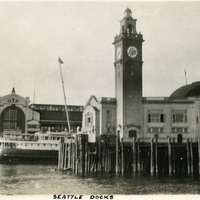
Caption: "Seattle Docks," c. 1914. Dock facilities at Seattle, showing a clock tower, as well as the G.T.P., or Grand Trunk Pacific, dock, a shipping pier at the end of Madison Street (the G.T.P. watchtower is visible at the far left of the photograph). This dock, built in 1910, was destroyed by a fire on July 30, 1914. It was rebuilt, but without the watchtower, and served the city until 1964 when it was demolished.
Date: 1914
-
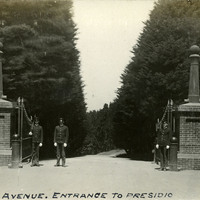
Caption: "Presidio Avenue. Entrance to Presidio," c. 1906. Gateway into the Presidio of San Francisco, bracketed by brick podiums topped by ornamental pinnacles. Three soldiers stand guard at the gate. Established in 1776 by Spanish explorers, the Presidio is a fortified location overlooking the Golden Gate, the entrance into San Francisco Bay. It was closed as a military structure in 1995, and is now a park within the Golden Gate National Recreation Area.
Date: 1906
-
Caption: "Subtreasury, Wall Street, New York. Washingion [sic] Statue Marking the Spot Where Washington took his Oath of Office, April 30, 1789, Aug. 6, 1934." The original building on this site, constructed in 1700, served as New York's City Hall, then as the Capitol for the newly-created United States under the Constitution of 1789, and was the site of George Washington's inauguration as the first U.S. President. The original building was demolished in 1812, but a new building, designed to house the U.S. Custom House for the Port of New York, was opened in 1842. It is this building that is seen in the photograph. The new building subsequently housed one of six U.S. sub-treasuries between 1862 and 1920. A statue of George Washington (John Quincy Adams Ward, sculptor) was erected in front of the building in 1882, to commemorate the approximate site of Washington's inauguration.
Date: 8/6/1934
-
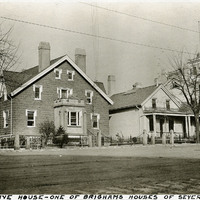
Caption: "The Bee Hive House -- One of Brighams Houses of Several Wives." Street scene in Salt Lake City, Utah. Brigham Young, founder of the Church of Jesus Christ of Latter Day Saints (the followers of which are known as Mormons) built the so-called "Beehive House" in 1854 to house himself and several of his wives (Young practiced polygamy). The Beehive House is visible in the photograph at the far right, with a widow's walk featured on its roofline. Designed by Salt Lake Temple architect Truman O. Angell, the Beehive House has since been used as a residence for several dignitaries of the Mormon Church, as well as a boarding home for young Mormon women. The house was restored in the late 1950s and now operates as a museum. See also 96-07-08-alb11-301.
Date: 1934-10-03
-
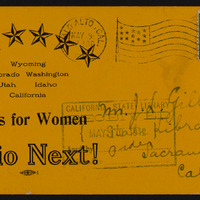
This postcard from our ephemera collection, sent by California suffragist Alice Locke Park to State Librarian James L. Gillis on May 9, 1912, features 6 stars, representing the only states that had granted women full suffrage by 1912: Wyoming (1869), Colorado (1893), Utah (1896), Idaho (1896), Washington (1910), and California (1911). Printed by the National American Woman Suffrage Association, the postcard reflects the desire to keep momentum going after California’s 1911 win by shifting the focus to Ohio's state suffrage amendment, which was ultimately defeated by male voters in both 1912 and 1914. Women in Ohio, along with millions of others nationwide, had to wait until the federal ratification of the 19th Amendment to finally gain the right to vote.
Date: May 9, 1912