
Search All Items
- Filters:
- Language
- English 6457
- Spanish 23
- ENGLISH 2
- English 2
- census_013 1
- contra_costa_schedule_1_volume_1 1
- Type
- Image 3882
- Still Image 2094
- Text 445
- Text 54
- Textual 2
- Image of the California Census from the records of the office of the California Secretary of State 1
Search Results 6211 to 6220 of 6559
-
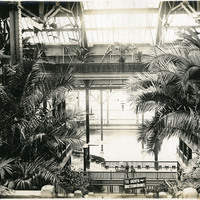
No Caption: Interior shot of the Sutro Baths, north of the Cliff House, c. 1910. Designed by Adolph Sutro in 1894, the bathhouses at one time covered three oceanfront acres just north of Ocean Beach and the Cliff House. Eventually, the Sutro Baths fell into disrepair and what was left of them burned down in 1966. Since 1973, the concrete ruins have been part of the Golden Gate National Recreation Area.
Date: 1910
-
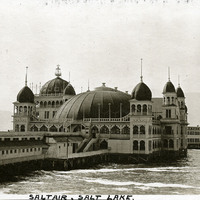
Caption: "Saltair. Salt Lake." View of the first Saltair resort pavilion, constructed in 1893. Designed by Richard K.A. Kletting, the pavilion hovered above the Great Salt Lake on more than 2,000 posts and pilings. The resort was a popular spot for Mormon families, only fifteen miles from Salt Lake City and overseen by Church leaders. The Church sold the pavilion in 1906. It was later destroyed by fire in 1925.
Date: 1916
-
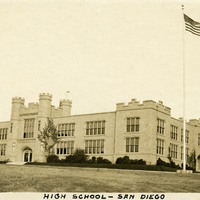
Caption: "High School -- San Diego," c. 1910. By 1902 San Diego's schools had become overcrowded enough to warrant the construction of a new high school building. Completed in 1907 and designed by F.S. Allen, the new building was quickly nicknamed the "Grey Castle on the Hill" in reference to its castle-like parapets and towers. The Grey Castle was torn down in 1975 to make way for a facility in compliance with new earthquake safety laws.
Date: 1910
-
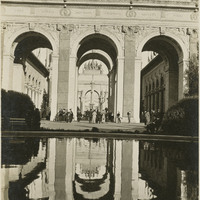
Caption: "Reflections," shows reflections of buildings in reflecting pool at the Panama-Pacific International Exposition. See also 96-07-08-alb01-103.
Date: 1915
-
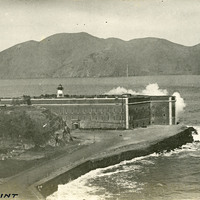
Caption: "Fort Point," c. 1910. This postcard shows a view of Fort Point, at the entrance to San Francisco Bay. The facilities at Fort Point were part of an effort by the U.S. government to protect the Golden Gate, entrance to the San Francisco Bay. Built between 1853-1861, the fort included emplacements for 141 guns but never fired a weapon in defense of the Bay. Its name was officially changed in 1882 to Fort Winfield Scott, but in 1886 the fort was officially downgraded to a sub-post of the San Francisco Presidio and the name discontinued. It was resurrected in 1912, with the establishment of a coastal artillery fortification at the Presidio, called, once again, Fort Winfield Scott.
Date: 1910
-
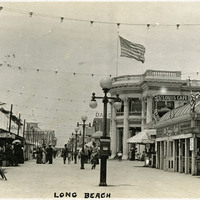
Caption: "Long Beach," c. 1915, shows a view of a portion of "The Pike," which was an amusement zone along the shoreline in Long Beach, California. It was founded in 1902 by Charles Rivers Drake, a Civil War veteran and early Long Beach developer. The Pike included arcades, gift shops, food stands, a variety of rides, and a grand bath house (the two-story building pictured on the right). After years of disrepair, The Pike was closed in 1979.
Date: 1915
-
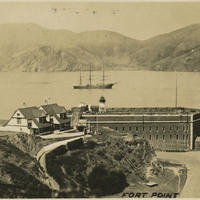
Caption: "Fort Point." c. 1906. See also 96-07-08-alb06-009 with caption: "Fort Point and Golden Gate," and 96-07-08-alb03-118, San Francisco. Fort Point in the foreground, with ships in the bay. Fort Point was part of an effort by the U.S. government to protect the Golden Gate, entrance to the San Francisco Bay. Built between 1853-1861 of brick and mortar, the fort included emplacements for 141 guns but never fired a weapon in defense of the Bay.
Date: 1906
-
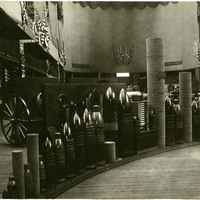
No Caption: See also 96-07-08-alb08-159 with caption: "Government exhibits of shot etc., Government Buidling." Portland Fair, Oregon, 1905. Exhibit of various types of heavy ordnance shells, including armor piercing shells as well as torpedoes. The exhibit was located in the Government Building of the Lewis and Clark Centennial Exposition, held in Portland, Oregon from June 1st to October 15th, 1905. It celebrated the one-hundred year anniversary of the exploratory expedition of the Louisiana Purchase and what became the northwestern part of the United States, led by Meriwether Lewis and William Clark. Some 1.6 million people visited the fair, viewing exhibits from twenty-one countries.
Date: 1905
-
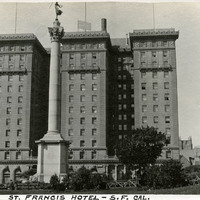
Caption: "St. Francis Hotel - S.F. Cal," c. 1913. St. Francis Hotel at Union Square with partial north wing extension and the Dewey Monument in the foreground (Robert I. Aitken, sculptor), which commemorated U.S. Admiral George Dewey's naval victory at the battle of Manila Bay during the Spanish American War of 1898. The luxury hotel opened in 1904 and, fortunately, suffered little damage from the 1906 earthquake. It was expanded in 1913, and 1972, making it one of the largest hotels in the city. See also 96-07-08-alb01-002.
Date: 1913
-
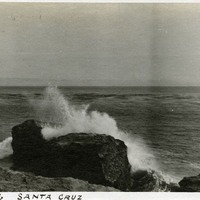
Caption: "Ver De Leu [sic], Santa Cruz," c. 1910. Ocean shore scene with rocks, waves, and high spray. The Vue de L'eau (View of the Water) was a station on the Santa Cruz, Garfield Park and Capitola Electric Railway electric streetcar line. The station, built in 1891, was located at the very end of the line, on a promontory overlooking the Pacific Ocean. It featured an observatory on the top story. The same company also built a casino, ballroom, and restaurant nearby. The station burned down in 1925.
Date: 1910