
Search All Items
- Filters:
- Language
- English 6219
- Spanish 19
- ENGLISH 2
- English 1
- contra_costa_schedule_1_volume_1 1
- Type
- Image 3871
- Still Image 1869
- Text 440
- Text 54
- Textual 2
- Image of the California Census from the records of the office of the California Secretary of State 1
Search Results 6241 to 6250 of 6312
-
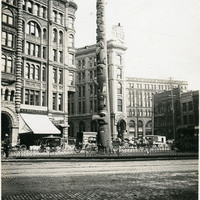
Caption: "Totem Pole, Seattle." Seattle, Washington, c. 1905. View of the Tlingit totem pole in Seattle's Pioneer Square. The totem pole was stolen in 1899 by a group of businessmen, and erected in the square, then known as Pioneer Place. An arsonist destroyed this pole in 1938, but it was later replaced by another carved by the Tlingit tribe (who were also finally paid for the original pole).
Date: 1905
-
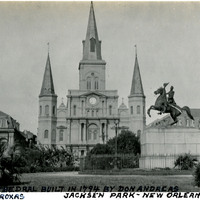
Caption: "St. Louis Cathedral Built in 1794 by Don Andreas Almonastry Roxas - Jacksen[sic] Park - New Orleans." St. Louis Cathedral anchors one end of Jackson Square in New Orleans' French Quarter. The structure of the cathedral largely dates to the 1850 restoration and expansion of an older cathedral built on the site in 1793. Very little of the older church survived, although the central bell tower (added on to the older church in 1819) was reused in the new structure and is still extant today. A statue of Andrew Jackson mounted on a rearing horse (Clark Mills, sculptor) stands in the square in front of the cathedral. The sculpture was erected in 1856. See also 96-07-08-alb11-052.
Date: 6/15/1934
-
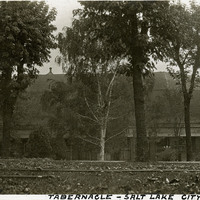
Caption: "Tabernacle -- Salt Lake City," c. 1916. View of the domed Salt Lake Tabernacle, built from 1864-1867. The Tabernacle housed meetings of the Church of Jesus Christ of Latter Day Saints until new facilities were constructed in 2000. The Tabernacle is home to the Mormon Tabernacle Choir, and is considered to be one of the most acoustically perfect buildings in the world due to its unique dome-shaped roof.
Date: 1916
-
Caption: "Old State Capitol-Benicia," c. 1918, shows the Benicia State Capitol building, built in 1852, the third location of the state capital from February 1853 to February 1854, before it was moved permanently to Sacramento. The historic building was listed as a California State Historic Landmark in 1935, and added to the National Register of Historic Places in 1971. Today the site is known as the Benicia Capitol State Historic Park.
Date: 1918
-
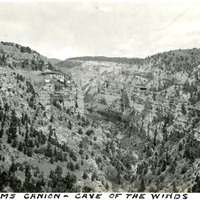
Caption: "Williams Canion [sic] - Cave of the Winds," c. 1923. View of a rugged canyon with a small building perched on one wall featuring a sign reading "CAVE." In 1880, two brothers, George and John Pickett, discovered the entrance to a large cave system in Williams Canyon. Further exploration resulted in opening more caverns within the system. The site became a tourist attraction called "Cave of the Winds," with guided tours having been on offer since 1881.
Date: 1923
-
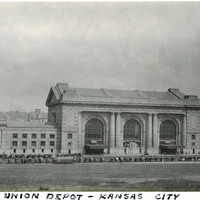
Caption: "Union Depot - Kansas City," c. 1923. This Beaux Arts-style rail station opened in 1914, replacing a small depot from 1871. Decreasing rail passenger traffic after World War II resulted in the closure of the depot in 1985. However, the restored depot later reopened in 1999, containing museums and other attractions. In 2002, it was again put to service as a rail depot when Amtrak again brought passenger trains to the area.
Date: 1923
-
The Census of 1852 collection includes enumerations of California's 32 counties, arranged into 126 volumes. Schedule I enumerated the county's inhabitants, while schedule II enurmerated economic production. Many pages of this volume are damaged.
Date: 1852
-
The Census of 1852 collection includes enumerations of California's 32 counties, arranged into 126 volumes. Schedule I enumerated the county's inhabitants, while schedule II enurmerated economic production. Many pages of this volume are damaged.
Date: 1852
-
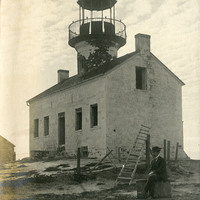
No Caption: View of the dilapidated Old Point Loma Lighthouse. An unidentified man sits in front of it. Lighted for the first time in 1855, this lighthouse sat on a high cliff above Point Loma near San Diego. Unfortunately, its high elevation resulted in fog or low-lying clouds often obscuring the light. The lighthouse was replaced by a new facility (Point Loma Light -- see 96-07-08-alb08-211 and 226) in 1891. The old lighthouse deteriorated over the years, until being restored in the early 1930s. It is now a museum.
Date: 1905
-
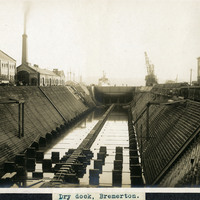
Caption: "Dry dock, Bremerton.," c. 1908-1912. View of a dry dock at the Puget Sound Naval Shipyard in Bremerton, Washington. Established in 1891 as a naval station, it became Naval Yard Puget Sound in 1901. During World War I the shipyard constructed hundreds of ships to support the war effort, while in World War II, the shipyard was dedicated primarily to repairing damaged ships. Today, it contains a portion of the U.S. Navy's mothball fleet (ships retired but retained in case of future need), as well as building, repairing, and maintaining sea-going vessels of all kinds.
Date: 1908