
Search All Items
- Filters:
- Language
- English 6219
- Spanish 19
- ENGLISH 2
- English 1
- contra_costa_schedule_1_volume_1 1
- Type
- Image 3871
- Still Image 1869
- Text 440
- Text 54
- Textual 2
- Image of the California Census from the records of the office of the California Secretary of State 1
Search Results 6251 to 6260 of 6312
-
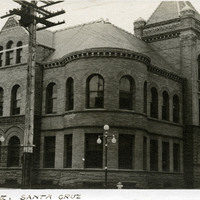
Caption: "Court House, Santa Cruz," c. 1912-1915. Image of the courthouse building constructed in Santa Cruz in 1896. The building was periodically renovated, the most extensive occurring after the 1906 earthquake, when much of the courthouse had to be rebuilt. In 1967, the county removed its court facilities to a new building. The old courthouse was subsequently remodeled, opening in 1972 as an office and retail building. Heavy damages sustained in 1989 as a result of the Loma Prieta earthquake necessitated the building's demolition. Please note that this photograph appears to be reversed, as this is a mirror image of the structure.
Date: 1915
-
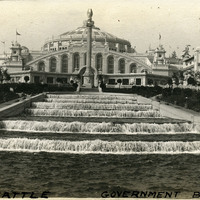
Caption: "A.Y.P.E. Seattle Government Bldg." View of the Government Building and the Cascades (a terraced fountain leading up to the building), part of the Alaska-Yukon-Pacific Exposition. Held in Seattle to celebrate the development of the Pacific Northwest, the fair attracted 3.7 million visitors over the course of its run from June to October 1909. Although most of the fair's buildings have since been destroyed, several of them now serve as part of the University of Washington campus. See also 96-07-08-alb08-125.
Date: 1909
-
The Census of 1852 collection includes enumerations of California's 32 counties, arranged into 126 volumes. Schedule I enumerated the county's inhabitants, while schedule II enurmerated economic production. Many pages of this volume are damaged.
Date: 1852
-
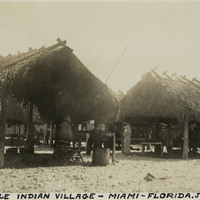
Caption: "Seminole Indian Village -- Miami -- Florida. June, [sic] 30, 1934." Several shelters with roofs of thatched grass or brush, with several unidentified women and children scattered throughout the photograph. The Seminoles are a Native American tribe from Florida, although most of the tribe had been forcibly relocated from Florida to Oklahoma by 1842. Fewer than 200 remained in Florida after the Third Seminole War ended in 1858, but a resurgence of the tribe occurred in the early to mid twentieth century. The Florida Seminole tribe received federal recognition in 1957.
Date: 6/30/1934
-
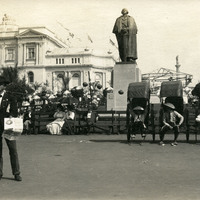
No Caption: A statue of George Washington (Lorado Taft, artist) dominates this photograph of fair-goers at the Alaska-Yukon-Pacific Exposition. Rickshaws and their drivers rest near the statue while waiting for their next fare. Held in Seattle to celebrate the development of the Pacific Northwest, the fair attracted 3.7 million visitors over the course of its run from June to October 1909. Although most of the fair's buildings have since been destroyed, several of them now serve as part of the University of Washington campus.
Date: 1909
-
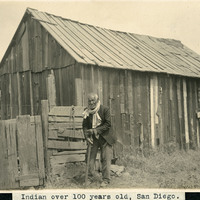
Caption: "Indian over 100 years old," c. 1905. Elderly man, possibly of Native American ethnicity, standing in front of a barn. Taken around 1905 in San Diego near the Old Mission, If William McCarthy's description is accurate, this person was born while California was under Spanish rule. Possibly of the Kumeyaay tribe, whose members had lived in the area long before the Spanish arrived, he may have lived and worked at Mission Basilica San Diego de Alcalá (Mission San Diego) or at a nearby Indian village.
Date: 1905
-
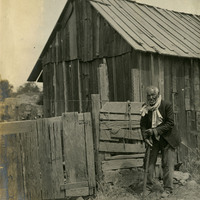
Caption: "INDIAN over 100 years old," c. 1905. Elderly man, possibly of Native American ethnicity, standing in front of a barn. Taken around 1905 in San Diego near the Old Mission, If William McCarthy's description is accurate, this person was born while California was under Spanish rule. Possibly of the Kumeyaay tribe, whose members had lived in the area long before the Spanish arrived, he may have lived and worked at Mission Basilica San Diego de Alcalá (Mission San Diego) or at a nearby Indian village.
Date: 1905
-
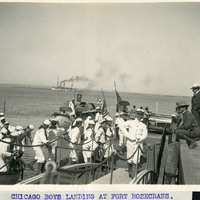
Caption: "CHICAGO BOYS LANDING AT FORT ROSECRANS." View of US Navy sailors coming ashore at Fort Rosecrans. The flagship of the US fleet in the Pacific at the time, the USS Chicago was called to the fort after a boiler explosion on the USS Bennington killed sixty-six and wounded dozens more. A board of inquiry into the cause of the explosion was convened on board the Chicago. The board found that no error on the part of the Bennington's crew contributed to the explosion.
Date: 1905
-
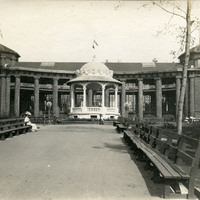
No Caption: View of the Forestry Building at the Alaska-Yukon-Pacific Exposition. Grace McCarthy is seated on a bench in front of the building, in a light-colored dress and hat. Made out of unpeeled logs, the Forestry Building was demolished in the 1930s. Held in Seattle to celebrate the development of the Pacific Northwest, the fair attracted 3.7 million visitors over the course of its run from June to October 1909. Although most of the fair's buildings have since been destroyed, several of them now serve as part of the University of Washington campus.
Date: 1909
-
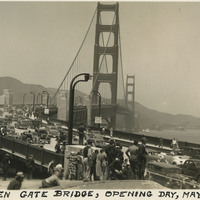
Caption: "Golden Gate Bridge, Opening Day, May 28, 1937." Dozens of automobiles are visible crossing the Golden Gate Bridge in this photograph, taken on the bridge's Opening Day, the first day that vehicular traffic was allowed over the bridge. Completed in 1937, the Golden Gate Bridge spans the mouth of San Francisco Bay (called the Golden Gate), connecting San Francisco with Marin County to the north. It is one of the most recognizable bridges in the world, and was named in 1994 as one of the Modern Wonders of the World by the American Society of Civil Engineers.
Date: 5/28/1937