
Search All Items
- Filters:
- Language
- English 6219
- Spanish 19
- ENGLISH 2
- English 1
- contra_costa_schedule_1_volume_1 1
- Type
- Image 3871
- Still Image 1869
- Text 440
- Text 54
- Textual 2
- Image of the California Census from the records of the office of the California Secretary of State 1
Search Results 611 to 620 of 6312
-
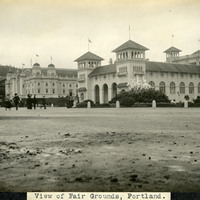
Caption: "View of Fair Grounds, Portland." This photograph shows several buildings of the Lewis and Clark Centennial Exposition, including the Foreign Palace (foreground), the Oriental Palace to its left, and the darkly-colored Forestry Building at the far left. The exposition was held in Portland, Oregon from June 1st to October 15th, 1905. It celebrated the one-hundred year anniversary of the exploratory expedition of the Louisiana Purchase and what became the northwestern part of the United States, led by Meriwether Lewis and William Clark. Some 1.6 million people visited the fair, viewing exhibits from twenty-one countries.
Date: 1905
-
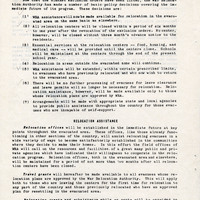
Summarization of policies; Sections: Relocation Assistance, Property Assistance, Welfare Assistance to Relocatees, Center Operations, Miscellaneous Information; Attached to: "Message for the Director of the War Relocation Authority," (F3729_119_002a-F3729_119_002e)
Date: Undated
-
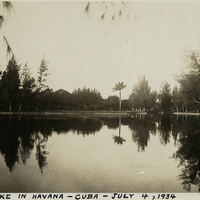
Caption: "Park Lake in Havana -- Cuba -- July 4, 1934." A calm lake surrounded by trees and other vegetation.
Date: 7/4/1934
-
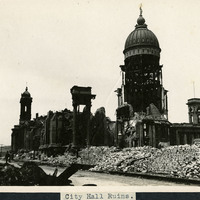
Caption: "City Hall Ruins." Photograph of the former San Francisco City Hall building, destroyed in the 1906 earthquake and fire.
Date: 1906
-
Caption: "Camp Life -- Chino Calif." William and Grace McCarthy laughing as they remove their shoes in preparation for getting into a bed situated under a tree in a yard or garden.
Date: 1915
-
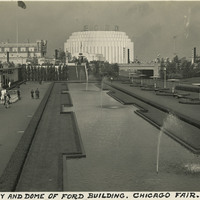
Caption: "Parkway and Dome of Ford Building. Chicago Fair. Sept. 17, 34." Several pedestrians wander along a parkway with a small lagoon and fountains, flanked by benches and manicured hedges. The Ford Building rises in the distance. The Exposition, a world fair attended by thirty-nine million people, celebrated Chicago's one-hundred year anniversary of incorporation. Originally planned to only run from May to November in 1933, it was such a success that its organizers decided to keep it running for a second season from May through October the following year. The central theme of the Exposition was technological innovation, with a motto of "Science Finds, Industry Applies, Man Conforms." None of the buildings constructed for the fair are still extant today, having been built as temporary facilities.
Date: 9/17/1934
-
Caption: "Ponciana [sic] and Whitehall Hotels. Ponciana {sic] is the Largest Frame Bldg. Hotel in the World. Palm Beach, Florida. July 8, 1934." Both the Royal Poinciana Hotel (center) and the Whitehall Hotel (far right) can be seen in this photograph, taken from across Lake Worth. The Royal Poinciana, built by Henry Flagler as a resort retreat for wealthy guests, opened in 1894. Renovations eventually enlarged the hotel to a length of 1,800 feet, with over three miles of corridors and hallways, and rooms for over 1,000 guests. At one point, it was reputed to be the largest wood structure in the world. Attendance declined in the 1920s, however, as tourists were attracted to more modern facilities. Damage by a hurricane and the Great Depression combined to close the hotel in 1934. The building was razed a year later. The Whitehall Hotel started its existence as a mansion, also built by Flagler, as a present for his wife. After Flagler's death in 1913, the home was sold to a group of investors who erected an eleven-story tower and converted the entire complex to use as a resort hotel. In 1959, the Henry Morrison Flagler Museum purchased the building. It now serves as a museum.
Date: 7/8/1934