Search All Items
- Filters:
- Language
- English 3825
- Spanish 4
- ENGLISH 1
- contra_costa_schedule_1_volume_1 1
- Type
- Image 2628
- Still Image 826
- Text 361
- Text 12
- Textual 2
- Image of the California Census from the records of the office of the California Secretary of State 1
Search Results 611 to 620 of 3868
-
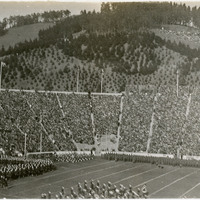
No caption, c. 1930. Football stadium filled with fans for a game, with a marching band on the field at the lower center of the photograph. The stadium is unidentified, but may be University of California, Berkeley's California Memorial Stadium, built in 1923.
Date: 1930
-
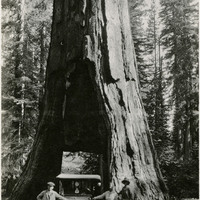
Caption: "California - Living Giant - Mariposa Grove," c. 1917. William and Grace McCarthy, with an unidentified friend, pose with their vehicle in the tunnel through the California Tree, a Giant Sequoia in the Mariposa Grove of Yosemite National Park. The tunnel was cut through the tree in 1895 to facilitate travel on the road into the grove, and also as a tourist attraction. It is now the only living Giant Sequoia with a tunnel cut through it (so-called "tunnel trees"), the others having all fallen.
Date: 1917
-
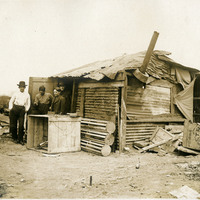
No Caption: See also 96-07-08-alb05-018 with caption: "Italian Refugee Hut S.F. 1906." Makeshift hut with four unidentified men standing in doorway. After the earthquake and fire that destroyed much of San Francisco in April 1906, hundreds of thousands of people were left homeless. Many of these people established temporary refugee camps, using debris from the destruction to cobble together shelters.
Date: 1906
-
Image withheld due to copyright considerations. For more information, please contact the California State Archives Reference Desk at ArchivesWeb@sos.ca.gov or (916) 653-2246. Caption: "Forty miles per hour on Lake Tahoe with Mr. E.D.N. Lehe." This postcard shows a speedboat with two occupants, crossing in front of a larger vessel, on Lake Tahoe.
Date: 1927
-
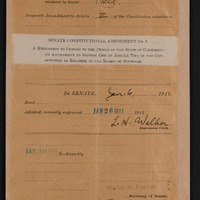
Absent of terms such as “women” or “sex”, the language for Senate Constitutional Amendment No. 8 appears intentionally neutral, labeled as “A Resolution to Propose to the People of the State of California an Amendment to Section One of Article Two of the Constitution in Relation to the Rights of Suffrage.” However, feelings about the amendment were decidedly strong. The arguments for and against Senate Constitutional Amendment No. 8 were closely watched by suffrage organizations, with crowds of onlookers filling the gallery and the lobby of the Capitol. Authored by Republican State Senator Charles W. Bell from Pasadena, Senate Constitutional Amendment No. 8 was passed by the Senate on February 2, 1911, receiving 66 ayes and 12 noes. Senate Constitutional Amendment No. 8 would be introduced to the public as Proposition 4 on the ballot for the special election scheduled for October 10, 1911, along with a variety of other reform amendments passed by the Senate.
Date: January 6, 1911
-
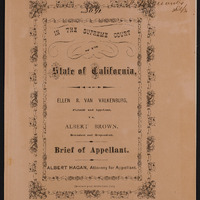
A Brief of Appellant is filed in the appellate court by the party who lost in the previous trial and argues in favor of appealing a lower court’s decision. Ellen Van Valkenburg began an important legal battle for women’s enfranchisement in California on July 21, 1871, when she requested that Santa Cruz County Clerk Albert Brown enter her name in the Great Register of voters. After Brown (a willing accomplice in helping her bring the case to court) refused to register her, Van Valkenburg and her lawyer, Santa Cruz Judge Albert Hagan, began legal proceedings by requesting a writ of mandamus, a judicial remedy used to compel agencies to perform ministerial acts, such as registering voters. Van Valkenburg and Hagan argued her case by citing the 14th Amendment of the U.S. Constitution. The new amendment, ratified 3 years earlier in 1868, defined all persons born or naturalized in the U.S. as citizens protected by civil rights. Van Valkenburg and Hagan asserted that American women were considered citizens under this amendment, and that citizenship automatically granted absolute rights, including the right to vote. The case first went to California’s Third District Court. Many of America’s most prominent suffragists, including Elizabeth Cady Stanton and Susan B. Anthony, were with Van Valkenburg in Santa Cruz when the lower court ruled against her on August 16, 1871. Van Valkenburg and Hagan swiftly appealed this decision through the Supreme Court of California. In the end, the Supreme Court of California upheld the lower court’s verdict under the reasoning that as a white American woman, Van Valkenburg already had citizenship and civil rights prior to the passage of the 14th amendment, and that the 14th amendment did not provide her with any additional political rights, such as the right to vote. While Van Valkenburg lost her case, and subsequent lawsuits failed to secure women's suffrage nationwide, the case stands as a critical early example of legal advocacy for women's political rights in California.
Date: September 29, 1871
-
Uncle Sam, Good Value, Quality and Quantity, and Finest Beyond Question Brands
Date: 1900
-
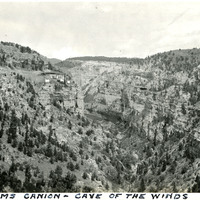
Caption: "Williams Canion [sic] - Cave of the Winds," c. 1923. View of a rugged canyon with a small building perched on one wall featuring a sign reading "CAVE." In 1880, two brothers, George and John Pickett, discovered the entrance to a large cave system in Williams Canyon. Further exploration resulted in opening more caverns within the system. The site became a tourist attraction called "Cave of the Winds," with guided tours having been on offer since 1881.
Date: 1923