
Search All Items
- Filters:
- Type
- Image 3882
- Still Image 2127
- Text 433
- Text 50
- Image of the California Census from the records of the office of the California Secretary of State 1
- Language
- English 6465
- Spanish 33
- ENGLISH 2
- English 2
- census_013 1
- contra_costa_schedule_1_volume_1 1
Search Results 6361 to 6370 of 6569
-
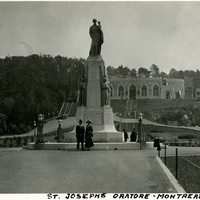
Caption: "St. Josephs Oratore [sic] - Montreal," c. 1925. William and Grace McCarthy pose in front of a bronze statue of St. Joseph placed at the base of the hill upon which St. Joseph's Oratory is under construction. The statue, created by Alfred Laliberté, was erected in 1923.
Date: 1925
-
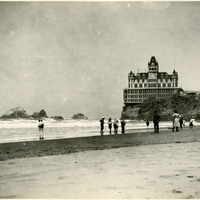
No Caption: The Cliff House, overlooking bathers at Ocean Beach, San Francisco, California, c. 1905. Unidentified people enjoying the surf and beach at Ocean Beach, overlooked by the iconic San Francisco Cliff House. The Victorian structure shown here is the third iteration of the Cliff House, constructed in 1896. It was later destroyed by a fire, in 1907.
Date: 1905
-
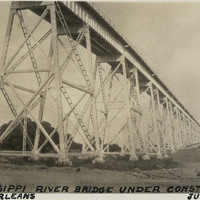
Caption: "Mississippi River Bridge Under Construction, New Orleans, June 14, 1934." View of the Huey P. Long Bridge while under construction. The cantilevered steel through truss bridge, designed by Ralph Modjeski, spans the Mississippi River between Elmwood and Bridge City. It opened to traffic in 1935.
Date: 6/14/1934
-
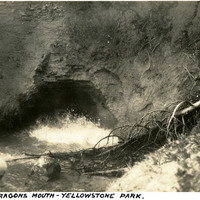
Caption: "Dragons Mouth - Yellowstone Park," c. 1923. This hot spring originates deep underground. Rising gas and steam create pressure bubbles within the mud of the cavern. When they burst against the cave roof, they emit a growling, booming sound. Steam also drifts from the cavern entrance, creating the illusion of smoke from a dragon's mouth.
Date: 1923
-
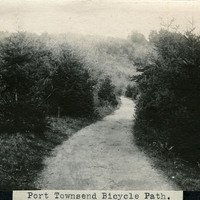
Caption: "Port Townsend Bicycle Path.," c. 1910. Image of a rural path or road, surrounded by trees and vegetation, with a hill in the distance. The bicycle made its first appearance in the Puget Sound area in the late 1870s. Within twenty years, thousands of enthusiasts had adapted the new mode of transportation. Such enthusiasts often formed clubs, such as the Queen City Good Roads Club, based in Seattle (south of Port Townsend). These clubs advocated, constructed, and helped to maintain pathways dedicated specifically to bicycle traffic. Ironically, the efforts made by the bicyclists to generally improve roadways contributed to the rise of another new mode of transportation -- the automobile.
Date: 1910
-
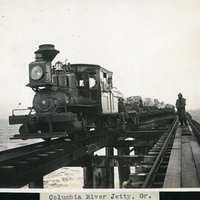
Caption: "Columbia River Jetty, Or.," c. 1910. View of a jetty built at the mouth of the Columbia River, carrying a railroad trestle. A train and its operators, hauling cars loaded with large rocks, dominates the photograph. This is likely the so-called South Jetty, extending more than six miles into the ocean from Point Adams on the Oregon side of the river mouth. The jetty system at the mouth of the Columbia River was constructed between 1885 and 1917. Designed to funnel water from the Columbia River in a more concentrated fashion into the Pacific Ocean, the jetty system helped create a deeper, more stable shipping channel.
Date: 1910
-
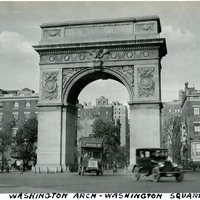
Caption: "Washington Arch - Washington Square. N.Y," c. 1925. The marble Washington Square Arch (Stanford White, architect) was built between 1890 and 1892 to replace the original wooden arch, which had been erected in 1889 to honor the centennial of President George Washington's inauguration.
Date: 1925
-
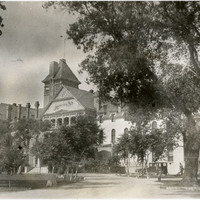
No caption, c. 1920. View of the Hotel el Paso de Robles. This resort hotel opened in 1891, featuring a variety of amenities including a mineral hot springs "plunge" bath. The hotel burned down in 1940, and was replaced by the building that is still in operation today as the Paso Robles Inn.
Date: 1920
-
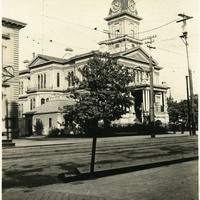
Caption: "Oakland City Hall," Oakland, California, c. 1910. Completed in 1879, the building was Oakland's second city hall and served until it was demolished in 1914 to create City Hall Plaza in front of the new City Hall that had been completed that year.
Date: 1910
-
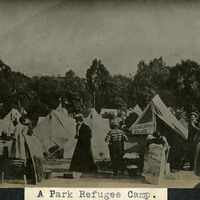
Caption: "A Park Refugee Camp," c. 1906. After the earthquake and fire that destroyed much of San Francisco in April 1906, hundreds of thousands of people were left homeless. Many of these people established temporary refugee camps, using tents or debris from the destruction to cobble together shelters.
Date: 1906