
Search All Items
- Filters:
- Language
- English 6457
- Spanish 23
- ENGLISH 2
- English 2
- census_013 1
- contra_costa_schedule_1_volume_1 1
- Type
- Image 3882
- Still Image 2094
- Text 445
- Text 54
- Textual 2
- Image of the California Census from the records of the office of the California Secretary of State 1
Search Results 6421 to 6430 of 6559
-
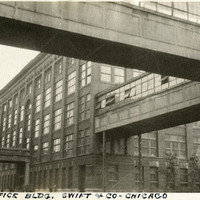
Caption: "Office Bldg. Swift & Co - Chicago," c. 1923. The general office of Chicago's Swift and Co., founded by meat packing magnate Gustavus Franklin Smith, Sr. in the late nineteenth century.
Date: 1923
-
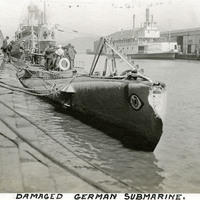
Caption: "Damaged German Submarine.," c. 1917. Shows the above-water portions of a German U-boat, or submarine, likely docked in either Petaluma or San Francisco, given the presence of a Petaluma and Santa Rosa Railway ferry in the background.
Date: 1917
-
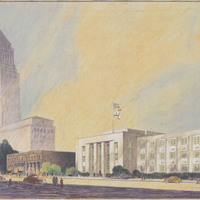
Design of office building for the Division of Highways, Los Angeles, by Anson Boyd and R. D. Murray. Built. Project for Department of Public Works - Highways - District VII - Los Angeles.
Date: 1946
-
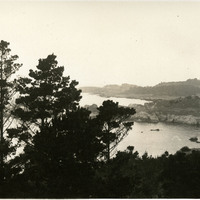
No caption, c. 1920. Scene of rocky sea cliffs and ocean, with trees bracketing the view. May be near Midway Point, near Pebble Beach. See also 96-07-08-alb04-217.
Date: 1920
-
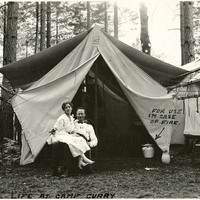
Caption: "Life At Camp Curry," c. 1917. Two unidentified people pose in front of their tent at Camp Curry. An arrow points to an enameled pail just inside the tent, labeled "For Use in Case of Fire." Yosemite's Half Dome Village, established by David and Jennie Curry in 1899, was originally called Camp Curry, and then later Curry Village. It was designed to provide cheaper accommodations for Yosemite tourists than the resort hotels. The couple set up furnished tents and provided amenities such as a dining tent. As attendance at the park increased, the couple constructed more facilities with more modern amenities. In 2016, as a result of a legal dispute over trademarked names in the park, Curry Village changed its name to Half Dome Village.
Date: 1917
-
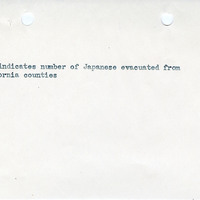
Map indicating number of Japanese removed from various counties in California
Date: Undated
-
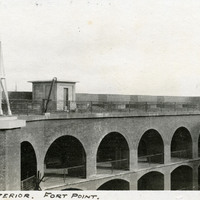
Caption: "Portion of Interior. Fort Point.," c. 1906. View of arched colonnades on ground and middle floors of Fort Point, and an upper tier with barbettes for the future installation of heavy artillery coastal defense weapons. The facilities at Fort Point were part of an effort by the U.S. government to protect the Golden Gate, entrance to the San Francisco Bay. Built between 1853-1861, the fort included emplacements for 141 guns but never fired a weapon in defense of the Bay. Its name was officially changed in 1882 to Fort Winfield Scott, but in 1886 the fort was officially downgraded to a sub-post of the San Francisco Presidio and the name discontinued. It was resurrected in 1912, with the establishment of a coastal artillery fortification at the Presidio, called, once again, Fort Winfield Scott.
Date: 1906
-
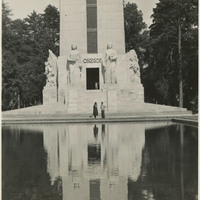
Caption: "Obregon's tomb, Mexico City." William and Grace McCarthy standing before the monument to General Alvaro Obregon (1880-1928), who was a leader of the Mexican Revolution (1920-1920). Obregon was elected President of post-Revolution Mexico, serving from 1920-1924. In 1928, he was again elected but was assassinated by Jose de Leon Toral, a Roman Catholic who opposed Obregon's policies on religious matters. The monument was completed in 1935 and stands in the San Angel region of Mexico City, in the same location where Obregon was assassinated.
Date: 1938